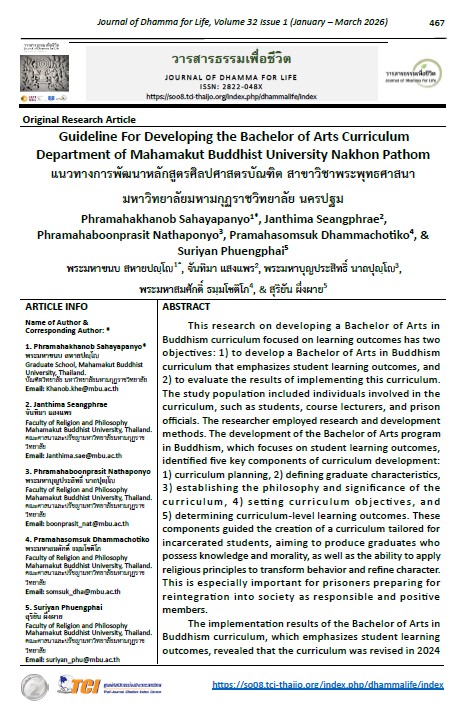
Guideline For Developing the Bachelor of Arts Curriculum Department of Mahamakut Buddhist University Nakhon Pathom
Article Sidebar
Main Article Content
Abstract
This research on developing a Bachelor of Arts in Buddhism curriculum focused on learning outcomes has two objectives: 1) to develop a Bachelor of Arts in Buddhism curriculum that emphasizes student learning outcomes, and 2) to evaluate the results of implementing this curriculum. The study population included individuals involved in the curriculum, such as students, course lecturers, and prison officials. The researcher employed research and development methods. The development of the Bachelor of Arts program in Buddhism, which focuses on student learning outcomes, identified five key components of curriculum development: 1) curriculum planning, 2) defining graduate characteristics, 3) establishing the philosophy and significance of the curriculum, 4) setting curriculum objectives, and 5) determining curriculum-level learning outcomes. These components guided the creation of a curriculum tailored for incarcerated students, aiming to produce graduates who possess knowledge and morality, as well as the ability to apply religious principles to transform behavior and refine character. This is especially important for prisoners preparing for reintegration into society as responsible and positive members.
The implementation results of the Bachelor of Arts in Buddhism curriculum, which emphasizes student learning outcomes, revealed that the curriculum was revised in 2024 for use in the 2025 academic year at Bang Kwang Central Prison. The evaluation of the curriculum implementation was based on four components: 1) curriculum effectiveness, 2) the ability to design course learning, 3) learner outcomes, and 4) the satisfaction of all stakeholders involved in the curriculum.
Article Details
References
คณะกรรมการมาตรฐานการอุดมศึกษา. (2565). ประกาศคณะกรรมการมาตรฐานการอุดมศึกษา เรื่อง รายละเอียดผลลัพธ์การเรียนรู้ตามมาตรฐานคุณวุฒิระดับอุดมศึกษา พ.ศ. 2565. ราชกิจจานุเบกษา, เล่ม 139 ตอนพิเศษ (35).
จันทิมา แสงแพร, พระมหาจักรพล อาจารสุโภ, และพระมหาขนบ สหายปญฺโญ. (2566). ความคาดหวังของนักศึกษาในเรือนจำที่มีต่อการพัฒนาหลักสูตรศิลปศาสตรบัณฑิต สาขาวิชาพระพุทธศาสนา: กรณีศึกษาเรือนจำกลางระยอง. วารสารพุทธศาสตร์ศึกษา, 73–88.
บัณฑิต ทิพากร. (2561). การจัดการศึกษาที่มุ่งเน้นผลลัพธ์ (Outcome-Based Education). กรุงเทพมหานคร: ผู้เขียน.
บุญร่วม คำเมืองแสน, พระมหาบุญไทย ปุญฺญามโน, พระครูปลัดสุวัฒนเมธาคุณ, พระมหามฆวินททร์ ปุริสุตฺตโม, และกฤตสุชิน พลเสน. (2562). แนวทางการจัดการศึกษาพระพุทธศาสนาแก่ผู้ต้องขังในทัณฑสถานของมหาวิทยาลัยมหามกุฏราชวิทยาลัย. วารสารพุทธศาสตร์ศึกษา, 349–363.
ภาควิชาพุทธศาสตร์. (2567). เอกสารบันทึกข้อตกลงความร่วมมือทางวิชาการและการจัดการศึกษาระดับอุดมศึกษาด้านพระพุทธศาสนาในเรือนจำและทัณฑสถาน. นครปฐม: คณะศาสนาและปรัชญา มหาวิทยาลัยมหามกุฏราชวิทยาลัย.
มานะ สินธุวงษานนท์, และนัฐยา บุญกองแสน. (2566). การจัดทำหลักสูตรที่มุ่งผลลัพธ์การเรียนรู้ของผู้เรียน (Outcome-Based Education: OBE) คณะศึกษาศาสตร์ มหาวิทยาลัยวงศ์ชวลิตกุล. วารสารศึกษาศาสตร์, 470–482.
ราชกิจจานุเบกษา. (2561). ประกาศ เรื่อง ยุทธศาสตร์ชาติ (พ.ศ. 2561–2580). ราชกิจจานุเบกษา, เล่ม 135 ตอนที่ 82 ก (1–71).
ราชกิจจานุเบกษา. (2565). ประกาศคณะกรรมการมาตรฐานการอุดมศึกษา เรื่อง รายละเอียดผลลัพธ์การเรียนรู้ตามมาตรฐานคุณวุฒิระดับอุดมศึกษา พ.ศ. 2565. ราชกิจจานุเบกษา (35).
สมชาย เทพแสง, กันต์ฐมณีญา นฤโฆษกิตติกีรติ, และอัจฉริยา เทพแสง. (2566). การศึกษาที่เน้นผลลัพธ์ Outcome-Based Education (OBE): Important Key in Student-Centered Learning Management. วารสารการศึกษา, 39–52.
พระพรหมคุณาภรณ์ (ป.อ. ปยุตฺโต). (2555). การศึกษากับการพัฒนามนุษย์. กรุงเทพฯ: มูลนิธิพุทธธรรม.
Biggs, J., & Tang, C. (2011). Teaching for quality learning at university (4th ed.). Maidenhead: McGraw-Hill/Open University Press.
Spady, W. G. (1994). Outcome-based education: Critical issues and answers. Arlington, VA: American Association of School Administrators.
Tyler, R. W. (1949). Basic principles of curriculum and instruction. Chicago: University of Chicago Press.
UNESCO. (2015). Rethinking education: Towards a global common good? Paris: UNESCO Publishing.
