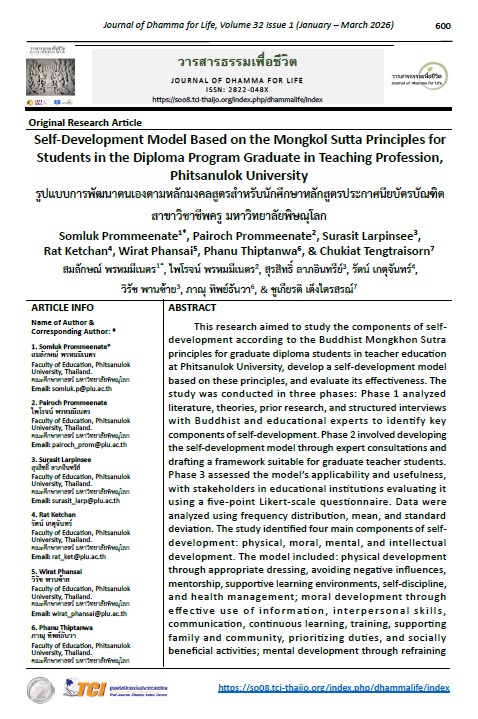
Self-Development Model Based on the Mongkol Sutta Principles for Students in the Diploma Program Graduate in Teaching Profession, Phitsanulok University
Article Sidebar
Main Article Content
Abstract
This research aimed to study the components of self-development according to the Buddhist Mongkhon Sutra principles for graduate diploma students in teacher education at Phitsanulok University, develop a self-development model based on these principles, and evaluate its effectiveness. The study was conducted in three phases: Phase 1 analyzed literature, theories, prior research, and structured interviews with Buddhist and educational experts to identify key components of self-development. Phase 2 involved developing the self-development model through expert consultations and drafting a framework suitable for graduate teacher students. Phase 3 assessed the model’s applicability and usefulness, with stakeholders in educational institutions evaluating it using a five-point Likert-scale questionnaire. Data were analyzed using frequency distribution, mean, and standard deviation. The study identified four main components of self-development: physical, moral, mental, and intellectual development. The model included: physical development through appropriate dressing, avoiding negative influences, mentorship, supportive learning environments, self-discipline, and health management; moral development through effective use of information, interpersonal skills, communication, continuous learning, training, supporting family and community, prioritizing duties, and socially beneficial activities; mental development through refraining from misconduct, performing duties diligently, gratitude, respecting colleagues’ opinions, listening to diverse perspectives, seeking knowledge, patient problem-solving, and contentment; and intellectual development through ethical behavior, engaging in personal and communal activities for mental well-being, adapting to change, and applying Mongkhon Sutra principles in professional duties. Evaluation indicated that the model is highly beneficial, appropriate, and feasible for enhancing self-development of graduate diploma teacher students at Phitsanulok University.
Article Details
References
ชื่น สกุลปัน, & บุญช่วย ศิริเกษม. (2561). ความต้องการพัฒนาตนเองของครูผู้สอนของโรงเรียนเอกชนในเครือมูลนิธิไทไชโย. สำนักงานคณะกรรมการการศึกษาเอกชน.
ธีระ กุลสวัสดิ์, & สมคิด เพชรประเสริฐ. (2564). ปัจจัยที่มีอิทธิพลต่อการพัฒนาตนเองของบุคลากรในเทศบาลนครในภาคตะวันออก. มหาวิทยาลัยบูรพา.
พรพรรณ พูวัฒนาธนสิน. (2562). ปัจจัยที่ส่งผลต่อการพัฒนาตนเองในการทำงานของข้าราชการกองบัญชาการกองทัพไทยพื้นที่แจ้งวัฒนา. ธุรกิจบัณฑิต, มหาวิทยาลัยเกษตรศาสตร์.
มะลานู อาลี. (2562). การพัฒนาตนเองตามความต้องการของวิชาชีพครู.
ราตรี พัฒนรังสรรค์. (2544). การพัฒนาตนเองเพื่อประสิทธิภาพในการปฏิบัติงาน.
ศิริรัตน์ วรรณกุล (2566) การศึกษาปัจจัยที่ส่งผลต่อการพัฒนาตนองของเด็กและเยาวชนของศาลเยาวชน และครอบครัว. สังกัดสำนักศาลยุติธรรมประจำภาค 4. จังหวัดกาฬสินธุ์: สำนักงานเขตพื้นที่การ ประถมศึกษา เขต 1.
แสวง สาระสิทธิ์. (2535). การใช้สารสนเทศเพื่อการพัฒนาการปฏิบัติงาน.
สงวน สุทธิเลิศอรุณ. (2545). การพัฒนาตนเอง. กรุงเทพฯ: สำนักพิมพ์จุฬาลงกรณ์มหาวิทยาลัย.
เสาวลักษณ์ รัตนปัญญา. (2558). ความต้องการพัฒนาตนเองด้านวิชาการและวิชาชีพ.
พระธรรมปิฎก (ป. อ. ปยุตฺโต). (2543). พุทธธรรม: ฉบับปรับปรุงและขยายความ. กรุงเทพฯ: มหาจุฬาลงกรณราชวิทยาลัย.
พระไตรปิฎก (2539). เล่มที่ 25 พระสุตตันตปิฎก ขุททกนิกาย ขุททกปาฐะ. กรุงเทพฯ: มหามกุฏราชวิทยาลัย.
Bass, B. M. (1990). Bass & Stogdill’s handbook of leadership: Theory, research, and managerial applications (3rd ed.). New York: Free Press.
Miller, J. P. (1979). Self-Development and Learning. New York: McGraw-Hill. (Cited in Songwut Rittirun, 2002)
