The Development of Learning Organizations in Private Schools in the Lower Northern Region 2 of Thailand -
Article Sidebar
Main Article Content
Abstract
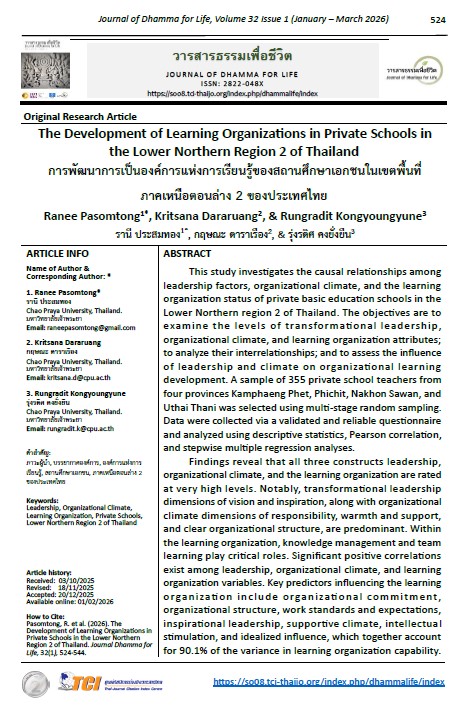
This study investigates the causal relationships among leadership factors, organizational climate, and the learning organization status of private basic education schools in the Lower Northern region 2 of Thailand. The objectives are to examine the levels of transformational leadership, organizational climate, and learning organization attributes; to analyze their interrelationships; and to assess the influence of leadership and climate on organizational learning development. A sample of 355 private school teachers from four provinces Kamphaeng Phet, Phichit, Nakhon Sawan, and Uthai Thani was selected using multi-stage random sampling. Data were collected via a validated and reliable questionnaire and analyzed using descriptive statistics, Pearson correlation, and stepwise multiple regression analyses.
Findings reveal that all three constructs leadership, organizational climate, and the learning organization are rated at very high levels. Notably, transformational leadership dimensions of vision and inspiration, along with organizational climate dimensions of responsibility, warmth and support, and clear organizational structure, are predominant. Within the learning organization, knowledge management and team learning play critical roles. Significant positive correlations exist among leadership, organizational climate, and learning organization variables. Key predictors influencing the learning organization include organizational commitment, organizational structure, work standards and expectations, inspirational leadership, supportive climate, intellectual stimulation, and idealized influence, which together account for 90.1% of the variance in learning organization capability. Based on these findings, the study proposes actionable strategies to develop transformational leadership, foster a learning-conducive organizational climate, and enhance internal components of the learning organization through effective knowledge management, teamwork, and appropriate use of information technology. These approaches aim to promote sustainable and effective learning organizations within private schools in the Lower Northern region 2 of Thailand.
Article Details
References
กิรชัญญา ของโพธิ์. (2565). บรรยากาศองค์การและผลกระทบต่อพฤติกรรมการทำงาน. วารสารบริหารธุรกิจ, 18(2), 112–130.
ชนัตพร เหี้ยมหาญ. (2562). บรรยากาศองค์การกับวัฒนธรรมองค์กร. วารสารสังคมศาสตร์, 9(1), 133–150.
ธนัทพงษ์ วังทะพันธ์. (2564). ผลของบรรยากาศองค์กรต่อประสิทธิภาพการทำงาน. วารสารจิตวิทยาองค์กร, 15(2), 98–115.
พัณภัสสา แก้วคำไสย์. (2566). ภาวะผู้นำการเปลี่ยนแปลง: กลยุทธ์การบริหารในยุคโลกาภิวัตน์. วารสารการบริหารการศึกษา, 14(2), 19–38.
พีระ แก้วสะอาด. (2564). ปัจจัยที่มีผลต่อบรรยากาศองค์การ. การบริหารธุรกิจ, 13(4), 72–88.
สุนิสา เนาวรัตน์. (2563). บรรยากาศองค์การ: ความหมายและผลกระทบ. วารสารบริหารการศึกษา, 11(1), 88–104.
อาวัชนนท์ อิ่มเพ็ง. (2566). ภาวะผู้นำการเปลี่ยนแปลงในสถานศึกษา: แนวทางการพัฒนาและขับเคลื่อนองค์กร. วารสารการบริหารการศึกษา, 15(1), 45–62. New
Bass, B. M., & Avolio, B. J. (1994). Improving organizational effectiveness through transformational leadership. Sage Publications.
Benedica, M. (2014). Organizational atmosphere and its components. Journal of Business Management, 12(3), 45–59.
Brown, S. P., & Moberg, D. J. (1980). Organizational climate: Its impact on employee performance. Organizational Dynamics, 8(4), 50–67.
Huang, C. (2013). Key elements of organizational climate for performance. International Journal of Management, 10(1), 25–33.
Jones, G. R., & George, J. M. (2016). Essentials of contemporary management. McGraw-Hill Education.
Kelly, J. (1980). Organizational climate theory. In Sornya (Ed.), Organization studies (211–234). Bangkok: Publisher.
Korejan, R., & Shahbazi, M. (2016). Characteristics and effects of transformational leadership. Journal of Management Studies, 12(2), 34–47.
Marquardt, M. J. (2002). Building the learning organization: A systems approach to quantum improvement and global success. McGraw-Hill.
Medcalf, G., & Gilbert, S. (2017). Enhancing learning organizations in education. Educational Development, 9(3), 123–138.
Pedler, M., Burgoyne, J., & Boydell, T. (1991). The learning company: A strategy for sustainable development. McGraw-Hill.
Rowe, A., & Guerrero, L. (2019). Strategies for organizational learning and transformational leadership. International Journal of Organizational Behavior, 14(1), 77–94.
Senge, P. M. (1990). The fifth discipline: The art and practice of the learning organization. Doubleday.
Warrilow, S. (2022). Creating a culture of continuous learning in schools. Journal of Education Leadership, 31(4), 210–227.
Wudarzewski, J. (2019). Management styles and organizational climate. International Journal of Business Management, 14(2), 102–118.
