The Role of Monks in Changing and Promoting Morality Today
Article Sidebar
Main Article Content
Abstract
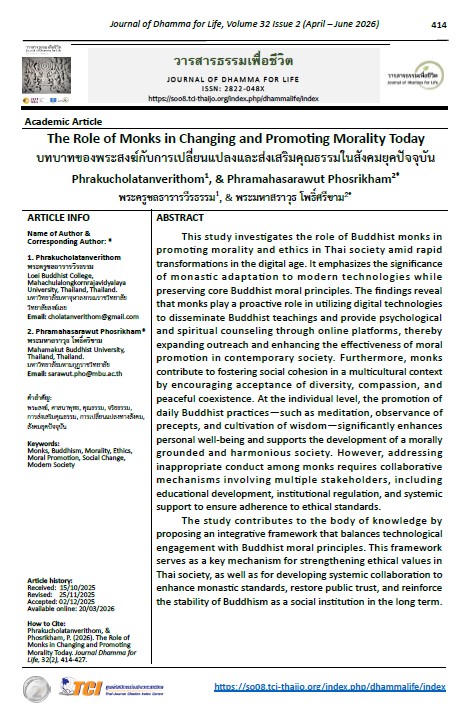
This study investigates the role of Buddhist monks in promoting morality and ethics in Thai society amid rapid transformations in the digital age. It emphasizes the significance of monastic adaptation to modern technologies while preserving core Buddhist moral principles. The findings reveal that monks play a proactive role in utilizing digital technologies to disseminate Buddhist teachings and provide psychological and spiritual counseling through online platforms, thereby expanding outreach and enhancing the effectiveness of moral promotion in contemporary society. Furthermore, monks contribute to fostering social cohesion in a multicultural context by encouraging acceptance of diversity, compassion, and peaceful coexistence. At the individual level, the promotion of daily Buddhist practices—such as meditation, observance of precepts, and cultivation of wisdom—significantly enhances personal well-being and supports the development of a morally grounded and harmonious society. However, addressing inappropriate conduct among monks requires collaborative mechanisms involving multiple stakeholders, including educational development, institutional regulation, and systemic support to ensure adherence to ethical standards.
The study contributes to the body of knowledge by proposing an integrative framework that balances technological engagement with Buddhist moral principles. This framework serves as a key mechanism for strengthening ethical values in Thai society, as well as for developing systemic collaboration to enhance monastic standards, restore public trust, and reinforce the stability of Buddhism as a social institution in the long term.
Article Details
References
ภัทรพร สิริกาญจน์. (2536). บทบาทของพระสงฆ์ในชุมชนไทย. กรุงเทพฯ: สำนักพิมพ์มหาวิทยาลัยธรรมศาสตร์.
พระมหาสุภา อุทโท. (2441). บทบาทของวัดและพระสงฆ์ในชุมชนไทย. กรุงเทพฯ: สำนักพิมพ์วัดไทย.
พระมหาสมชาย ฐานวุฑฺโฒ. (2560). บทบาทพระสงฆ์ในการใช้เทคโนโลยีเพื่อการเผยแผ่พระพุทธศาสนา. กรุงเทพฯ: สำนักพิมพ์ธรรมสภา.
พระพรหมคุณาภรณ์ (ป.อ. ปยุตฺโต). (2559). จิตใจและสมาธิในการปรับตัวของพระสงฆ์ยุคดิจิทัล. กรุงเทพฯ: สำนักพิมพ์มหามกุฏราชวิทยาลัย.
พระพรหมคุณากรณ์ (ป.อ. ปยุตฺโต). (2559). ไตรสิกขา: หลักสูตรพัฒนาตนทางพุทธศาสนา. กรุงเทพฯ: โรงพิมพ์มหาจุฬาลงกรณ์ราชวิทยาลัย.
พระพรหมคุณาณ์. (2551). การพัฒนาคุณธรรมจริยธรรมในสังคมไทย. กรุงเทพฯ: สำนักพิมพ์มหาจุฬาลงกรณ์ราชวิทยาลัย.
พระราชวรมุนี (ป.อ.ปยุตฺโต). (2536). ธรรมะกับชีวิตคนยุคใหม่. กรุงเทพฯ: มหาจุฬาลงกรณราชวิทยาลัย.
พระราชวรมุนี (ประยุทธ ปยุตฺโต). (2530). การให้ธรรมทานและการพัฒนาคุณธรรมในสังคม. กรุงเทพฯ: สำนักพิมพ์ธรรมสภา.
พระเทพเวที (ป.อ. ปยุตฺโต). (2533). บทบาทของพระสงฆ์ต่อการพัฒนาสังคมและชุมชน. กรุงเทพฯ: มหามกุฏราชวิทยาลัย.
พระเทพเวที (ประยุทธ์ ปยุตฺโต). (2533). พจนานุกรมพุทธศาสน์ ฉบับประมวลศัพท์. กรุงเทพฯ: โรงพิมพ์มหาจุฬาลงกรณ์ราชวิทยาลัย.
พระไพศาล วิสาโล. (2552). พุทธศาสนาเพื่อสังคม. กรุงเทพฯ: สำนักพิมพ์ศูนย์สันติศึกษา.
พินิจ ลาภธนานนท์. (2535). พระสงฆ์กับสังคมไทย: บทบาทและหน้าที่. กรุงเทพฯ: มหาวิทยาลัยธรรมศาสตร์.
พินิจ ลาภธนานนท์ & แทนพันธุ์ เสนะพันธุ์ บัวใหม่. (2557). การปรับตัวของพระสงฆ์ต่อสังคมและเทคโนโลยีสมัยใหม่. กรุงเทพฯ: สำนักพิมพ์มหาวิทยาลัย.
สมศรี จินะวงษ์. (2532). พระสงฆ์กับการใช้สื่อสมัยใหม่. กรุงเทพฯ: มหาวิทยาลัยมหาจุฬาลงกรณราชวิทยาลัย.
Bauman, Z. (2012). Liquid modernity. Cambridge: Polity Press.
Beck, U. (1992). Risk society: Towards a new modernity. London: Sage.
Borwornsak Uwanno. (2018). Ethical challenges in contemporary Thai society. Bangkok: Thammasat University Press.
Campbell, H. A. (2013). Digital religion: Understanding religious practice in digital media. New York: Routledge.
Casanova, J. (2011). The public relevance of religion. New York: Social Science Research Council.
Chaiyawan, P. (2019). Digital media and ethical behavior of Thai youth. Bangkok: Chulalongkorn University Press.
Giddens, A. (1991). Modernity and self-identity: Self and society in the late modern age. Cambridge: Polity Press.
Hick, J. (2004). The pluralist paradigm: A new approach to theology. London: Oneworld Publications.
Kitiarsa, P. (2012). Spiritual practices and contemporary Thai culture. Chiang Mai: Silkworm Books.
McCargo, D. (2017). Contemporary Buddhism in Thailand: Religion and society in modern Thailand. Singapore: NUS Press.
Office of the National Economic and Social Development Council. (2022). Thailand social and economic report 2022. Bangkok: ONESDC.
Phra Brahmagunabhorn [P.A. Payutto]. (2016). Buddhism and contemporary society. Bangkok: Mahachulalongkornrajavidyalaya University Press.
Phra Dhammapitaka. (2017). Moral values and Thai youth. Bangkok: Mahamakut Buddhist University Press.
Phra Maha Hansa Dhammahāso. (2014). Monks as moral agents and social capital in Thailand. Bangkok: Mahachulalongkornrajavidyalaya University Press.
Phra Maha Somboon Vuddhikaro. (2021). Digital engagement of Thai monks in modern society. Bangkok: Mahachulalongkornrajavidyalaya University Press.
Phra Paisal Visalo. (2019). Engaged Buddhism in Thailand: Social action and moral leadership. Bangkok: Silpakorn University Press.
Putnam, R. D. (2000). Bowling alone: The collapse and revival of American community. New York: Simon & Schuster.
Queen, C. S., & King, S. B. (1996). Engaged Buddhism: Buddhist liberation movements in Asia. Albany: SUNY Press.
Smart, N. (1999). The world’s religions. Cambridge: Cambridge University Press.
Srisuk, S. (2020). Impact of digital media on ethical behavior in Thai society. Bangkok: Kasetsart University Press.
Suwannathat-Pian, K. (2015). The evolving role of Thai monks in contemporary society. Bangkok: Chulalongkorn University Press.
Taylor, C. (1992). Sources of the self: The making of the modern identity. Cambridge, MA: Harvard University Press.
