
Big Data and Machine Learning to Study The Media Consumption Behavior of the New Generation
Article Sidebar
Main Article Content
Abstract
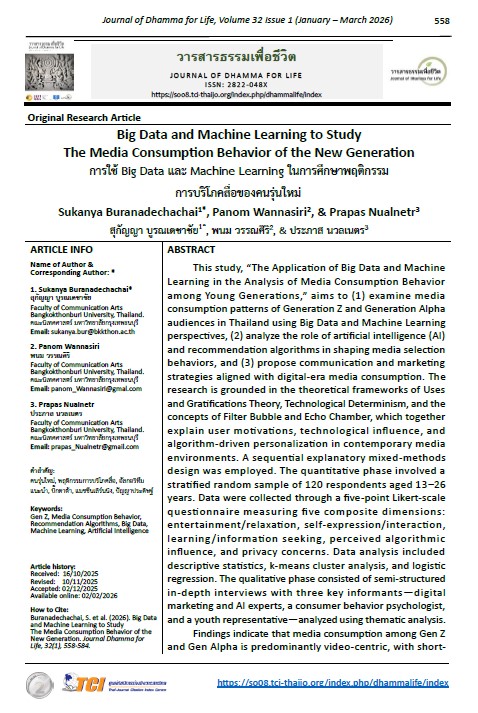
This study, “The Application of Big Data and Machine Learning in the Analysis of Media Consumption Behavior among Young Generations,” aims to (1) examine media consumption patterns of Generation Z and Generation Alpha audiences in Thailand using Big Data and Machine Learning perspectives, (2) analyze the role of artificial intelligence (AI) and recommendation algorithms in shaping media selection behaviors, and (3) propose communication and marketing strategies aligned with digital-era media consumption. The research is grounded in the theoretical frameworks of Uses and Gratifications Theory, Technological Determinism, and the concepts of Filter Bubble and Echo Chamber, which together explain user motivations, technological influence, and algorithm-driven personalization in contemporary media environments. A sequential explanatory mixed-methods design was employed. The quantitative phase involved a stratified random sample of 120 respondents aged 13–26 years. Data were collected through a five-point Likert-scale questionnaire measuring five composite dimensions: entertainment/relaxation, self-expression/interaction, learning/information seeking, perceived algorithmic influence, and privacy concerns. Data analysis included descriptive statistics, k-means cluster analysis, and logistic regression. The qualitative phase consisted of semi-structured in-depth interviews with three key informants—digital marketing and AI experts, a consumer behavior psychologist, and a youth representative—analyzed using thematic analysis.
Findings indicate that media consumption among Gen Z and Gen Alpha is predominantly video-centric, with short-form video platforms playing a central role. Recommendation algorithms significantly influence platform choice and content exposure, reinforcing habitual consumption patterns. Cluster analysis identified three distinct user profiles with differing motivations and engagement styles. The results highlight the strong interplay between user gratifications and algorithmic systems, supporting both Uses and Gratifications Theory and Technological Determinism. Based on these findings, the study proposes a strategic framework emphasizing mobile-first, short-form content combined with responsible personalization to balance marketing effectiveness, informational credibility, and user privacy within the Thai digital media context.
Article Details
References
กระทรวงดิจิทัลเพื่อเศรษฐกิจและสังคม. (2023). รายงานสถานการณ์ข่าวปลอมและผลกระทบจากเทคโนโลยีปัญญาประดิษฐ์ในประเทศไทย. กรุงเทพมหานคร: กระทรวงดิจิทัลเพื่อเศรษฐกิจและสังคม.
สำนักงานคณะกรรมการคุ้มครองข้อมูลส่วนบุคคล (PDPC). (2022). พระราชบัญญัติคุ้มครองข้อมูลส่วนบุคคล พ.ศ. 2562. ราชกิจจานุเบกษา.
Adobe. (2025, February 24). What is cluster analysis in marketing? https://business. adobe.com/blog/basics/cluster-analysis
American Psychological Association. (2020). Publication manual of the American Psychological Association (7th ed.). APA.
Blumler, J. G., & Katz, E. (1974). The uses of mass communications: Current perspectives on gratifications research. Sage Publications.
Chen, M., Mao, S., & Liu, Y. (2014). Big data: A survey. Mobile Networks and Applications, 19(2), 171–209.
DataReportal. (2024). Digital 2024: Thailand — Social media statistics. https://datare portal.com/reports/digital-2024-thailand
DataReportal. (2025). Digital 2025 Thailand. We Are Social & Hootsuite.
Global Initiative Against Transnational Organized Crime. (2023). Digital threats and mis/disinformation report. Global Initiative.
John, J. M., et al. (2023). An exploration of clustering algorithms for customer segmentation. MDPI.
Kaplan, A. M., & Haenlein, M. (2019). Siri, Siri, in my hand: Who’s the fairest in the land? On the interpretations, illustrations, and implications of artificial intelligence. Business Horizons, 62(1), 15–25.
Kietzmann, J. H., Paschen, J., & Treen, E. (2018). Artificial intelligence in advertising: How marketers can leverage artificial intelligence along the consumer journey. Journal of Advertising Research, 58(3), 263–267.
Ma, Z., Jørgensen, B. N., & Ma, Z. G. (2025). A systematic data characteristic understanding framework towards physical-sensor big data challenges (6Vs model). arXiv.
McLuhan, M. (1964). Understanding media: The extensions of man. McGraw-Hill.
Microsoft Canada. (2015). Attention spans: Consumer insights. Microsoft Corporation.
National Institute of Standards and Technology. (2019). NIST Big Data Interoperability Framework (Vols. 3, 6, & 8). U.S. Department of Commerce.
Pariser, E. (2011). The filter bubble: What the Internet is hiding from you. Penguin Press.
Qlik. (n.d.). Clustering (k-means) analysis. https://help.qlik.com
Ruggiero, T. E. (2000). Uses and gratifications theory in the 21st century. Mass Communication & Society, 3(1), 3–37.
We Are Social, & Hootsuite. (2024). Digital 2024: Thailand. We Are Social Ltd.
