การใช้ Big Data และ Machine Learning ในการศึกษาพฤติกรรม การบริโภคสื่อของคนรุ่นใหม่
Article Sidebar
Main Article Content
บทคัดย่อ
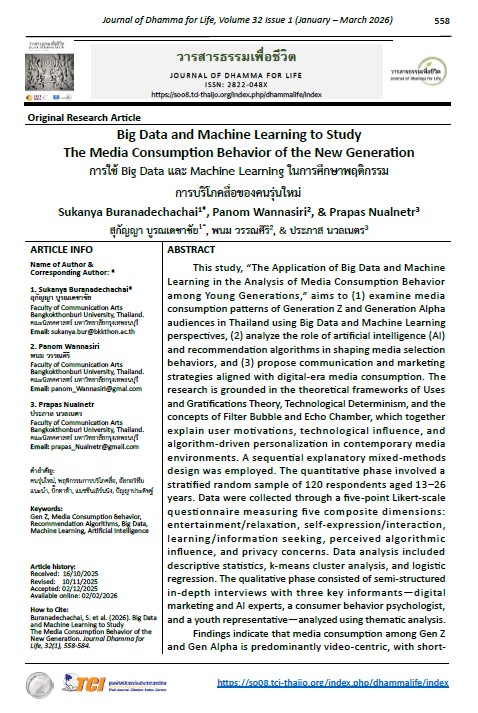
การวิจัยเรื่อง การใช้ Big Data และ Machine Learning ในการศึกษาพฤติกรรมการบริโภคสื่อของคน รุ่นใหม่ มีวัตถุประสงค์เพื่อ (1) ศึกษาและวิเคราะห์พฤติกรรมการบริโภคสื่อของผู้รับสารกลุ่ม Gen Z และ Gen Alpha ในประเทศไทยโดยอาศัยแนวคิด Big Data และ Machine Learning (2) วิเคราะห์บทบาทของปัญญาประดิษฐ์ (AI) และระบบแนะนำเนื้อหา (Recommendation Algorithms) ที่มีอิทธิพลต่อการเลือกเสพสื่อ และ (3) เสนอแนวทางกลยุทธ์การสื่อสารและการตลาดที่สอดคล้องกับพฤติกรรมผู้บริโภคสื่อในยุคดิจิทัล งานวิจัยอาศัยกรอบแนวคิด Uses and Gratifications Theory Technological Determinism และแนวคิด Filter Bubble/Echo Chamber เพื่ออธิบายทั้งแรงจูงใจในการเลือกใช้สื่อและอิทธิพลของเทคโนโลยีต่อประสบการณ์การรับสาร ระเบียบวิธีวิจัยเป็นการวิจัยแบบผสมผสานตามลำดับ (Sequential Explanatory Mixed Methods) โดยส่วนเชิงปริมาณใช้การสุ่มตัวอย่างแบบแบ่งชั้นจากประชากร Gen Z และ Gen Alpha ในประเทศไทย จำนวน 120 คน เก็บข้อมูลด้วยแบบสอบถามมาตราส่วนประมาณค่า 5 ระดับ วิเคราะห์ข้อมูลด้วยสถิติเชิงพรรณา การจัดกลุ่มข้อมูลด้วยเทคนิค k-means และการวิเคราะห์ถดถอยโลจิสติก ส่วนเชิงคุณภาพใช้การสัมภาษณ์เชิงลึกแบบกึ่งโครงสร้างจากผู้เชี่ยวชาญด้านดิจิทัลและตัวแทนผู้ใช้สื่อ วิเคราะห์ข้อมูลด้วยการวิเคราะห์เชิงเนื้อหาแบบธีม (Thematic Analysis)
ผลการวิจัยพบว่า ผู้รับสารกลุ่มตัวอย่างมีพฤติกรรมการบริโภคสื่อที่เน้นวิดีโอเป็นศูนย์กลาง โดยเฉพาะวิดีโอสั้นผ่านแพลตฟอร์มที่ขับเคลื่อนด้วยอัลกอริทึม ซึ่งมีบทบาทสำคัญต่อการกำหนดรูปแบบการรับสาร การจัดกลุ่มพฤติกรรมสะท้อนให้เห็นความแตกต่างของแรงจูงใจและรูปแบบการใช้สื่ออย่างชัดเจน ข้อค้นพบดังกล่าวนำไปสู่ข้อเสนอเชิงกลยุทธ์ด้านการสื่อสารและการตลาดที่เน้นการออกแบบเนื้อหาให้สอดคล้องกับระบบแนะนำเนื้อหา ควบคู่กับความรับผิดชอบด้านจริยธรรมและความเป็นส่วนตัวของผู้ใช้ในบริบทสังคมดิจิทัลไทย
Article Details
เอกสารอ้างอิง
กระทรวงดิจิทัลเพื่อเศรษฐกิจและสังคม. (2023). รายงานสถานการณ์ข่าวปลอมและผลกระทบจากเทคโนโลยีปัญญาประดิษฐ์ในประเทศไทย. กรุงเทพมหานคร: กระทรวงดิจิทัลเพื่อเศรษฐกิจและสังคม.
สำนักงานคณะกรรมการคุ้มครองข้อมูลส่วนบุคคล (PDPC). (2022). พระราชบัญญัติคุ้มครองข้อมูลส่วนบุคคล พ.ศ. 2562. ราชกิจจานุเบกษา.
Adobe. (2025, February 24). What is cluster analysis in marketing? https://business. adobe.com/blog/basics/cluster-analysis
American Psychological Association. (2020). Publication manual of the American Psychological Association (7th ed.). APA.
Blumler, J. G., & Katz, E. (1974). The uses of mass communications: Current perspectives on gratifications research. Sage Publications.
Chen, M., Mao, S., & Liu, Y. (2014). Big data: A survey. Mobile Networks and Applications, 19(2), 171–209.
DataReportal. (2024). Digital 2024: Thailand — Social media statistics. https://datare portal.com/reports/digital-2024-thailand
DataReportal. (2025). Digital 2025 Thailand. We Are Social & Hootsuite.
Global Initiative Against Transnational Organized Crime. (2023). Digital threats and mis/disinformation report. Global Initiative.
John, J. M., et al. (2023). An exploration of clustering algorithms for customer segmentation. MDPI.
Kaplan, A. M., & Haenlein, M. (2019). Siri, Siri, in my hand: Who’s the fairest in the land? On the interpretations, illustrations, and implications of artificial intelligence. Business Horizons, 62(1), 15–25.
Kietzmann, J. H., Paschen, J., & Treen, E. (2018). Artificial intelligence in advertising: How marketers can leverage artificial intelligence along the consumer journey. Journal of Advertising Research, 58(3), 263–267.
Ma, Z., Jørgensen, B. N., & Ma, Z. G. (2025). A systematic data characteristic understanding framework towards physical-sensor big data challenges (6Vs model). arXiv.
McLuhan, M. (1964). Understanding media: The extensions of man. McGraw-Hill.
Microsoft Canada. (2015). Attention spans: Consumer insights. Microsoft Corporation.
National Institute of Standards and Technology. (2019). NIST Big Data Interoperability Framework (Vols. 3, 6, & 8). U.S. Department of Commerce.
Pariser, E. (2011). The filter bubble: What the Internet is hiding from you. Penguin Press.
Qlik. (n.d.). Clustering (k-means) analysis. https://help.qlik.com
Ruggiero, T. E. (2000). Uses and gratifications theory in the 21st century. Mass Communication & Society, 3(1), 3–37.
We Are Social, & Hootsuite. (2024). Digital 2024: Thailand. We Are Social Ltd.
