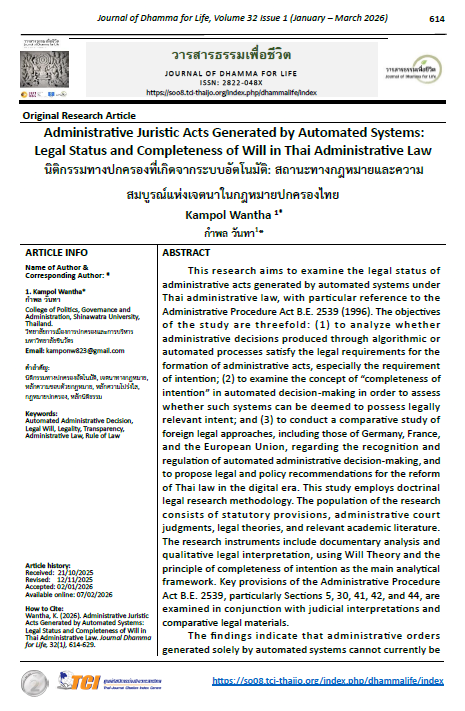
Administrative Juristic Acts Generated by Automated Systems: Legal Status and Completeness of Will in Thai Administrative Law
Article Sidebar
Main Article Content
Abstract
This research aims to examine the legal status of administrative acts generated by automated systems under Thai administrative law, with particular reference to the Administrative Procedure Act B.E. 2539 (1996). The objectives of the study are threefold: (1) to analyze whether administrative decisions produced through algorithmic or automated processes satisfy the legal requirements for the formation of administrative acts, especially the requirement of intention; (2) to examine the concept of “completeness of intention” in automated decision-making in order to assess whether such systems can be deemed to possess legally relevant intent; and (3) to conduct a comparative study of foreign legal approaches, including those of Germany, France, and the European Union, regarding the recognition and regulation of automated administrative decision-making, and to propose legal and policy recommendations for the reform of Thai law in the digital era. This study employs doctrinal legal research methodology. The population of the research consists of statutory provisions, administrative court judgments, legal theories, and relevant academic literature. The research instruments include documentary analysis and qualitative legal interpretation, using Will Theory and the principle of completeness of intention as the main analytical framework. Key provisions of the Administrative Procedure Act B.E. 2539, particularly Sections 5, 30, 41, 42, and 44, are examined in conjunction with judicial interpretations and comparative legal materials.
The findings indicate that administrative orders generated solely by automated systems cannot currently be regarded as valid administrative acts under Thai law, as they lack the essential element of intention on the part of the authorized administrative official. Such practices may also conflict with the principles of legality and transparency. Accordingly, the study concludes that the use of automated systems in administrative decision-making must be accompanied by clear mechanisms for attributing and supervising administrative intent, in order to ensure compliance with the rule of law and the protection of individual rights in the digital age.
Article Details
References
พระราชบัญญัติวิธีปฏิบัติราชการทางปกครอง พ.ศ. 2539 และที่แก้ไขเพิ่มเติม
รัฐธรรมนูญแห่งราชอาณาจักรไทย พุทธศักราช 2560 มาตรา 27, มาตรา 37 และมาตรา 41
คำพิพากษาศาลปกครองสูงสุดเกี่ยวกับการออกคำสั่งทางปกครองโดยระบบอิเล็กทรอนิกส์และการแสดงเจตนาในการใช้อำนาจรัฐ
ชาญชัย แสวงศักดิ์. (2563). กฎหมายปกครอง (พิมพ์ครั้งที่ …). กรุงเทพฯ: สำนักพิมพ์วิญญูชน.
บรรเจิด สิงคะเนติ. (2560). หลักนิติธรรมกับการใช้อำนาจทางปกครอง. กรุงเทพมหานคร: สำนักพิมพ์วิญญูชน.
วีรพงษ์ วิรัชกุล. (2565). กฎหมายปกครอง. กรุงเทพมหานคร: สำนักพิมพ์วิญญูชน.
อนันต์ จันทรานนท์. (2560). ทฤษฎีนิติกรรมและเจตนาในกฎหมายมหาชน. กรุงเทพมหานคร: สำนักพิมพ์นิติธรรม.
Alexy, R. (2002). A theory of constitutional rights. Oxford: Oxford University Press.
Binns, R. (2018). Fairness in machine learning: Lessons from political philosophy. Proceedings of the 1st Conference on Fairness, Accountability and Transparency (FAT*), 149–159.
Bovens, M., Zouridis, S., & Van Eck, M. (2020). Algorithmic public administration. In M. Bovens, P. ’t Hart, & B. G. Peters (Eds.), The Oxford handbook of public accountability. Oxford: Oxford University Press.
Brownsword, R. (2019). Law, technology and society: Re-imagining the regulatory environment. London: Routledge.
Citron, D. K. (2008). Technological due process. Washington University Law Review, 85(6), 1249–1313.
Craig, P. (2012). Administrative law (7th ed.). London: Sweet & Maxwell.
Dicey, A. V. (1959). Introduction to the study of the law of the constitution (10th ed.). London: Macmillan.
Dunleavy, P., Margetts, H., Bastow, S., & Tinkler, J. (2006). New public management is dead—Long live digital-era governance. Journal of Public Administration Research and Theory, 16(3), 467–494. https://doi.org/10.1093/jopart/mui057
Eubanks, V. (2018). Automating inequality: How high-tech tools profile, police, and punish the poor. New York, NY: St. Martin’s Press.
European Commission. (2020). White paper on artificial intelligence: A European approach to excellence and trust. Brussels: European Union.
Floridi, L., Cowls, J., Beltrametti, M., et al. (2018). AI4People—An ethical framework for a good AI society: Opportunities, risks, principles, and recommendations. Minds and Machines, 28(4), 689–707. https://doi.org/10.1007/s11023-018-9482-5
Hofmann, H. C. H., & Gerke, S. (2021). Algorithmic decision-making in public administration. European Law Journal, 27(1–2), 3–24.
Maurer, H. (2011). Allgemeines Verwaltungsrecht (18. Aufl.). München: C. H. Beck.
Maurer, H., & Waldhoff, C. (2017). Allgemeines Verwaltungsrecht (19. Aufl.). München: C. H. Beck.
OECD. (2019). Principles on artificial intelligence. Paris: OECD Publishing.
OECD. (2020). Digital government index: 2019 results. Paris: OECD Publishing. https:// doi.org/10.1787/4de9f5bb-en
Pasquale, F. (2015). The black box society: The secret algorithms that control money and information. Cambridge, MA: Harvard University Press.
Regulation (EU) 2016/679 of the European Parliament and of the Council of 27 April 2016 (General Data Protection Regulation).
Savigny, F. C. von. (1840). System des heutigen Römischen Rechts. Berlin: Veit und Comp.
Schwarze, J. (2018). European administrative law. London: Sweet & Maxwell.
UNESCO. (2021). Recommendation on the ethics of artificial intelligence. Paris: UNESCO.
Wachter, S., Mittelstadt, B., & Floridi, L. (2017). Why a right to explanation of automated decision-making does not exist in the General Data Protection Regulation. International Data Privacy Law, 7(2), 76–99.
Wade, H. W. R., & Forsyth, C. F. (2014). Administrative law (11th ed.). Oxford: Oxford University Press.
Wirtz, B. W., Weyerer, J. C., & Geyer, C. (2019). Artificial intelligence and the public sector—Applications and challenges. International Journal of Public Administration, 42(7), 596–615. https://doi.org/10.1080/01900692.2018.1498103
Zalnieriute, M., Moses, L. B., & Williams, G. (2019). The rule of law and automation of government decision-making. The Modern Law Review, 82(3), 425–455. https://doi.org/10.1111/1468-2230.12412
