
นิติกรรมทางปกครองที่เกิดจากระบบอัตโนมัติ: สถานะทางกฎหมายและความสมบูรณ์แห่งเจตนาในกฎหมายปกครองไทย
Article Sidebar
Main Article Content
บทคัดย่อ
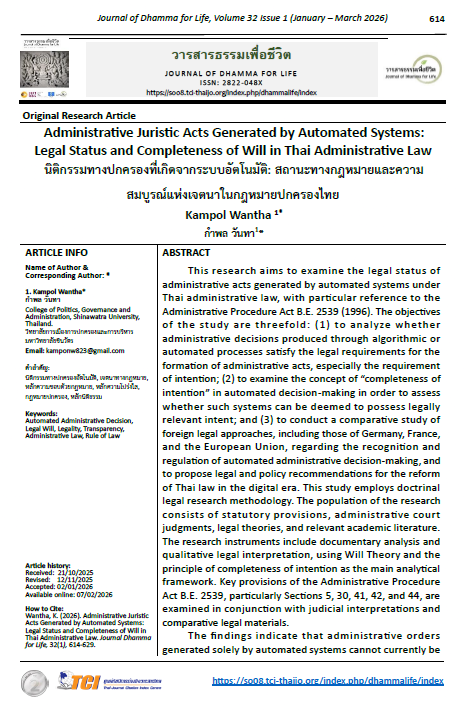
การวิจัยนี้มีวัตถุประสงค์เพื่อ (1) วิเคราะห์สถานะทางกฎหมายของนิติกรรมทางปกครองที่เกิดจากระบบอัตโนมัติภายใต้พระราชบัญญัติวิธีปฏิบัติราชการทางปกครอง พ.ศ. 2539 โดยมุ่งพิจารณาประเด็นความสมบูรณ์แห่งเจตนาในการใช้อำนาจทางปกครอง (2) ศึกษาและเปรียบเทียบแนวคิดและหลักเกณฑ์ทางกฎหมายของต่างประเทศ ได้แก่ กฎหมายเยอรมัน ฝรั่งเศส และกฎหมายของสหภาพยุโรป เกี่ยวกับการรับรองคำสั่งทางปกครองที่ออกโดยระบบอัตโนมัติ และ (3) เสนอแนวทางเชิงนโยบายและกฎหมายเพื่อปรับปรุงกฎหมายปกครองไทยให้สอดคล้องกับหลักนิติธรรมในยุคดิจิทัล การวิจัยนี้เป็นการวิจัยเชิงเอกสารโดยใช้ระเบียบวิธีวิจัยเชิงหลักการทางกฎหมาย (Doctrinal Legal Research) ประชากรในการวิจัยประกอบด้วยบทบัญญัติแห่งกฎหมาย คำพิพากษาศาลปกครอง แนวคิดทางทฤษฎีกฎหมาย และเอกสารทางวิชาการที่เกี่ยวข้อง เครื่องมือที่ใช้ในการวิจัยคือการวิเคราะห์เอกสารทางกฎหมาย โดยใช้กรอบแนวคิดเรื่องทฤษฎีเจตนา (Will Theory) และหลักความสมบูรณ์แห่งเจตนา (Completeness of Intention) เป็นเครื่องมือในการวิเคราะห์เชิงคุณภาพ
ผลการวิจัยพบว่า คำสั่งทางปกครองที่เกิดจากระบบอัตโนมัติซึ่งขาดการตัดสินใจโดยตรงจากเจ้าหน้าที่ผู้มีอำนาจ ยังไม่อาจถือเป็นนิติกรรมทางปกครองที่สมบูรณ์ได้ตามกฎหมายไทย เนื่องจากขาดองค์ประกอบสำคัญคือ เจตนา อันเป็นสาระสำคัญของการก่อให้เกิดนิติกรรม อีกทั้งอาจขัดต่อหลักความชอบด้วยกฎหมายและหลักความโปร่งใส ดังนั้น การนำระบบอัตโนมัติมาใช้ในการบริหารราชการแผ่นดินจำเป็นต้องมีกลไกกำกับและรับรองเจตนาทางปกครองอย่างชัดเจน เพื่อคุ้มครองสิทธิของประชาชนและธำรงไว้ซึ่งหลักนิติธรรมในสังคมดิจิทัล
Article Details
เอกสารอ้างอิง
พระราชบัญญัติวิธีปฏิบัติราชการทางปกครอง พ.ศ. 2539 และที่แก้ไขเพิ่มเติม
รัฐธรรมนูญแห่งราชอาณาจักรไทย พุทธศักราช 2560 มาตรา 27, มาตรา 37 และมาตรา 41
คำพิพากษาศาลปกครองสูงสุดเกี่ยวกับการออกคำสั่งทางปกครองโดยระบบอิเล็กทรอนิกส์และการแสดงเจตนาในการใช้อำนาจรัฐ
ชาญชัย แสวงศักดิ์. (2563). กฎหมายปกครอง (พิมพ์ครั้งที่ …). กรุงเทพฯ: สำนักพิมพ์วิญญูชน.
บรรเจิด สิงคะเนติ. (2560). หลักนิติธรรมกับการใช้อำนาจทางปกครอง. กรุงเทพมหานคร: สำนักพิมพ์วิญญูชน.
วีรพงษ์ วิรัชกุล. (2565). กฎหมายปกครอง. กรุงเทพมหานคร: สำนักพิมพ์วิญญูชน.
อนันต์ จันทรานนท์. (2560). ทฤษฎีนิติกรรมและเจตนาในกฎหมายมหาชน. กรุงเทพมหานคร: สำนักพิมพ์นิติธรรม.
Alexy, R. (2002). A theory of constitutional rights. Oxford: Oxford University Press.
Binns, R. (2018). Fairness in machine learning: Lessons from political philosophy. Proceedings of the 1st Conference on Fairness, Accountability and Transparency (FAT*), 149–159.
Bovens, M., Zouridis, S., & Van Eck, M. (2020). Algorithmic public administration. In M. Bovens, P. ’t Hart, & B. G. Peters (Eds.), The Oxford handbook of public accountability. Oxford: Oxford University Press.
Brownsword, R. (2019). Law, technology and society: Re-imagining the regulatory environment. London: Routledge.
Citron, D. K. (2008). Technological due process. Washington University Law Review, 85(6), 1249–1313.
Craig, P. (2012). Administrative law (7th ed.). London: Sweet & Maxwell.
Dicey, A. V. (1959). Introduction to the study of the law of the constitution (10th ed.). London: Macmillan.
Dunleavy, P., Margetts, H., Bastow, S., & Tinkler, J. (2006). New public management is dead—Long live digital-era governance. Journal of Public Administration Research and Theory, 16(3), 467–494. https://doi.org/10.1093/jopart/mui057
Eubanks, V. (2018). Automating inequality: How high-tech tools profile, police, and punish the poor. New York, NY: St. Martin’s Press.
European Commission. (2020). White paper on artificial intelligence: A European approach to excellence and trust. Brussels: European Union.
Floridi, L., Cowls, J., Beltrametti, M., et al. (2018). AI4People—An ethical framework for a good AI society: Opportunities, risks, principles, and recommendations. Minds and Machines, 28(4), 689–707. https://doi.org/10.1007/s11023-018-9482-5
Hofmann, H. C. H., & Gerke, S. (2021). Algorithmic decision-making in public administration. European Law Journal, 27(1–2), 3–24.
Maurer, H. (2011). Allgemeines Verwaltungsrecht (18. Aufl.). München: C. H. Beck.
Maurer, H., & Waldhoff, C. (2017). Allgemeines Verwaltungsrecht (19. Aufl.). München: C. H. Beck.
OECD. (2019). Principles on artificial intelligence. Paris: OECD Publishing.
OECD. (2020). Digital government index: 2019 results. Paris: OECD Publishing. https:// doi.org/10.1787/4de9f5bb-en
Pasquale, F. (2015). The black box society: The secret algorithms that control money and information. Cambridge, MA: Harvard University Press.
Regulation (EU) 2016/679 of the European Parliament and of the Council of 27 April 2016 (General Data Protection Regulation).
Savigny, F. C. von. (1840). System des heutigen Römischen Rechts. Berlin: Veit und Comp.
Schwarze, J. (2018). European administrative law. London: Sweet & Maxwell.
UNESCO. (2021). Recommendation on the ethics of artificial intelligence. Paris: UNESCO.
Wachter, S., Mittelstadt, B., & Floridi, L. (2017). Why a right to explanation of automated decision-making does not exist in the General Data Protection Regulation. International Data Privacy Law, 7(2), 76–99.
Wade, H. W. R., & Forsyth, C. F. (2014). Administrative law (11th ed.). Oxford: Oxford University Press.
Wirtz, B. W., Weyerer, J. C., & Geyer, C. (2019). Artificial intelligence and the public sector—Applications and challenges. International Journal of Public Administration, 42(7), 596–615. https://doi.org/10.1080/01900692.2018.1498103
Zalnieriute, M., Moses, L. B., & Williams, G. (2019). The rule of law and automation of government decision-making. The Modern Law Review, 82(3), 425–455. https://doi.org/10.1111/1468-2230.12412
