
Coaching Skill Indicators for Teachers to Empower Student Learning in the 21st Century
Article Sidebar
Main Article Content
Abstract
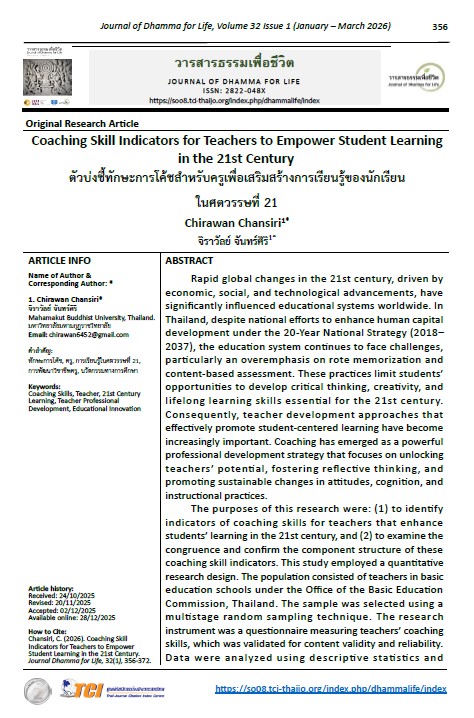
Rapid global changes in the 21st century, driven by economic, social, and technological advancements, have significantly influenced educational systems worldwide. In Thailand, despite national efforts to enhance human capital development under the 20-Year National Strategy (2018–2037), the education system continues to face challenges, particularly an overemphasis on rote memorization and content-based assessment. These practices limit students’ opportunities to develop critical thinking, creativity, and lifelong learning skills essential for the 21st century. Consequently, teacher development approaches that effectively promote student-centered learning have become increasingly important. Coaching has emerged as a powerful professional development strategy that focuses on unlocking teachers’ potential, fostering reflective thinking, and promoting sustainable changes in attitudes, cognition, and instructional practices.
The purposes of this research were: (1) to identify indicators of coaching skills for teachers that enhance students’ learning in the 21st century, and (2) to examine the congruence and confirm the component structure of these coaching skill indicators. This study employed a quantitative research design. The population consisted of teachers in basic education schools under the Office of the Basic Education Commission, Thailand. The sample was selected using a multistage random sampling technique. The research instrument was a questionnaire measuring teachers’ coaching skills, which was validated for content validity and reliability. Data were analyzed using descriptive statistics and confirmatory factor analysis to verify the construct validity and model fit. The findings revealed that the indicators of teachers’ coaching skills comprised multiple components that demonstrated good congruence with empirical data and met acceptable statistical criteria. The confirmed model indicates that coaching skills are a crucial factor in enhancing students’ learning and competencies required in the 21st century. The results of this study provide empirical evidence that can inform teacher professional development programs and support the improvement of instructional practices aligned with 21st-century educational goals.
Article Details
References
จุฑาทิพย์ หาญกุดตุ้ม, & คณะ. (2561). การตั้งคำถามเพื่อส่งเสริมการเรียนรู้และการคิดวิเคราะห์ของผู้เรียน. กรุงเทพฯ: สำนักพิมพ์มหาวิทยาลัย.
นงลักษณ์ วิรัชชัย. (2542). การวิจัยเชิงปริมาณ: วิธีการและเทคนิค (การวิจัยเชิงปริมาณ: วิธีการและเทคนิค.กรุงเทพฯ: สำนักพิมพ์มหาวิทยาลัย.
พระพรหมคุณาภรณ์ (ป.อ. ปยุตฺโต). (2557). การชี้แนะเพื่อพัฒนาตนเองและผู้อื่น. กรุงเทพฯ: โรงพิมพ์ธรรมสภา.
พระพรหมคุณาภรณ์ (ป.อ. ปยุตฺโต). (2563). ปัญญาและการศึกษา (112). กรุงเทพฯ: มูลนิธิพุทธธรรม.
สำนักงานบริการภาครัฐ Big Data จังหวัดสุราษฎร์ธานี. (2024). ข้อมูลจำนวนครูประถมศึกษา.
สำนักงานคณะกรรมการการศึกษาขั้นพื้นฐาน. (2566). แผนพัฒนาการศึกษาขั้นพื้นฐาน พ.ศ. 2566–2570. กรุงเทพฯ: กระทรวงศึกษาธิการ.
สำนักงานสภาพัฒนาการเศรษฐกิจและสังคมแห่งชาติ. (2563). ยุทธศาสตร์ชาติ 20 ปี (พ.ศ. 2561–2580). กรุงเทพฯ: สำนักนายกรัฐมนตรี.
สุภัทรา ภูษิตรัตนาวลี. (2560). การคิดวิเคราะห์และการตัดสินใจอย่างมีเหตุผล. กรุงเทพฯ: สำนักพิมพ์มหาวิทยาลัย.
วรภัทร์ ภู่เจริญ. (2565). ศิลปะแห่งการตั้งคำถาม: กระบวนการเรียนรู้สู่ปัญญา. กรุงเทพฯ: สำนักพิมพ์อมรินทร์.
Avalos, B. (2011). Teacher professional development in teaching and teacher education: A review of the literature. Teaching and Teacher Education, 27(1), 10–20. https://doi.org/10.1016/j.tate.2010.08.007
Bollan, B. (1980, cited in Nonglak Wiratchai, 2542). Sample size determination in relation to the number of parameters.
Bonwell, C. C., & Eison, J. A. (1991). Active learning: Creating excitement in the classroom. ASHE-ERIC Higher Education Report No. 1. Washington, DC: George Washington University.
Cooley, W. W., & Lohnes, P. R. (1971). Multivariate data analysis. New York: John Wiley & Sons.
Darling-Hammond, L., Hyler, M. E., & Gardner, M. (2020). Effective teacher professional development. Palo Alto, CA: Learning Policy Institute. https://learningpolicyinstitute.org/product/effective-teacher-professional-development-report
Dewey, J. (1938). Experience and education. New York: Macmillan.
Gold, A. (1980, cited in Nonglak Wiratchai, 2542). Guidelines for determining sample size in multivariate research.
Hook, H. (2014). Powerful questioning in education (73). London: Routledge.
Kennedy, A. (2016). How does professional development improve teaching? Review of Educational Research, 86(4), 945–980. https://doi.org/10.3102/0034654315626800
Kerlinger, F. N. (1986). Foundations of behavioral research (3rd ed.). New York: Holt, Rinehart and Winston.
Kim, J. O., & Mueller, C. W. (1978). Introduction to factor analysis: What it is and how to do it. Beverly Hills: Sage Publications.
Knight, J. (2007). Instructional coaching: A partnership approach to improving instruction. Corwin Press.
OECD. (2019). Teaching and learning in the 21st century: Preparing teachers and students for the future. Paris: OECD Publishing. https://doi.org/10.1787/9789264313873-en
Partnership for 21st Century Skills (P21). (2019). Framework for 21st century learning. Washington, DC: P21. https://www.battelleforkids.org/networks/p21
Peterson, D. B., & Hicks, M. D. (1996). Leader as coach: Strategies for coaching & developing others. Minneapolis, MN: Personnel Decisions International.
Piaget, J. (1972). The psychology of the child. New York, NY: Basic Books.
Plato. (1997). Socratic method and dialogues. New York: Oxford University Press.
Rogers, C. (1977). On personal power: Inner strength and its revolutionary impact. New York, NY: Delacorte Press.
Steven, J. (1996). Applied multivariate statistics for the social sciences (3rd ed.). Hillsdale, NJ: Lawrence Erlbaum Associates.
Trilling, B., & Fadel, C. (2009). 21st century skills: Learning for life in our times. San Francisco, CA: Jossey-Bass.
UNESCO. (2015). Rethinking education: Towards a global common good? Paris: UNESCO Publishing. https://unesdoc.unesco.org/ark:/48223/pf0000232555
UNESCO. (2018). Education 2030: Incheon Declaration and Framework for Action. Paris: UNESCO Publishing. https://unesdoc.unesco.org/ark:/48223/pf0000261444
Voogt, J., Fisser, P., Good, J., Mishra, P., & Yadav, A. (2015). Computational thinking in compulsory education: Towards an agenda for research and practice. Education and Information Technologies, 20(4), 715–728. https://doi.org/10.1007/s10639-015-9412-5
Vygotsky, L. S. (1978). Mind in society: The development of higher psychological processes. Cambridge, MA: Harvard University Press.
