
Synthesizing High-Performance Organization Components for Application in Local Government
Article Sidebar
Main Article Content
Abstract
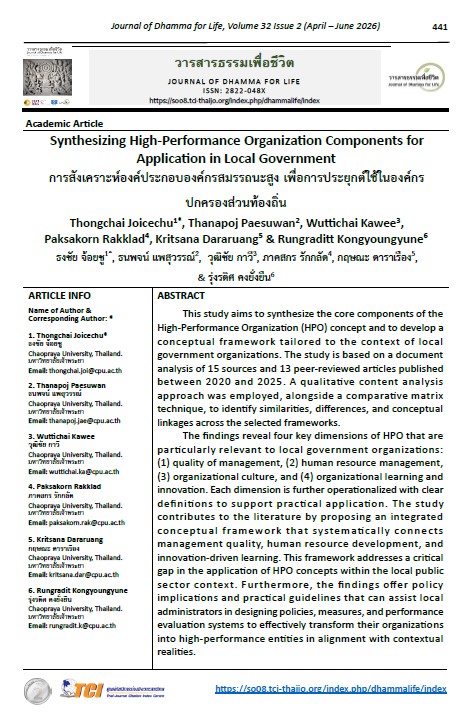
This study aims to synthesize the core components of the High-Performance Organization (HPO) concept and to develop a conceptual framework tailored to the context of local government organizations. The study is based on a document analysis of 15 sources and 13 peer-reviewed articles published between 2020 and 2025. A qualitative content analysis approach was employed, alongside a comparative matrix technique, to identify similarities, differences, and conceptual linkages across the selected frameworks.
The findings reveal four key dimensions of HPO that are particularly relevant to local government organizations: (1) quality of management, (2) human resource management, (3) organizational culture, and (4) organizational learning and innovation. Each dimension is further operationalized with clear definitions to support practical application. The study contributes to the literature by proposing an integrated conceptual framework that systematically connects management quality, human resource development, and innovation-driven learning. This framework addresses a critical gap in the application of HPO concepts within the local public sector context. Furthermore, the findings offer policy implications and practical guidelines that can assist local administrators in designing policies, measures, and performance evaluation systems to effectively transform their organizations into high-performance entities in alignment with contextual realities.
Article Details
References
อาจารี ฤทธิชัย, เฉลิมชัย กิตติศักดิ์นาวิน, โกสินทร์ เตชะนิยม, & อภิชาต กิตติศักดิ์นาวิน. (2563). การพัฒนาทรัพยากรมนุษย์เพื่อองค์กรสมรรถนะสูง. วารสารการบริหารรัฐกิจ, 15(2), 45–62.
ธันวา วาทิตต์พันธ์, & นุขนรา รัตนศิระประภา. (2564). ความเป็นมืออาชีพและการพัฒนาพนักงานในองค์กรสาธารณะ. วารสารบริหารธุรกิจและการจัดการ, 12(1), 77–91.
Adatsi, Y., Yamamoto, K., & Lloyd, S. (2020). Human resource practices in high performance public organizations. Public Management Review, 22(5), 693–712.
Asier, I. (2021). Employee engagement and team performance in high performance organizations. Journal of Organizational Psychology, 21(2), 55–70.
Beer, S. (1972). Brain of the firm: A development in management cybernetics. London: Herder and Herder.
Collins, J. (2001). Good to great: Why some companies make the leap… and others don’t. HarperCollins.
Combs, J. (2006). The role of employee perceptions in human resource management. Journal of Management, 32(6), 803–828.
Deming, W. E. (1982). Quality, productivity, and competitive position. MIT Press.
Do, N. T., & Mai, T. T. (2020). Organizational culture and high performance: Evidence from public sector agencies in Vietnam. Journal of Organizational Culture, Communications and Conflict, 24(2), 1–18.
de Waal, A. A. (2010). What makes a high-performance organization: Five valid factors of competitive advantage. Enfield: Global Professional Publishing.
de Waal, A. A. (2012). Strategic performance management: A managerial and behavioral approach. Palgrave Macmillan.
HPO Center. (n.d.). What is a high-performance organization? Retrieved March 19, 2026, from https://www.hpocenter.com
Holbeche, L. (2005). The high-performance organization: Creating dynamic stability and sustainable success. London: Butterworth-Heinemann.
Ipinazar, I., et al. (2021). Knowledge sharing, team self-management and innovation performance: Evidence from local governments. Public Management Review, 23(8), 1123–1145.
ICMA (International City/County Management Association). (2021). High-performance local government framework. Washington, DC: ICMA.
Karnsomdee, N. (2025). Leadership and policy experimentation for local government innovation: Case studies in Thailand. Asian Journal of Public Administration, 47(1), 45–67.
Kaplan, R. S., & Norton, D. P. (1992). The balanced scorecard: Measures that drive performance. Harvard Business Review, 70(1), 71–79.
Katz, D., & Kahn, R. L. (1966). The social psychology of organizations (2nd ed.). New York, NY: Wiley.
Khan, S., et al. (2024). Dynamic capabilities and organizational learning for continuous innovation. Journal of Business Research, 162, 113543.
Kotter, J., & Heskett, J. (1992). Corporate culture and performance. Free Press.
Mohammed, A., et al. (2022). Knowledge sharing and innovation in public organizations: A systematic review. International Journal of Public Sector Management, 35(5), 589–610.
Peters, T. J., & Waterman, R. H. (1982). In search of excellence: Lessons from America’s best-run companies. Harper & Row.
Remme, J., & de Waal, A. (2020). Governance and leadership for high performance organizations. International Journal of Productivity and Performance Management, 69(2), 215–231.
Remme, J., & de Waal, A. A. (2020). Organizational learning in public sector organizations: How culture drives innovation. Public Administration Review, 80(4), 645–659.
von Bertalanffy, L. (1968). General system theory: Foundations, development, applications. New York, NY: George Braziller.
Waal, A. (2010). Strategic performance management: Leveraging and measuring your intangible value drivers. Palgrave Macmillan.
Waal, A., & Julie, S. (2020). Leadership behaviors in high performance organizations. Journal of Leadership Studies, 14(3), 33–45.
Yadav, N., & de Waal, A. (2020). Ethics, integrity, and outcomes in high performance public organizations. Public Integrity, 22(4), 405–423.
Wiener, N. (1948). Cybernetics: Or control and communication in the animal and the machine. Cambridge, MA: MIT Press.
