การสังเคราะห์องค์ประกอบองค์กรสมรรถนะสูง เพื่อการประยุกต์ใช้ในองค์กรปกครองส่วนท้องถิ่น
Article Sidebar
Main Article Content
บทคัดย่อ
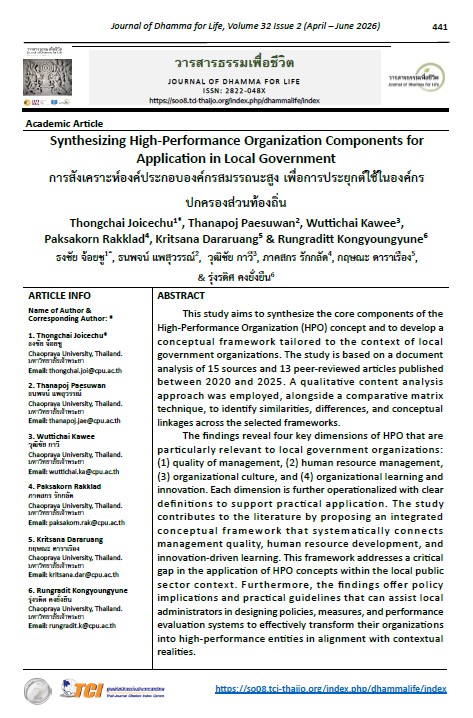
บทความวิจัยนี้มีวัตถุประสงค์เพื่อสังเคราะห์องค์ประกอบหลักของแนวคิดองค์กรสมรรถนะสูง (High Performance Organization: HPO) และพัฒนาเป็นกรอบแนวคิดที่เหมาะสมสำหรับบริบทองค์กรปกครองส่วนท้องถิ่น การศึกษานี้ใช้การวิเคราะห์เอกสารจากแหล่งข้อมูลรวม 15 แหล่ง และร่วมกับบทความวิชาการจำนวน 13 ชิ้นที่ตีพิมพ์ระหว่าง พ.ศ. 2020–2025 โดยใช้วิธีการวิเคราะห์เนื้อหาเชิงคุณภาพ (qualitative content analysis) และการจัดทำเมทริกซ์เปรียบเทียบเพื่อระบุความสอดคล้อง ความแตกต่าง และความเชื่อมโยงขององค์ประกอบเชิงแนวคิด
ผลการศึกษาพบว่า องค์ประกอบหลักขององค์กรสมรรถนะสูงที่สอดคล้องและเหมาะสมกับบริบทองค์กรปกครองส่วนท้องถิ่นประกอบด้วย 4 มิติ ได้แก่ (1) คุณภาพการบริหารองค์การ (2) การบริหารทรัพยากรมนุษย์ (3) วัฒนธรรมองค์การ และ (4) องค์การแห่งการเรียนรู้และนวัตกรรม โดยแต่ละมิติได้รับการนิยามเชิงปฏิบัติการอย่างชัดเจนเพื่อรองรับการนำไปใช้จริง องค์ความรู้ที่ได้จากการศึกษานี้คือการพัฒนากรอบแนวคิดเชิงบูรณาการของ HPO ที่เชื่อมโยงมิติด้านการบริหาร การพัฒนาทรัพยากรมนุษย์ และการขับเคลื่อนนวัตกรรมเข้าด้วยกันอย่างเป็นระบบ ซึ่งช่วยเติมเต็มช่องว่างทางวิชาการในการประยุกต์ใช้แนวคิด HPO ในภาครัฐระดับท้องถิ่น นอกจากนี้ ผลการศึกษายังนำไปสู่ข้อเสนอเชิงนโยบายและแนวทางเชิงปฏิบัติที่สามารถใช้เป็นเครื่องมือสำหรับผู้บริหารท้องถิ่นในการออกแบบนโยบาย มาตรการ และระบบการประเมินผล เพื่อยกระดับองค์กรสู่การเป็นองค์กรสมรรถนะสูงได้อย่างมีประสิทธิภาพและสอดคล้องกับบริบทเชิงพื้นที่
Article Details
เอกสารอ้างอิง
อาจารี ฤทธิชัย, เฉลิมชัย กิตติศักดิ์นาวิน, โกสินทร์ เตชะนิยม, & อภิชาต กิตติศักดิ์นาวิน. (2563). การพัฒนาทรัพยากรมนุษย์เพื่อองค์กรสมรรถนะสูง. วารสารการบริหารรัฐกิจ, 15(2), 45–62.
ธันวา วาทิตต์พันธ์, & นุขนรา รัตนศิระประภา. (2564). ความเป็นมืออาชีพและการพัฒนาพนักงานในองค์กรสาธารณะ. วารสารบริหารธุรกิจและการจัดการ, 12(1), 77–91.
Adatsi, Y., Yamamoto, K., & Lloyd, S. (2020). Human resource practices in high performance public organizations. Public Management Review, 22(5), 693–712.
Asier, I. (2021). Employee engagement and team performance in high performance organizations. Journal of Organizational Psychology, 21(2), 55–70.
Beer, S. (1972). Brain of the firm: A development in management cybernetics. London: Herder and Herder.
Collins, J. (2001). Good to great: Why some companies make the leap… and others don’t. HarperCollins.
Combs, J. (2006). The role of employee perceptions in human resource management. Journal of Management, 32(6), 803–828.
Deming, W. E. (1982). Quality, productivity, and competitive position. MIT Press.
Do, N. T., & Mai, T. T. (2020). Organizational culture and high performance: Evidence from public sector agencies in Vietnam. Journal of Organizational Culture, Communications and Conflict, 24(2), 1–18.
de Waal, A. A. (2010). What makes a high-performance organization: Five valid factors of competitive advantage. Enfield: Global Professional Publishing.
de Waal, A. A. (2012). Strategic performance management: A managerial and behavioral approach. Palgrave Macmillan.
HPO Center. (n.d.). What is a high-performance organization? Retrieved March 19, 2026, from https://www.hpocenter.com
Holbeche, L. (2005). The high-performance organization: Creating dynamic stability and sustainable success. London: Butterworth-Heinemann.
Ipinazar, I., et al. (2021). Knowledge sharing, team self-management and innovation performance: Evidence from local governments. Public Management Review, 23(8), 1123–1145.
ICMA (International City/County Management Association). (2021). High-performance local government framework. Washington, DC: ICMA.
Karnsomdee, N. (2025). Leadership and policy experimentation for local government innovation: Case studies in Thailand. Asian Journal of Public Administration, 47(1), 45–67.
Kaplan, R. S., & Norton, D. P. (1992). The balanced scorecard: Measures that drive performance. Harvard Business Review, 70(1), 71–79.
Katz, D., & Kahn, R. L. (1966). The social psychology of organizations (2nd ed.). New York, NY: Wiley.
Khan, S., et al. (2024). Dynamic capabilities and organizational learning for continuous innovation. Journal of Business Research, 162, 113543.
Kotter, J., & Heskett, J. (1992). Corporate culture and performance. Free Press.
Mohammed, A., et al. (2022). Knowledge sharing and innovation in public organizations: A systematic review. International Journal of Public Sector Management, 35(5), 589–610.
Peters, T. J., & Waterman, R. H. (1982). In search of excellence: Lessons from America’s best-run companies. Harper & Row.
Remme, J., & de Waal, A. (2020). Governance and leadership for high performance organizations. International Journal of Productivity and Performance Management, 69(2), 215–231.
Remme, J., & de Waal, A. A. (2020). Organizational learning in public sector organizations: How culture drives innovation. Public Administration Review, 80(4), 645–659.
von Bertalanffy, L. (1968). General system theory: Foundations, development, applications. New York, NY: George Braziller.
Waal, A. (2010). Strategic performance management: Leveraging and measuring your intangible value drivers. Palgrave Macmillan.
Waal, A., & Julie, S. (2020). Leadership behaviors in high performance organizations. Journal of Leadership Studies, 14(3), 33–45.
Yadav, N., & de Waal, A. (2020). Ethics, integrity, and outcomes in high performance public organizations. Public Integrity, 22(4), 405–423.
Wiener, N. (1948). Cybernetics: Or control and communication in the animal and the machine. Cambridge, MA: MIT Press.
