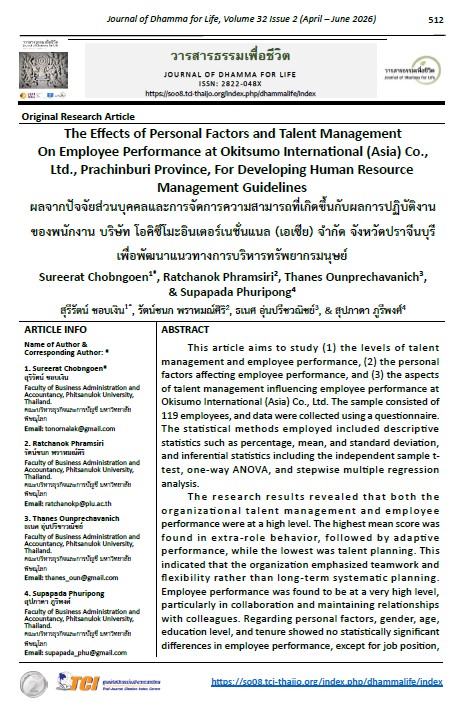
The Effects of Personal Factors and Talent Management On Employee Performance at Okitsumo International (Asia) Co., Ltd., Prachinburi Province, For Developing Human Resource Management Guidelines
Article Sidebar
Main Article Content
Abstract
This article aims to study (1) the levels of talent management and employee performance, (2) the personal factors affecting employee performance, and (3) the aspects of talent management influencing employee performance at Okisumo International (Asia) Co., Ltd. The sample consisted of 119 employees, and data were collected using a questionnaire. The statistical methods employed included descriptive statistics such as percentage, mean, and standard deviation, and inferential statistics including the independent sample t-test, one-way ANOVA, and stepwise multiple regression analysis.
The research results revealed that both the organizational talent management and employee performance were at a high level. The highest mean score was found in extra-role behavior, followed by adaptive performance, while the lowest was talent planning. This indicated that the organization emphasized teamwork and flexibility rather than long-term systematic planning. Employee performance was found to be at a very high level, particularly in collaboration and maintaining relationships with colleagues. Regarding personal factors, gender, age, education level, and tenure showed no statistically significant differences in employee performance, except for job position, which did have a significant difference. Employees in managerial positions demonstrated higher performance than operational employees, reflecting the importance of roles and responsibilities.The variables of talent management that significantly influenced employee performance were retention and motivation (Beta = 0.556) and talent planning (Beta = 0.251) at the 0.01 significance level. These findings indicate that maintaining employee motivation and systematically planning talent development are key factors in enhancing employee performance, while recruitment and training/development have not yet shown a direct impact.
Article Details
References
บุญชม ศรีสะอาด. (2545). การวิจัยเบื้องต้น (พิมพ์ครั้งที่ 7). กรุงเทพมหานคร: สุวีริยาสาส์น.
ศุภกานต์ ภูวพัฒน์. (2561). ความสัมพันธ์ระหว่างปัจจัยส่วนบุคคลกับผลการปฏิบัติงานของพนักงานโรงงานอุตสาหกรรม. วารสารวิจัยธุรกิจและสังคม, 16(3), 112–124.
สุนันทา ภู่วโรดม. (2563). การจัดการความสามารถของพนักงานในองค์กรอุตสาหกรรม. วารสารการจัดการและพัฒนาทรัพยากรมนุษย์, 7(2), 45–58.
วรรณี รัตนพงษ์. (2564). การจัดการความสามารถของพนักงานในอุตสาหกรรมการผลิต: กรณีศึกษาเขตภาคตะวันออก. วารสารบริหารธุรกิจและเศรษฐศาสตร์, 9(1), 33–49.
วรัญญา พิศนุรักษ์. (2562). ปัจจัยส่วนบุคคลที่มีผลต่อผลการปฏิบัติงานของพนักงานในอุตสาหกรรมการผลิต. วารสารวิชาการมหาวิทยาลัยราชภัฏบ้านสมเด็จเจ้าพระยา, 14(27), 65–77.
Aguinis, H. (2019). Performance management (4th ed.). Chicago, IL: Chicago Business Press.
Collings, D. G., & Mellahi, K. (2009). Strategic talent management: A review and research agenda. Human Resource Management Review, 19(4), 304–313. https://doi.org/ 10.1016/j.hrmr.2009.04.001
Creswell, J. W., & Creswell, J. D. (2018). Research design: Qualitative, quantitative, and mixed methods approach (5th ed.). Thousand Oaks, CA: Sage Publications.
Hair, J. F. Jr., Black, W. C., Babin, B. J., & Anderson, R. E. (2019). Multivariate data analysis (8th ed.). Cengage Learning.
Herzberg, F. (1959). The motivation to work. New York, NY: John Wiley & Sons.
Katzenbach, J. R., & Smith, D. K. (1993). The wisdom of teams: Creating the high-performance organization. Boston, MA: Harvard Business School Press.
Kerlinger, F. N., & Lee, H. B. (2000). Foundations of behavioral research (4th ed.). Fort Worth, TX: Harcourt College Publishers.
Nunnally, J. C. (1978). Psychometric theory (2nd ed.). New York, NY: McGraw-Hill.
Nuwongsri, S., & Nawakitphaitoon, K. (2021). The impact of performance management systems on employee job satisfaction and performance in Thai organizations. Journal of Business and Management Studies, 9(2), 45–60.
Pulakos, E. D., Arad, S., Donovan, M. A., & Plamondon, K. E. (2000). Adaptability in the workplace: Development of a taxonomy of adaptive performance. Journal of Applied Psychology, 85(4), 612–624. https://doi.org/10.1037/0021-9010.85.4.612
Rattanan, S. (2017). Human resource competency management and its effects on employee performance: Evidence from Thailand. Asian Journal of Human Resource Management, 5(2), 75–90.
Robbins, S. P. (2003). Organizational behavior (10th ed.). Upper Saddle River, NJ: Prentice Hall.
Roopsuwankun, P. (2019). Personal factors influencing employee performance in Thai manufacturing firms. Thai Journal of Management Research, 8(1), 12–25.
Saha, S., Banerjee, A., & Singh, P. (2021). Knowledge management practices and employee performance: Empirical evidence from Asian manufacturing. Knowledge and Process Management, 28(3), 210–222. https://doi.org/10.1002/kpm.1675
Schwab, K. (2017). The fourth industrial revolution. Geneva, Switzerland: World Economic Forum.
Srisook, K., & Pasunon, S. (2025). Strategic human resource management and employee performance in Thai industries. Thai Journal of Organizational Studies, 12(1), 101–120.
Srisunthorn, P. (2022). Knowledge management and organizational performance: Insights from Thai SMEs. Journal of Knowledge Management Practice, 13(2), 34–50.
Stahl, G. K., Björkman, I., Farndale, E., Morris, S., Paauwe, J., Stiles, P., ... & Wright, P. (2012). Six principles of effective global talent management. Sloan Management Review, 53(2), 25–32.
