
Service Quality Influences the Image of the Spa Business in Phuket Province
Article Sidebar
Main Article Content
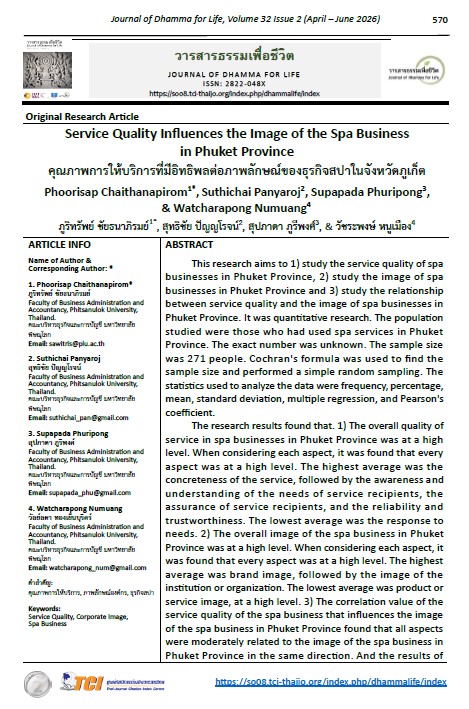
Abstract
This research aims to 1) study the service quality of spa businesses in Phuket Province, 2) study the image of spa businesses in Phuket Province and 3) study the relationship between service quality and the image of spa businesses in Phuket Province. It was quantitative research. The population studied were those who had used spa services in Phuket Province. The exact number was unknown. The sample size was 271 people. Cochran's formula was used to find the sample size and performed a simple random sampling. The statistics used to analyze the data were frequency, percentage, mean, standard deviation, multiple regression, and Pearson's coefficient.
The research results found that. 1) The overall quality of service in spa businesses in Phuket Province was at a high level. When considering each aspect, it was found that every aspect was at a high level. The highest average was the concreteness of the service, followed by the awareness and understanding of the needs of service recipients, the assurance of service recipients, and the reliability and trustworthiness. The lowest average was the response to needs. 2) The overall image of the spa business in Phuket Province was at a high level. When considering each aspect, it was found that every aspect was at a high level. The highest average was brand image, followed by the image of the institution or organization. The lowest average was product or service image, at a high level. 3) The correlation value of the service quality of the spa business that influences the image of the spa business in Phuket Province found that all aspects were moderately related to the image of the spa business in Phuket Province in the same direction. And the results of testing the hypothesis that the service quality of the spa business in Phuket Province had a positive influence on the image of the spa business in Phuket Province found that all hypotheses were consistent.
Article Details
References
กรมสนับสนุนบริการสุขภาพ, กระทรวงสาธารณสุข. (2567). รายงานสถานประกอบการเพื่อสุขภาพในประเทศไทย ณ เดือนตุลาคม 2567. กรุงเทพฯ: กระทรวงสาธารณสุข.
ชูศรี วงศ์รัตนะ. (2560). สถิติการวิจัยเชิงปริมาณสำหรับนักศึกษาและนักวิจัย. กรุงเทพฯ: สำนักพิมพ์มหาวิทยาลัยรามคำแหง.
จันติยา เพชรมาลา. (2565). อิทธิพลของปัจจัยประชากรศาสตร์ต่อการตัดสินใจใช้บริการสปาของคนวัยทำงาน: กรณีศึกษากรุงเทพมหานครและปริมณฑล. วารสารพฤติกรรมศาสตร์เพื่อการบริหาร, 12(1), 23–39.
สุทธิสินี ถิระธรรมสรณ์, น., & คณะ. (2561). การศึกษาคุณภาพการบริการและภาพลักษณ์ของธุรกิจสปาในประเทศไทย. วารสารวิจัยทางการบริหารธุรกิจ, 15(2), 45–62.
ธานินทร์ ศิลป์จารุ. (2549). การวิจัยเชิงปริมาณ: การประยุกต์ใช้มาตราส่วนการวัดแบบลิเคิร์ต (Likert Scale). กรุงเทพฯ: สำนักพิมพ์จุฬาลงกรณ์มหาวิทยาลัย.
อัครพงศ์ อันทอง. (2557) การพัฒนาธุรกิจสปาไทยในตลาดต่างประเทศ. กรุงเทพฯ: สำนักพิมพ์มหาวิทยาลัย.
Aduly, J. (2016). Concepts and Strategies for Creating Customer Experience in the Service Business. Bangkok: University Press.
Phongsak, P. (2019). Service Quality and Image of Hotel Businesses in Thailand. Bangkok: University Press.
Sirivan, S. (2017). Service Quality Management in Thai Service Businesses: Guidelines for Creating a Competitive Advantage. Bangkok: University Press.
Supatra, S. (2018). Corporate Image and its Impact on Customer Trust in Thai Service Businesses. Bangkok: University Press.
Wannee, S. (2020). The Relationship Between Service Quality and Corporate Image in the Spa Business. Bangkok: University Press.
Cochran, W. G. (1977). Sampling techniques (3rd ed.). New York: John Wiley & Sons.
Kandampully, J., Zhang, T., & Jaakkola, E. (2015). Customer experience management in hospitality: A literature synthesis, new understanding and research agenda. International Journal of Contemporary Hospitality Management, 27(6), 1154–1181. https://doi.org/10. 1108/IJCHM-09-2014-0452
Kotler, P. (2000). Marketing management (10th ed.). Upper Saddle River, NJ: Prentice Hall.
Kotler, P., & Keller, K. L. (2016). Marketing management (15th ed.). Pearson.
Lai, F., Griffin, M., & Babin, B. (2009). How quality service creates customer loyalty? International Journal of Service Industry Management, 20(1), 14–31. https://doi.org/ 10.1108/09564230910938364
Nguyen, N., & Leblanc, G. (2001). Corporate image and corporate reputation in customers’ retention decisions in services. Journal of Retailing and Consumer Services, 8(4), 227–236. https://doi.org/10.1016/S0969-6989(00)00032-0
Parasuraman, A., Zeithaml, V. A., & Berry, L. L. (1988). SERVQUAL: A multiple-item scale for measuring consumer perceptions of service quality. Journal of Retailing, 64(1), 12–40.
Varadarajan, R., & Zeithaml, V. A. (1996). Services marketing and corporate image. Journal of Marketing, 60(4), 20–35.
