Buddhist Ethics and Peaceful Coexistence in a Multi-Religious Society
Article Sidebar
Main Article Content
Abstract
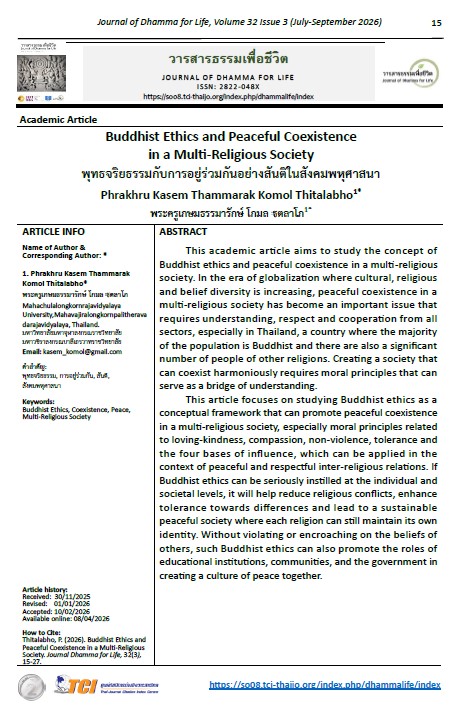
This academic article aims to study the concept of Buddhist ethics and peaceful coexistence in a multi-religious society. In the era of globalization where cultural, religious and belief diversity is increasing, peaceful coexistence in a multi-religious society has become an important issue that requires understanding, respect and cooperation from all sectors, especially in Thailand, a country where the majority of the population is Buddhist and there are also a significant number of people of other religions. Creating a society that can coexist harmoniously requires moral principles that can serve as a bridge of understanding.
This article focuses on studying Buddhist ethics as a conceptual framework that can promote peaceful coexistence in a multi-religious society, especially moral principles related to loving-kindness, compassion, non-violence, tolerance and the four bases of influence, which can be applied in the context of peaceful and respectful inter-religious relations. If Buddhist ethics can be seriously instilled at the individual and societal levels, it will help reduce religious conflicts, enhance tolerance towards differences and lead to a sustainable peaceful society where each religion can still maintain its own identity. Without violating or encroaching on the beliefs of others, such Buddhist ethics can also promote the roles of educational institutions, communities, and the government in creating a culture of peace together.
Article Details
References
บัญญัติ จันทร์เสนา. (2552). การพัฒนาจริยธรรมในสังคมพหุวัฒนธรรม. กรุงเทพมหานคร: สำนักพิมพ์มหาวิทยาลัย.
บุญรักษ์ บุญญะเขตมาลา. (2558). จริยธรรมกับการให้อภัยในสังคมร่วมสมัย. กรุงเทพมหานคร: สำนักพิมพ์แห่งจุฬาลงกรณ์มหาวิทยาลัย.
พระธรรมกิตติวงศ์ (ทองดี สุรเตโช). (2541). พุทธจริยธรรมเพื่อการดำเนินชีวิต. กรุงเทพมหานคร: ธรรมสภา.
พระธรรมปิฎก (ป.อ. ปยุตฺโต). (2526). พุทธจริยธรรมและการอยู่ร่วมกันในสังคมพหุศาสนา. กรุงเทพฯ: มหามกุฏราชวิทยาลัย.
พระธรรมปิฎก (ป.อ. ปยุตฺโต). (2538). จริยธรรมเพื่อความเจริญ. กรุงเทพฯ: มหามกุฏราชวิทยาลัย.
พระพุทธโฆษาจารย์ (ป.อ. ปยุตฺโต). (2557). จริยธรรมขั้นพื้นฐานในพระพุทธศาสนา. กรุงเทพฯ: มหามกุฏราชวิทยาลัย.
พระพรหมคุณาภรณ์ (ป.อ. ปยุตฺโต). (2551). พุทธจริยธรรม: ศีล สมาธิ และปัญญา. กรุงเทพฯ: มหามกุฏราชวิทยาลัย.
สมศักดิ์ ศรีสันติสุข. (2566). การเสริมพลังชุมชนและการพัฒนาสังคมอย่างยั่งยืน. กรุงเทพมหานคร: สำนักพิมพ์มหาวิทยาลัยธรรมศาสตร์.
สมเด็จพระพุทธโฆษาจารย์ (ป.อ. ปยุตฺโต). (2545). อหิงสาและการไม่เบียดเบียน. กรุงเทพฯ: มหามกุฏราชวิทยาลัย.
สำนักงานคณะกรรมการพัฒนาสังคมและความมั่นคงของมนุษย์. (2562). นโยบายและแผนพัฒนาสังคมแห่งชาติ. กรุงเทพมหานคร: กระทรวงการพัฒนาสังคมและความมั่นคงของมนุษย์.
ทิศนา แขมณี. (2544). หลักธรรมเพื่อการพัฒนาตนเอง: จริยธรรมส่วนบุคคล. กรุงเทพฯ: สำนักพิมพ์มหาวิทยาลัย.
Apichai Puntasen. (2007). Education for peace and multicultural understanding in Thailand. Bangkok: Chulalongkorn University Press.
Chaiwat Satha-Anand. (2002). Religion, pluralism, and social harmony in Thailand. Bangkok: Silpakorn University Press.
Phra Brahmagunabhorn [P. A. Payutto]. (2016). Understanding religious diversity in contemporary society. Bangkok: Mahachulalongkornrajavidyalaya University Press.
Phra Dhammapitaka [P. A. Payutto]. (2012). Buddhist ethics and social harmony. Bangkok: Mahachulalongkornrajavidyalaya University Press.
Sulak Sivaraksa. (2005). Buddhism and peacebuilding: Moral principles for social transforma tion. Bangkok: Sathirakoses-Nagapradipa Foundation.
