An Analysis of the Law of Karma and Its Effects on the Understanding of Violence in the Perspective of Buddhism
Article Sidebar
Main Article Content
Abstract
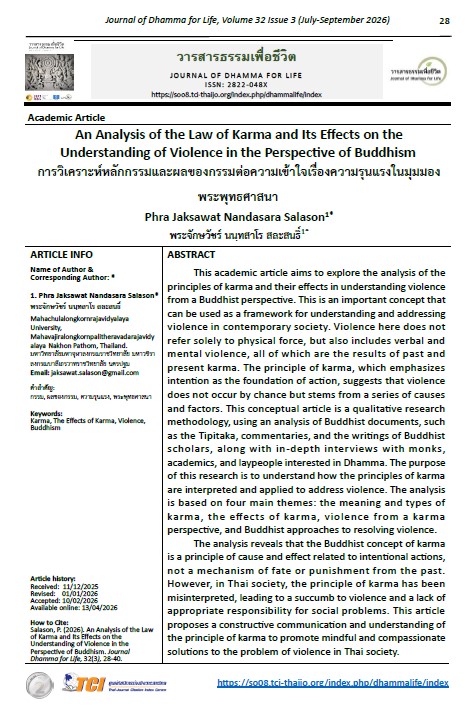
This academic article aims to explore the analysis of the principles of karma and their effects in understanding violence from a Buddhist perspective. This is an important concept that can be used as a framework for understanding and addressing violence in contemporary society. Violence here does not refer solely to physical force, but also includes verbal and mental violence, all of which are the results of past and present karma. The principle of karma, which emphasizes intention as the foundation of action, suggests that violence does not occur by chance but stems from a series of causes and factors. This conceptual article is a qualitative research methodology, using an analysis of Buddhist documents, such as the Tipitaka, commentaries, and the writings of Buddhist scholars, along with in-depth interviews with monks, academics, and laypeople interested in Dhamma. The purpose of this research is to understand how the principles of karma are interpreted and applied to address violence. The analysis is based on four main themes: the meaning and types of karma, the effects of karma, violence from a karma perspective, and Buddhist approaches to resolving violence.
The analysis reveals that the Buddhist concept of karma is a principle of cause and effect related to intentional actions, not a mechanism of fate or punishment from the past. However, in Thai society, the principle of karma has been misinterpreted, leading to a succumb to violence and a lack of appropriate responsibility for social problems. This article proposes a constructive communication and understanding of the principle of karma to promote mindful and compassionate solutions to the problem of violence in Thai society.
Article Details
References
พระอินทรีย์ อตฺถยุตฺโต. (2011). “การศึกษาเรื่องวิบากในพุทธศาสนาเถรวาท”. วิทยานิพนธ์พุทธศาสตรมหาบัณฑิต. บัณฑิตวิทยาลัย: มหาวิทยาลัยมหาจุฬาลงกรณราชวิทยาลัย.
พระเทพกิตติปัญญาคุณ (กิตติวุฑฺโฒ ภิกขุ). (2014). กรรม-และการให้ผลของกรรม, พิมพ์ครั้งที่ 4. กรุงเทพมหานคร: โรงพิมพ์สหธรรมิก.
พระเทพเวที (ประยุทธ์ ปยุตฺโต). (1993). พุทธวิธีแก้ปัญหาเพื่อศตวรรษที่ 21. กรุงเทพมหานคร:บริษัท สหธรรมิก จำกัด.
พระพรหมคุณาภรณ์ (ป.อ. ปยุตฺโต). (2546). พจนานุกรมพุทธศาสตร์ ฉบับประมวลธรรม. กรุงเทพฯ: สำนักพิมพ์ผลิธัมม์.
พระพรหมคุณาภรณ์ (ป.อ. ปยุตฺโต). (2548). พุทธธรรม (ฉบับปรับขยาย). กรุงเทพฯ: โรงพิมพ์มหาจุฬาลงกรณราชวิทยาลัย.
พระพรหมคุณาภรณ์ (ป.อ. ปยุตฺโต). (2551). พุทธธรรม (ฉบับปรับขยาย). กรุงเทพฯ: สำนักพิมพ์ผลิธัมม์.
พระพรหมคุณาภรณ์ (ป.อ. ปยุตฺโต). (2555). พุทธธรรม ฉบับปรับขยาย. กรุงเทพฯ: โรงพิมพ์พระพุทธศาสนาแห่งชาติ.
พระพรหมโมลี. (2002). กรรมทีปนี. กรุงเทพมหานคร: สำนักพิมพ์ดอกหญ้า.
พุทธทาสภิกขุ. (2548). คู่มือมนุษย์. สุราษฎร์ธานี: ธรรมทานมูลนิธิ ไชยา.
มหาจุฬาลงกรณราชวิทยาลัย. (2539). พระไตรปิฎกภาษาไทย ฉบับมหาจุฬาลงกรณราชวิทยาลัย. กรุงเทพฯ: มหาจุฬาลงกรณราชวิทยาลัย.
มหาจุฬาลงกรณราชวิทยาลัย. (2556). พระไตรปิฎก ฉบับภาษาไทย. กรุงเทพฯ: โรงพิมพ์มหาจุฬาลงกรณราชวิทยาลัย.
Bodhi, Bhikkhu. (2012). The Numerical Discourses of the Buddha: A Translation of the Aṅguttara Nikāya. Boston: Wisdom Publications.
Bourdieu, P. (1991). Language and symbolic power. Cambridge: Polity Press.
Galtung, J. (1969). Violence, peace, and peace research. Journal of Peace Research, 6(3), 167–191. https://doi.org/10.1177/002234336900600301
Galtung, J. (1990). Cultural violence. Journal of Peace Research, 27(3), 291–305. https://doi.org/ 10.1177/0022343390027003005
Gethin, R. (1998). The foundations of Buddhism. Oxford: Oxford University Press.
Harvey, P. (2013). An introduction to Buddhism: Teachings, history and practices (2nd ed.). Cambridge: Cambridge University Press.
Keown, D. (2013). Buddhism: A very short introduction. Oxford: Oxford University Press.
United Nations Office on Drugs and Crime (UNODC). (n.d.). Violence prevention. https://www. unodc.org
