The Vipassana Practice According to the Principle of Kāyānupassanāsatipaṭṭhāna
Article Sidebar
Main Article Content
Abstract
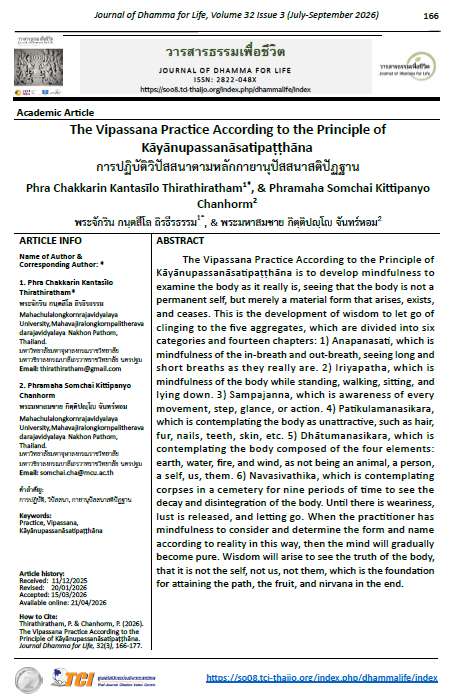
The Vipassana Practice According to the Principle of Kāyānupassanāsatipaṭṭhāna is to develop mindfulness to examine the body as it really is, seeing that the body is not a permanent self, but merely a material form that arises, exists, and ceases. This is the development of wisdom to let go of clinging to the five aggregates, which are divided into six categories and fourteen chapters: 1) Anapanasati, which is mindfulness of the in-breath and out-breath, seeing long and short breaths as they really are. 2) Iriyapatha, which is mindfulness of the body while standing, walking, sitting, and lying down. 3) Sampajanna, which is awareness of every movement, step, glance, or action. 4) Patikulamanasikara, which is contemplating the body as unattractive, such as hair, fur, nails, teeth, skin, etc. 5) Dhātumanasikara, which is contemplating the body composed of the four elements: earth, water, fire, and wind, as not being an animal, a person, a self, us, them. 6) Navasivathika, which is contemplating corpses in a cemetery for nine periods of time to see the decay and disintegration of the body. Until there is weariness, lust is released, and letting go. When the practitioner has mindfulness to consider and determine the form and name according to reality in this way, then the mind will gradually become pure. Wisdom will arise to see the truth of the body, that it is not the self, not us, not them, which is the foundation for attaining the path, the fruit, and nirvana in the end.
Article Details
References
พระครูภาวนาสังวรกิจ. (2558). การปฏิบัติวิปัสสนากรรมฐานตามแนวสติปัฏฐาน. กรุงเทพมหานคร: มหาจุฬาลงกรณราชวิทยาลัย.
พระไตรปิฎกภาษาไทย ฉบับมหาจุฬาลงกรณราชวิทยาลัย. (2539). เล่มที่ 10 มหาสติปัฏฐานสูตร. กรุงเทพมหานคร: มหาวิทยาลัยมหาจุฬาลงกรณราชวิทยาลัย.
พระธรรมปิฎก (ป.อ. ปยุตฺโต). (2543). แนวทางการเจริญวิปัสสนา. กรุงเทพมหานคร: สำนักพิมพ์ธรรมสภา.
พระพรหมคุณาภรณ์ (ป.อ. ปยุตฺโต). (2556). พุทธธรรม ฉบับปรับปรุงและขยายความ. กรุงเทพมหานคร: มูลนิธิพุทธธรรม.
พระภาวนาพิศาลเมธี. (2562). แนวทางการเจริญสติปัฏฐาน 4. กรุงเทพมหานคร: โรงพิมพ์มหาจุฬาลงกรณราชวิทยาลัย.
พระมหาอนุชน สาสนกิตฺติ. (2555). การศึกษากายานุปัสสนาสติปัฏฐาน. กรุงเทพมหานคร: มหามกุฏราชวิทยาลัย.
พระสมุห์มานัส อคฺคปญฺโญ. (2565). การพัฒนาปัญญาด้วยกายานุปัสสนาสติปัฏฐาน. กรุงเทพมหานคร: สำนักพิมพ์มหาวิทยาลัยสงฆ์.
พระโสภณมหาเถระ (มหาสีสยาดอ). (2549). มหาสติปัฏฐานสูตร ทางสู่พระนิพพาน. กรุงเทพมหานคร: สำนักพิมพ์ที่เกี่ยวข้อง.
มหาจุฬาลงกรณราชวิทยาลัย. (2539). พระไตรปิฎกภาษาไทย ฉบับมหาจุฬาลงกรณราชวิทยาลัย (เล่มที่ 10). กรุงเทพมหานคร: มหาจุฬาลงกรณราชวิทยาลัย.
วรรณสิทธิ์ ไวทยะเสวี. (2553). สติปัฏฐาน 4 และการปฏิบัติวิปัสสนากรรมฐาน. กรุงเทพฯ: ไม่ปรากฏสำนักพิมพ์.
สมเด็จพระพุทธโฆษาจารย์ (ป.อ. ปยุตฺโต). (2560). พุทธธรรม (ฉบับปรับปรุงและขยายความ). กรุงเทพมหานคร: ผลิธัมม์.
สยาดอภัททันตวิโรจนะ. (2556). มหาสติปัฏฐานสูตร (คำอธิบาย). กรุงเทพมหานคร: สำนักพิมพ์ธรรมสภา.
Mahachulalongkornrajavidyalaya University. (1996). Tipitaka: Mahasatipatthana Sutta (Vol. 10). Bangkok: MCU Press.
Mahasi Sayadaw. (2006). The Satipatthana Vipassana Meditation. Bangkok: Buddhist Publication.
Payutto, P. A. (2013). Buddhadhamma: Expanded Edition. Bangkok: Buddhadhamma Foundation.
