Dhamma for the Sick
Article Sidebar
Main Article Content
Abstract
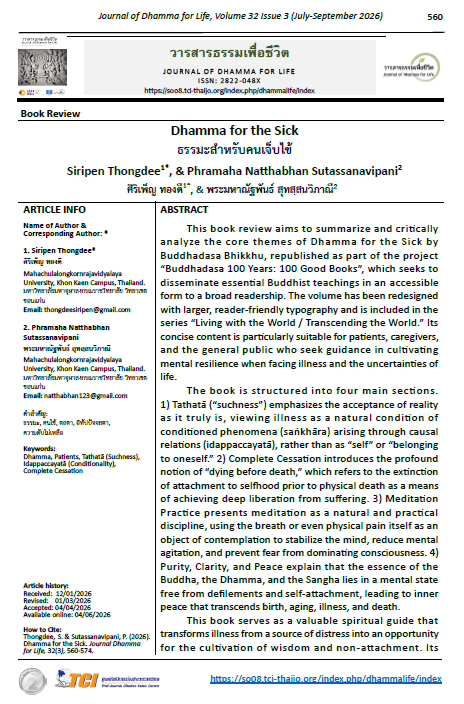
This book review aims to summarize and critically analyze the core themes of Dhamma for the Sick by Buddhadasa Bhikkhu, republished as part of the project “Buddhadasa 100 Years: 100 Good Books”, which seeks to disseminate essential Buddhist teachings in an accessible form to a broad readership. The volume has been redesigned with larger, reader-friendly typography and is included in the series “Living with the World / Transcending the World.” Its concise content is particularly suitable for patients, caregivers, and the general public who seek guidance in cultivating mental resilience when facing illness and the uncertainties of life.
The book is structured into four main sections. 1) Tathatā (“suchness”) emphasizes the acceptance of reality as it truly is, viewing illness as a natural condition of conditioned phenomena (saṅkhāra) arising through causal relations (idappaccayatā), rather than as “self” or “belonging to oneself.” 2) Complete Cessation introduces the profound notion of “dying before death,” which refers to the extinction of attachment to selfhood prior to physical death as a means of achieving deep liberation from suffering. 3) Meditation Practice presents meditation as a natural and practical discipline, using the breath or even physical pain itself as an object of contemplation to stabilize the mind, reduce mental agitation, and prevent fear from dominating consciousness. 4) Purity, Clarity, and Peace explain that the essence of the Buddha, the Dhamma, and the Sangha lies in a mental state free from defilements and self-attachment, leading to inner peace that transcends birth, aging, illness, and death.
This book serves as a valuable spiritual guide that transforms illness from a source of distress into an opportunity for the cultivation of wisdom and non-attachment. Its strengths lie in its concise language and vivid analogies, while its main limitation is the use of certain Buddhist technical terms that may be challenging for beginners. Therefore, it is recommended that readers engage with this work alongside introductory Buddhist texts to gain a more comprehensive understanding.
Article Details
References
กรมศาสนา. (2548). พุทธทาสภิกขุ บุคคลสำคัญของโลก. กรุงเทพฯ: กระทรวงวัฒนธรรม.
คณะอนุกรรมการฝ่ายหนังสืออนุสรณ์ 100 ปี ชาตกาล พุทธทาสภิกขุ. (2549). พุทธทาสยังอยู่ไปไม่มีตาย (เล่ม 3). กรุงเทพมหานคร: คณะกรรมการอำนวยการจัดงาน 100 ปี ชาตกาล พุทธทาสภิกขุ.
พระธรรมปิฎก (ป. อ. ปยุตฺโต). (2546). พจนานุกรมพุทธศาสตร์ ฉบับประมวลธรรม (พิมพ์ครั้งที่ 12). มหาจุฬาลงกรณราชวิทยาลัย.
พระพรหมคุณาภรณ์ (ป.อ. ปยุตฺโต). (2554). พุทธวิธีในการดับทุกข์. กรุงเทพมหานคร: ธรรมสภา.
พระพรหมคุณาภรณ์ (ป.อ. ปยุตฺโต). (2558).พจนานุกรมพุทธศาสน์ ฉบับประมวลธรรม. กรุงเทพมหานคร: มหาจุฬาลงกรณราชวิทยาลัย.
พระพรหมคุณาภรณ์ (ป. อ. ปยุตฺโต). (2560). พุทธธรรม: กฎธรรมชาติและคุณค่าของชีวิต. กรุงเทพฯ: มูลนิธิพุทธธรรม.
พระพุทธโฆษาจารย์. (2546). วิสุทธิมรรค (พระพุทธโฆษาจารย์ (ป. อ. ปยุตฺโต), ผู้แปล). กรุงเทพฯ: มหามกุฏราชวิทยาลัย
พระโพธิญาณเถร (ชา สุภัทโท). (2549). หยดน้ำที่เย็นฉ่ำ. กรุงเทพมหานคร: อมรินทร์ธรรมะ.
พระศักดิธัช สํวโร, และ สมหวัง แก้วสุฟอง. (2562). การดูแลผู้ป่วยระยะสุดท้ายเชิงพุทธบูรณาการ. วารสาร มหาจุฬาฯ วิทยาเขตแพร่, 14(1), 1–15.
พุทธทาสภิกขุ. (2508). แก่นพุทธศาสน์. กรุงเทพมหานคร: สุขภาพใจ.
พุทธทาสภิกขุ. (2546). ประวัติและผลงานพุทธทาสภิกขุ. กรุงเทพมหานคร: สำนักพิมพ์สุขภาพใจ.
พุทธทาสภิกขุ. (2566). ธรรมะสำหรับคนเจ็บไข้. กรุงเทพมหานคร: สำนักพิมพ์สุขภาพใจ.
มหาวิทยาลัยมหาจุฬาลงกรณราชวิทยาลัย. (2539). พระไตรปิฎกภาษาไทย ฉบับมหาจุฬาลงกรณราชวิทยาลัย. กรุงเทพมหานคร: โรงพิมพ์มหาจุฬาลงกรณราชวิทยาลัย.
Rinpoche, S. (2002). The Tibetan book of living and dying (Rev. ed.). HarperSanFrancisco.
Sogyal Rinpoche. (1992). The Tibetan book of living and dying. HarperCollins.
Walshe, M. (1978). Buddhism and death. Buddhist Publication Society.
