
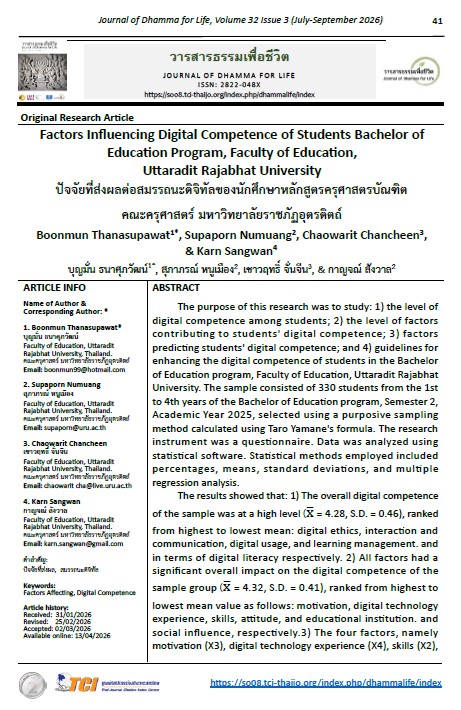
Factors Influencing Digital Competence of Students Bachelor of Education Program, Faculty of Education, Uttaradit Rajabhat University
Article Sidebar
Main Article Content
Abstract
The purpose of this research was to study: 1) the level of digital competence among students; 2) the level of factors contributing to students' digital competence; 3) factors predicting students' digital competence; and 4) guidelines for enhancing the digital competence of students in the Bachelor of Education program, Faculty of Education, Uttaradit Rajabhat University. The sample consisted of 330 students from the 1st to 4th years of the Bachelor of Education program, Semester 2, Academic Year 2025, selected using a purposive sampling method calculated using Taro Yamane's formula. The research instrument was a questionnaire. Data was analyzed using statistical software. Statistical methods employed included percentages, means, standard deviations, and multiple regression analysis.
The results showed that: 1) The overall digital competence of the sample was at a high level ( = 4.28, S.D. = 0.46), ranked from highest to lowest mean: digital ethics, interaction and communication, digital usage, and learning management. and in terms of digital literacy respectively. 2) All factors had a significant overall impact on the digital competence of the sample group ( = 4.32, S.D. = 0.41), ranked from highest to lowest mean value as follows: motivation, digital technology experience, skills, attitude, and educational institution. and social influence, respectively.3) The four factors, namely motivation (X3), digital technology experience (X4), skills (X2), and attitude (X1), can collectively predict 41.20% of students' digital competence with statistical significance at the 0.05 level. This can be written as a regression analysis equation as follows: Y ̂ = 1.070 + 0.267(X4) + 0.215(X3) + 0.209(X2) + 0.205(X1) 4) The top three guidelines for developing students' digital competence, in order of frequency, are: Faculties/universities should establish policies to promote and support digital competence for students and personnel (frequency = 228). Allocating sufficient and appropriate learning support resources and digital resources to meet the needs (frequency = 203). Teaching and learning management that emphasizes practical application for learners. Practice using various digital tools (frequency = 200) in sequence.
Article Details
References
กันฬาพัฒน์ ทันแก้ว, และคณะ. (2566). การพัฒนาทักษะดิจิทัลของนักศึกษาผ่านการเรียนรู้ด้วยตนเอง. วารสารนวัตกรรมการศึกษา, 15(1), 120–135.
ติพงษ์ จันทร์ศักดิ์. (2566). การส่งผ่านของตัวแปรที่เป็นปัจจัยต่อการพัฒนาสมรรถนะดิจิทัลของ ครูในศตวรรษที่ 21. วิทยานิพนธ์การศึกษาศาสตรมหาบัณฑิต สาขาวิชาวิธีวิทยาการวิจัยทางการ. ภาควิชาพื้นฐานทางการศึกษามหาวิทยาลัยศิลปากร
จุฬารัตน์ บุษบงก์. (2567). สมรรถนะดิจิทัลของนักศึกษาหลักสูตรประกาศนียบัตรบัณฑิตวิชาชีพครู ในยุคการศึกษา 4.0 . วารสารสมาคมพัฒนาวิชาชีพการบริหารการศึกษาแห่งประเทศไทย (สพบท.). 6(2), 105-120.
จุฬารัตน์ บุษบงก์. (2564). ปัจจัยที่มีอิทธิพลต่อสมรรถนะดิจิทัลของผู้เรียน. วารสารวิจัยทางการศึกษา, 12(1), 23–38.
จุฬารัตน์ บุษบงก์. (2567). การพัฒนาสมรรถนะดิจิทัลของผู้เรียนในศตวรรษที่ 21. วารสารการศึกษาและเทคโนโลยี, 15(2), 45–60.
นันทวัตน์ เหมยม, และคณะ. (2568). โมเดลเชิงสาเหตุของสมรรถนะดิจิทัลของนักศึกษา. วารสารวิจัยทางการศึกษา, 22(1), 130–145.
ประพจน์ แย้มทิม, และคณะ. (2565). ปัจจัยที่ส่งผลต่อสมรรถนะดิจิทัลของนักศึกษาระดับอุดมศึกษา. วารสารวิจัยและพัฒนาการศึกษา, 21(1), 101–115.
ประพจน์ แย้มทิม และคณะ. (2568). รูปแบบการพัฒนาสมรรถนะดิจิทัลของนักศึกษาในยุคดิจิทัล. วารสารนวัตกรรมการเรียนรู้, 10(3), 67–85.
พิชญาภา วงษ์ศิริ. (2565). ปัจจัยสนับสนุนการเรียนรู้ดิจิทัลในระดับอุดมศึกษา. วารสารวิชาการมหาวิทยาลัย, 14(3), 90–105.
พิทักษ์ สุรินทร์วัฒนกุล, และคณะ. (2568). การวิเคราะห์สมรรถนะดิจิทัลของนักศึกษาครูในประเทศไทย. วารสารการศึกษาไทย, 19(2), 55–70.
พิทักษ์ สุรินทร์วัฒนกุล, และคณะ. (2568). การจัดการศึกษาในศตวรรษที่ 21 กับเทคโนโลยีดิจิทัล. 638).
พรพิมล พิศูตร. (2565). การยอมรับเทคโนโลยีและพฤติกรรมการใช้งานของนักศึกษา. วารสารเทคโนโลยีการศึกษา, 18(2), 67–80.
มะยุรีย์ พิทยาเสนีย์, และคณะ. (2563). สมรรถนะดิจิทัลของนักศึกษาครูในศตวรรษที่ 21. วารสารศึกษาศาสตร์, 14(2), 45–60.
เมษา นวลศรี, และกุลชาติ พันธุวรกุล. (2565). การพัฒนาทักษะดิจิทัลของนักศึกษาวิชาชีพครู. วารสารวิจัยทางการศึกษา, 17(1), 88–102.
วราภรณ์ อินทรักษา. (2563). แรงจูงใจกับการเรียนรู้ในยุคดิจิทัล. วารสารศึกษาศาสตร์มหาวิทยาลัย, 12(1), 33–47.
วรานิษฐ์ ธนชัยวรพันธ์และสุวิทย์ ฝ่ายสงค์. (2568). การวิเคราะห์องค์ประกอบเชิงยืนยัน สมรรถนะการใช้เทคโนโลยีดิจิทัลสำหรับนักศึกษาครู มหาวิทยาลัยราชภัฏกลุ่มภาคกลาง. วารสารสังคมศาสตร์และวัฒนธรรม. 9(9),171-183
วรรณภา อารีราษฎร์. (2565). ปัจจัยเชิงจิตวิทยาที่มีผลต่อการพัฒนาทักษะดิจิทัล. วารสารจิตวิทยาการศึกษา, 11(2), 40–55.
วิชัย วงษ์ใหญ่และมารุต พัฒผล. (2564). การเรียนรู้เชิงสร้างสรรค์=Creative Learning. กรุงเทพมหานคร : จรัลสนิทวงศ์การพิมพ์
วิภาวรรณ บุญรอด. (2561). อิทธิพลทางสังคมต่อการใช้เทคโนโลยีสารสนเทศของนักศึกษา. วารสารสังคมศาสตร์และมนุษยศาสตร์, 10(2), 75–89.
ศิริพร โชติวิจิตร. (2564). บทบาทของสถานศึกษาในการส่งเสริมสมรรถนะดิจิทัล. วารสารการบริหารการศึกษา, 16(1), 58–72.
ศิริพร โชติวิจิตร. (2564). ปัจจัยที่มีอิทธิพลต่อสมรรถนะดิจิทัลของผู้เรียน. วารสารวิจัยทางการศึกษา, 12(1), 23–38.
สำนักงานคณะกรรมการดิจิทัลเพื่อเศรษฐกิจและสังคมแห่งชาติ. (2562). กรอบสมรรถนะดิจิทัลสำหรับพลเมืองไทย (Digital Competency Framework for Thai Citizens). กรุงเทพฯ: กระทรวงดิจิทัลเพื่อเศรษฐกิจและสังคม.
สำนักงานเลขาธิการสภาการศึกษา. (2560). แผนการศึกษาแห่งชาติ พ.ศ. 2560–2579. กรุงเทพมหานคร: สำนักงานเลขาธิการสภาการศึกษา.
ราชกิจจานุเบกษา. (2562). มาตรฐานวิชาชีพครู. กรุงเทพมหานคร: ราชกิจจานุเบกษา.
ราชกิจจานุเบกษา. (2562). ข้อบังคับคุรุสภาว่าด้วยมาตรฐานวิชาชีพ (ฉบับที่ 4) พ.ศ. 2562. ราชกิจจานุเบกษา เล่ม 136 ตอน พิเศษ 68 18-19 (20 มีนาคม 2562).
Cronbach, L. J. (1990). Essentials of Psychological Testing (5th ed.). New York: Harper Collins.
Mannila, L., Nordén, L. Å., Pears, A., Dagienė, V., & Stupurienė, G. (2018). Computational thinking in K–9 Education: Guidelines for teachers. European Schoolnet.
Yamane, T. (1973). Statistics: An Introductory Analysis (3rd ed.). New York: Harper and Row.
