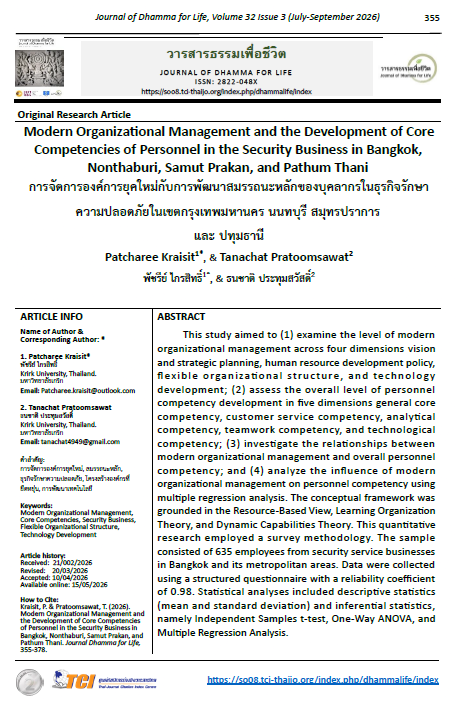
Modern Organizational Management and the Development of Core Competencies of Personnel in the Security Business in Bangkok, Nonthaburi, Samut Prakan, and Pathum Thani
Article Sidebar
Main Article Content
Abstract
This study aimed to (1) examine the level of modern organizational management across four dimensions vision and strategic planning, human resource development policy, flexible organizational structure, and technology development; (2) assess the overall level of personnel competency development in five dimensions general core competency, customer service competency, analytical competency, teamwork competency, and technological competency; (3) investigate the relationships between modern organizational management and overall personnel competency; and (4) analyze the influence of modern organizational management on personnel competency using multiple regression analysis. The conceptual framework was grounded in the Resource-Based View, Learning Organization Theory, and Dynamic Capabilities Theory. This quantitative research employed a survey methodology. The sample consisted of 635 employees from security service businesses in Bangkok and its metropolitan areas. Data were collected using a structured questionnaire with a reliability coefficient of 0.98. Statistical analyses included descriptive statistics (mean and standard deviation) and inferential statistics, namely Independent Samples t-test, One-Way ANOVA, and Multiple Regression Analysis.
The findings revealed that (1) all four dimensions of modern organizational management and all five dimensions of personnel competency were rated at the highest level (mean = 4.24–4.37); (2) gender showed no statistically significant differences in competency levels (p > .05); (3) age, work experience, and organizational size significantly affected competency levels (p < .05), with employees aged 41–50, those with 3–7 years of experience, and those working in large organizations reporting the highest mean scores, while education level and job position showed no significant differences (p > .05); and (4) the four dimensions of modern organizational management significantly predicted personnel competency at the .001 level (R² = .715–.749), with flexible organizational structure exerting the strongest influence, followed by technology development. The results underscore the strategic importance of organizational flexibility and technological investment in enhancing personnel competencies sustainably.
Article Details
References
สมชาย ภคภาสน์วิวัฒน์. (2563). ประเทศไทย 4.0 กับการพัฒนาองค์กรในยุคดิจิทัล. สำนักพิมพ์แห่งจุฬาลงกรณ์มหาวิทยาลัย.
สุรศักดิ์ ปาณะนนท์. (2559). ความสัมพันธ์ระหว่างคุณลักษณะส่วนบุคคลกับสมรรถนะในการปฏิบัติงานของพนักงานภาคเอกชน. วารสารบริหารธุรกิจ, 39(152), 45–60.
วิภาดา คุณวุฒิ. (2562). ปัจจัยด้านโครงสร้างองค์การที่ส่งผลต่อประสิทธิภาพการปฏิบัติงานของพนักงานในธุรกิจบริการ. วารสารวิทยาการจัดการ, 36(2), 89–105.
Allied Market Research. (2024). Security services market by service type, end user, and region: Global opportunity analysis and industry forecast, 2019–2024. Allied Market Research.
Argyris, C., & Schön, D. A. (1978). Organizational learning: A theory of action perspective. Addison-Wesley.
Armstrong, M. (2014). Armstrong’s handbook of human resource management practice (13th ed.). Kogan Page.
Barney, J. B. (1991). Firm resources and sustained competitive advantage. Journal of Management, 17(1), 99–120. https://doi.org/10.1177/014920639101700108
Boyatzis, R. E. (1982). The competent manager: A model for effective performance. John Wiley & Sons.
Boyatzis, R. E. (2011). Managerial and leadership competencies: A behavioral approach to emotional, social and cognitive intelligence. Vision: The Journal of Business Perspective, 15(2), 91–100. https://doi.org/10.1177/097226291101500202
Brynjolfsson, E., & Hitt, L. M. (2000). Beyond computation: Information technology, organizational transformation and business performance. Journal of Economic Perspectives, 14(4), 23–48. https://doi.org/10.1257/jep.14.4.23
Deloitte. (2024). Global security outlook 2024. Deloitte Insights.
Drucker, P. F. (1999). Management challenges for the 21st century. HarperBusiness.
Edmondson, A. C. (2012). Teaming: How organizations learn, innovate, and compete in the knowledge economy. Jossey-Bass.
Eisenhardt, K. M., & Martin, J. A. (2000). Dynamic capabilities: What are they? Strategic Management Journal, 21(10–11), 1105–1121. https://doi.org/10.1002/1097-0266(200010/11)21:10/11<1105: AID-SMJ133>3.0.CO;2-E
Goldman, S. L., Nagel, R. N., & Preiss, K. (1995). Agile competitors and virtual organizations: Strategies for enriching the customer. Van Nostrand Reinhold.
Huber, G. P. (1991). Organizational learning: The contributing processes and the literatures. Organization Science, 2(1), 88–115. https://doi.org/10.1287/orsc.2.1.88
International Labour Organization. (2023). Skills shortages and digital skills gaps in Southeast Asia. ILO Regional Office for Asia and the Pacific.
Kotter, J. P. (2012). Leading change. Harvard Business Review Press. (Original work published 1996)
Locke, E. A., & Latham, G. P. (2002). Building a practically useful theory of goal setting and task motivation: A 35-year odyssey. American Psychologist, 57(9), 705–717.
McClelland, D. C. (1973). Testing for competence rather than for intelligence. American Psychologist, 28(1), 1–14. https://doi.org/10.1037/h0034092
McKinsey Global Institute. (2023). Jobs lost, jobs gained: Workforce transitions in a time of automation (Updated insights 2023). McKinsey & Company.
Parasuraman, A., Zeithaml, V. A., & Berry, L. L. (1988). SERVQUAL: A multiple-item scale for measuring consumer perceptions of service quality. Journal of Retailing, 64(1), 12–40.
Penrose, E. (1959). The theory of the growth of the firm. Oxford University Press.
Porter, M. E., & Kramer, M. R. (2011). Creating shared value. Harvard Business Review, 89(1–2), 62–77.
Schumpeter, J. A. (1934). The theory of economic development. Harvard University Press. (Original work published 1911)
Schwab, K. (2016). The fourth industrial revolution. World Economic Forum.
Senge, P. M. (1990). The fifth discipline: The art and practice of the learning organization. Doubleday.
Senge, P. M. (2006). The fifth discipline: The art and practice of the learning organization (Rev. ed.). Doubleday. (Original work published 1990)
Spencer, L. M., & Spencer, S. M. (1993). Competence at work: Models for superior performance. John Wiley & Sons.
Teece, D. J. (2007). Explicating dynamic capabilities: The nature and microfoundations of (sustainable) enterprise performance. Strategic Management Journal, 28(13), 1319–1350. https://doi.org/10.1002/smj.640
Teece, D. J. (2018). Business models and dynamic capabilities. Long Range Planning, 51(1), 40–49. https://doi.org/10.1016/j.lrp.2017.06.007
Teece, D. J. (2023). Dynamic capabilities and strategic management: Organizing for innovation and growth (Updated ed.). Oxford University Press.
Teece, D. J., Pisano, G., & Shuen, A. (1997). Dynamic capabilities and strategic management. Strategic Management Journal, 18(7), 509–533.
Venkatesh, V., Morris, M. G., Davis, G. B., & Davis, F. D. (2003). User acceptance of information technology: Toward a unified view. MIS Quarterly, 27(3), 425–478.
Wernerfelt, B. (1984). A resource-based view of the firm. Strategic Management Journal, 5(2), 171–180. https://doi.org/10.1002/smj.4250050207
World Economic Forum. (2023). The future of jobs report 2023. World Economic Forum.
