Boonniyom Market’s Model in Thai Socciety
Article Sidebar
Main Article Content
Abstract
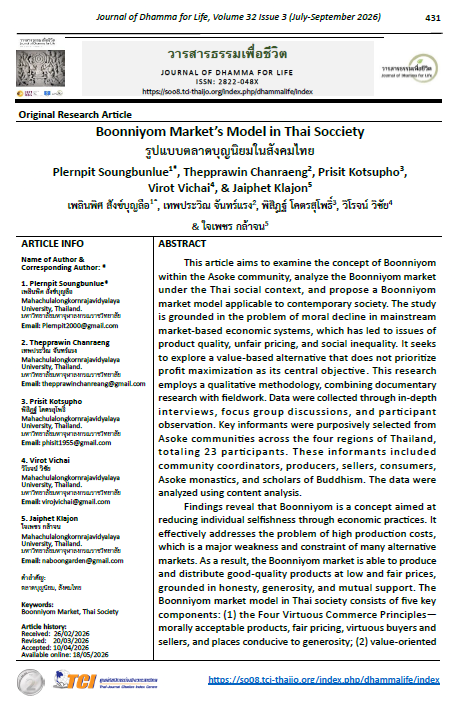
This article aims to examine the concept of Boonniyom within the Asoke community, analyze the Boonniyom market under the Thai social context, and propose a Boonniyom market model applicable to contemporary society. The study is grounded in the problem of moral decline in mainstream market-based economic systems, which has led to issues of product quality, unfair pricing, and social inequality. It seeks to explore a value-based alternative that does not prioritize profit maximization as its central objective. This research employs a qualitative methodology, combining documentary research with fieldwork. Data were collected through in-depth interviews, focus group discussions, and participant observation. Key informants were purposively selected from Asoke communities across the four regions of Thailand, totaling 23 participants. These informants included community coordinators, producers, sellers, consumers, Asoke monastics, and scholars of Buddhism. The data were analyzed using content analysis.
Findings reveal that Boonniyom is a concept aimed at reducing individual selfishness through economic practices. It effectively addresses the problem of high production costs, which is a major weakness and constraint of many alternative markets. As a result, the Boonniyom market is able to produce and distribute good-quality products at low and fair prices, grounded in honesty, generosity, and mutual support. The Boonniyom market model in Thai society consists of five key components: (1) the Four Virtuous Commerce Principles—morally acceptable products, fair pricing, virtuous buyers and sellers, and places conducive to generosity; (2) value-oriented objectives; (3) operational processes; (4) evaluation mechanisms; and (5) conditions for success, including low production costs, collective production among virtuous networks, and the outcomes of merit and karma. This model reflects the potential of the Boonniyom market as an ethical alternative market within contemporary Thai society.
Article Details
References
พระพรหมคุณาภรณ์ (ป.อ. ปยุตฺโต). (2546). พุทธธรรม: ฉบับปรับขยาย. มหาวิทยาลัยมหาจุฬาลงกรณราชวิทยาลัย.
พระไตรปิฎก. (ฉบับมหาจุฬาลงกรณราชวิทยาลัย). มหาวิทยาลัยมหาจุฬาลงกรณราชวิทยาลัย.
Thamrong, S., & Aranuch, S. (2018). การส่งเสริมการผลิตข้าวไร้สารพิษโดยชุมชนบุญนิยมราชธานีอโศก อำเภอวารินชำราบ จังหวัดอุบลราชธานี. วารสารรัชต์ภาคย์, 12(25), 255–270.
Thiumek, N. (2020). การพัฒนาคุณภาพมนุษย์ด้วยระบบบุญนิยมของชุมชนชาวอโศกเชิงพุทธบูรณาการ (ดุษฎีนิพนธ์ปริญญาดุษฎีบัณฑิต). มหาวิทยาลัยมหามกุฏราชวิทยาลัย.
Adam Smith. (1776). An inquiry into the nature and causes of the wealth of nations. W. Strahan and T. Cadell.
Food and Agriculture Organization of the United Nations. (2015). Food safety and quality: Global perspectives. https://www.fao.org/food-safety
Granovetter, M. (1985). Economic action and social structure: The problem of embeddedness. American Journal of Sociology, 91(3), 481–510. https://doi.org/10.1086/228311
International Buddhist Texts Commission, Mahachulalongkornrajavidyalaya University. (1996). The Thai Tripitaka, Mahachulalongkornrajavidyalaya Edition. Mahachulalongkornrajavid yalaya University Printing House.
Jaipech, K. (2015). Buddhist-based medical volunteerism for humanity (Doctoral dissertation). Surin Rajabhat University.
Kotler, P., & Keller, K. L. (2016). Marketing management (15th ed.). Pearson.
Persky, J. (1995). Retrospectives: The ethology of Homo economicus. Journal of Economic Perspectives, 9(2), 221–231.
Polanyi, K. (1944). The great transformation: The political and economic origins of our time. Farrar & Rinehart.
Sen, A. K. (1977). Rational fools: A critique of the behavioral foundations of economic theory. Philosophy & Public Affairs, 6(4), 317–344.
Thai Pesticide Alert Network (Thai-PAN). (2016). Report on the results of random testing for pesticide residues in vegetables and fruits in Thailand, 2016.
World Bank Group. (2018). The cost of food safety failures in low- and middle-income countries. https://www.worldbank.org
World Health Organization. (2015). WHO estimates of the global burden of foodborne diseases: Foodborne disease burden epidemiology reference group 2007–2015. https://www.who. int/publications/i/item/9789241565165
