Risk Management System for Structural Quality under Corruption in Public Construction Projects in Thailand
Article Sidebar
Main Article Content
Abstract
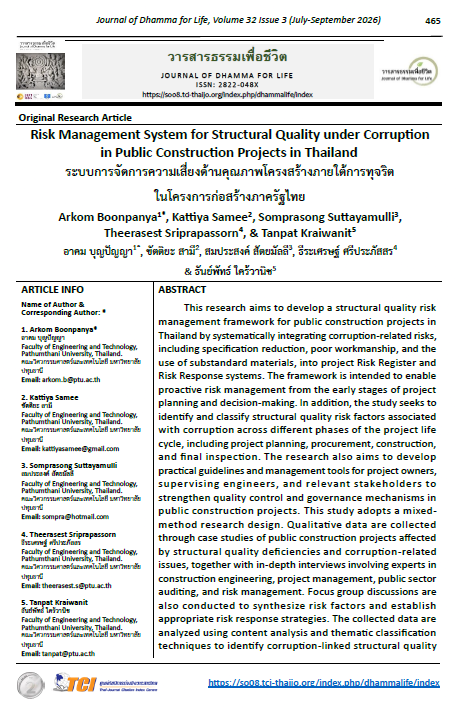
This research aims to develop a structural quality risk management framework for public construction projects in Thailand by systematically integrating corruption-related risks, including specification reduction, poor workmanship, and the use of substandard materials, into project Risk Register and Risk Response systems. The framework is intended to enable proactive risk management from the early stages of project planning and decision-making. In addition, the study seeks to identify and classify structural quality risk factors associated with corruption across different phases of the project life cycle, including project planning, procurement, construction, and final inspection. The research also aims to develop practical guidelines and management tools for project owners, supervising engineers, and relevant stakeholders to strengthen quality control and governance mechanisms in public construction projects. This study adopts a mixed-method research design. Qualitative data are collected through case studies of public construction projects affected by structural quality deficiencies and corruption-related issues, together with in-depth interviews involving experts in construction engineering, project management, public sector auditing, and risk management. Focus group discussions are also conducted to synthesize risk factors and establish appropriate risk response strategies. The collected data are analyzed using content analysis and thematic classification techniques to identify corruption-linked structural quality risks. Subsequently, the findings are utilized to develop and validate a structural quality risk management framework through expert review and evaluation.
The expected outcomes of this research include a comprehensive structural quality risk management framework capable of integrating corruption-related risks into public construction project risk management systems in a practical and systematic manner. The study is also expected to produce a structured list of risk factors, risk assessment and response guidelines, and practical management tools such as quality inspection checklists, Risk Register templates, and risk assessment manuals. These outputs can be applied to enhance quality assurance systems, reduce the likelihood of structural quality failures, and support the development of sustainable anti-corruption measures and governance policies for public construction projects in Thailand.
Article Details
References
American Society for Quality. (2023). Quality tools and preventive quality control in construction projects. ASQ.
Basel Institute on Governance. (2025). Public procurement and corruption risks in infrastructure projects. Basel Institute on Governance.
Bowen, G. A. (2009). Document analysis as a qualitative research method. Qualitative Research Journal, 9(2), 27–40. https://doi.org/10.3316/QRJ0902027
Braun, V., & Clarke, V. (2019). Reflecting on reflexive thematic analysis. Qualitative Research in Sport, Exercise and Health, 11(4), 589–597. https://doi.org/10.1080/2159676X.2019. 1628806
Constructing Excellence. (2022). Quality management and technical risks in construction projects. https://www.constructingexcellence.org.uk/
Cooper, D. F., Grey, S., Raymond, G., & Walker, P. (2014). Project risk management guidelines: Managing risk in large projects and complex systems. John Wiley & Sons.
Creswell, J. W., & Plano Clark, V. L. (2017). Designing and conducting mixed methods research (3rd ed.). SAGE Publications.
Delgado-Gazo, J., & López-García, R. (2023). Risk management practices in project environments: Application of PMBOK framework. Journal of Project Management Studies, 18(2), 45–62.
DiCicco-Bloom, B., & Crabtree, B. F. (2006). The qualitative research interview. Medical Education, 40(4), 314–321. https://doi.org/10.1111/j.1365-2929.2006.02418.x
FIDIC. (2017). FIDIC integrity management guidance. International Federation of Consulting Engineers.
Garvin, M. J., & Bosso, D. (2008). Assessing the impact of construction corruption on project performance. Construction Management and Economics, 26(5), 491–503.
Institute of Risk Management Thailand. (2022). Guidelines for project risk management in infrastructure development. IRM Thailand.
Institution of Civil Engineers. (2022). Risk management in civil engineering projects: Best practice guide. ICE Publishing.
Integrity Risk Management Handbook. (2024). Corruption and integrity risks in public sector projects. Transparency International Publications.
International Finance Corporation. (2022). Life-cycle cost implications of low-quality infrastructure projects. World Bank Group.
Kaplan, R. S., & Norton, D. P. (2004). Strategy maps: Converting intangible assets into tangible outcomes. Harvard Business School Press.
Kenny, C. (2007). Construction, corruption, and developing countries. World Bank Policy Research Working Paper.
Kerzner, H. (2017). Project management: A systems approach to planning, scheduling, and controlling (12th ed.). John Wiley & Sons.
Merna, T., & Al-Thani, F. F. (2008). Corporate risk management. Wiley.
Merriam, S. B., & Tisdell, E. J. (2015). Qualitative research: A guide to design and implementation (4th ed.). Jossey-Bass.
Morgan, D. L. (1996). Focus groups as qualitative research (2nd ed.). SAGE Publications.
National Anti-Corruption Commission (NACC). (2023). Report on corruption risks in public construction projects in Thailand. NACC.
National Office of Audit Thailand. (2023). Report on transparency and risk management in public sector projects. Government of Thailand.
National News Agency. (2025). Public confidence and impacts of infrastructure failures in Thailand. Bangkok: NNA.
OECD. (2023). Government procurement and corruption risks in infrastructure projects. Organisation for Economic Co-operation and Development. https://www.oecd.org/gov/ public-procurement/
Pallant, J. (2020). SPSS survival manual: A step-by-step guide to data analysis using IBM SPSS (7th ed.). McGraw-Hill Education.
Prieto, R., & Martinez, J. (2022). Structural reliability and risk assessment under material quality degradation. Journal of Construction Engineering and Management, 148(5), 04022015. https://doi.org/xxxxx
Project Management Institute. (2021). A guide to the project management body of knowledge (PMBOK® guide) (7th ed.). PMI.
Project Management Institute. (2022). A guide to the project management body of knowledge (PMBOK® guide) (7th ed.). Project Management Institute.
Ritchie, J., Lewis, J., Nicholls, C. M., & Ormston, R. (Eds.). (2013). Qualitative research practice: A guide for social science students and researchers (2nd ed.). SAGE Publications.
Royal Society of Engineers Thailand. (2023). Structural safety and material quality standards in civil engineering practice. Bangkok: RSET.
Royal Society of Engineers Thailand. (2025). Preliminary investigation report on structural failure of government office building. Bangkok: RSET.
State Audit Office of Thailand. (2024). Annual report on public construction budget and procurement oversight. Bangkok: SAO.
Thai Engineering Council. (2023). Engineering quality control and professional standards in construction projects. Council of Engineers Thailand.
Thai Institute of Architectural and Engineering Quality. (2024). Guidelines for quality assurance and risk management in infrastructure projects. TIAEQ.
Thai Enquirer. (2025). Investigative report on transparency in public construction procurement. Thai Enquirer.
Transparency International. (2023). Corruption in public procurement: Construction sector analysis. Transparency International.
Transparency International. (2024). Global corruption report: Infrastructure and public works. Transparency International.
Transparency International. (2025). Corruption risks in infrastructure and construction sectors: Global report. https://www.transparency.org/
Transparency International. (2025). Construction sector integrity and governance risks. Transparency International.
United Nations Office on Drugs and Crime. (2023). Anti-corruption measures in infrastructure and public procurement. UNODC.
World Bank. (2022). Why infrastructure governance matters: Efficiency, trust, and long-term fiscal impacts. https://www.worldbank.org/
