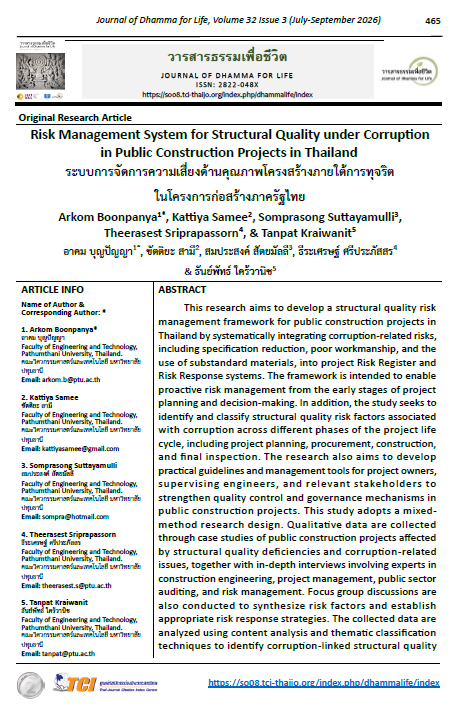
ระบบการจัดการความเสี่ยงด้านคุณภาพโครงสร้างภายใต้การทุจริต ในโครงการก่อสร้างภาครัฐไทย
Article Sidebar
Main Article Content
บทคัดย่อ
งานวิจัยนี้มีวัตถุประสงค์เพื่อพัฒนากรอบการบริหารความเสี่ยงด้านคุณภาพโครงสร้างสำหรับโครงการก่อสร้างภาครัฐของประเทศไทย โดยมุ่งบูรณาการความเสี่ยงที่เกี่ยวข้องกับพฤติกรรมการทุจริต เช่น การลดสเปก การลดคุณภาพงาน และการใช้วัสดุด้อยคุณภาพ เข้ากับระบบการบริหารความเสี่ยงของโครงการในรูปแบบ Risk Register และ Risk Response อย่างเป็นระบบ เพื่อให้สามารถบริหารจัดการความเสี่ยงได้ตั้งแต่ระยะเริ่มต้นของการวางแผนโครงการ นอกจากนี้ งานวิจัยยังมุ่งระบุและจัดทำรายการปัจจัยเสี่ยงด้านคุณภาพโครงสร้างที่เชื่อมโยงกับการทุจริตในแต่ละช่วงของวงจรโครงการ ตั้งแต่การวางแผน การจัดซื้อจัดจ้าง การก่อสร้าง จนถึงการตรวจรับงาน ตลอดจนพัฒนาแนวทางและเครื่องมือเชิงปฏิบัติสำหรับผู้ควบคุมงาน หน่วยงานเจ้าของโครงการ และผู้มีส่วนเกี่ยวข้อง เพื่อสนับสนุนการควบคุมคุณภาพและการกำกับดูแลโครงการอย่างมีประสิทธิภาพ การวิจัยใช้ระเบียบวิธีวิจัยแบบผสมผสาน โดยเก็บรวบรวมข้อมูลเชิงคุณภาพจากกรณีศึกษาโครงการก่อสร้างภาครัฐที่ประสบปัญหาด้านคุณภาพโครงสร้างและข้อร้องเรียนเกี่ยวกับการทุจริต ร่วมกับการสัมภาษณ์เชิงลึกผู้เชี่ยวชาญด้านวิศวกรรมก่อสร้าง การบริหารโครงการ การตรวจสอบภาครัฐ และการบริหารความเสี่ยง รวมทั้งการสนทนากลุ่มเพื่อสังเคราะห์ปัจจัยเสี่ยงและแนวทางจัดการความเสี่ยง ข้อมูลที่ได้ถูกนำมาวิเคราะห์เชิงเนื้อหาและจัดหมวดหมู่ปัจจัยเสี่ยง ก่อนพัฒนาเป็นกรอบการบริหารความเสี่ยงด้านคุณภาพโครงสร้าง และตรวจสอบความเหมาะสมของกรอบแนวคิดโดยผู้เชี่ยวชาญเฉพาะด้าน
ผลการวิจัยคาดว่าจะได้กรอบการบริหารความเสี่ยงด้านคุณภาพโครงสร้างที่สามารถเชื่อมโยงความเสี่ยงจากการทุจริตเข้ากับระบบบริหารความเสี่ยงของโครงการก่อสร้างภาครัฐได้อย่างเป็นรูปธรรม รวมถึงได้รายการปัจจัยเสี่ยง แนวทางการประเมินและตอบสนองความเสี่ยง ตลอดจนเครื่องมือเชิงปฏิบัติ เช่น Checklist การตรวจสอบคุณภาพ แบบฟอร์ม Risk Register และคู่มือการประเมินความเสี่ยง ซึ่งสามารถนำไปประยุกต์ใช้เพื่อยกระดับประสิทธิภาพการควบคุมคุณภาพ ลดโอกาสการเกิดความเสียหายด้านโครงสร้าง และสนับสนุนการกำหนดมาตรการป้องกันการทุจริตในโครงการก่อสร้างภาครัฐอย่างยั่งยืน
Article Details
เอกสารอ้างอิง
American Society for Quality. (2023). Quality tools and preventive quality control in construction projects. ASQ.
Basel Institute on Governance. (2025). Public procurement and corruption risks in infrastructure projects. Basel Institute on Governance.
Bowen, G. A. (2009). Document analysis as a qualitative research method. Qualitative Research Journal, 9(2), 27–40. https://doi.org/10.3316/QRJ0902027
Braun, V., & Clarke, V. (2019). Reflecting on reflexive thematic analysis. Qualitative Research in Sport, Exercise and Health, 11(4), 589–597. https://doi.org/10.1080/2159676X.2019. 1628806
Constructing Excellence. (2022). Quality management and technical risks in construction projects. https://www.constructingexcellence.org.uk/
Cooper, D. F., Grey, S., Raymond, G., & Walker, P. (2014). Project risk management guidelines: Managing risk in large projects and complex systems. John Wiley & Sons.
Creswell, J. W., & Plano Clark, V. L. (2017). Designing and conducting mixed methods research (3rd ed.). SAGE Publications.
Delgado-Gazo, J., & López-García, R. (2023). Risk management practices in project environments: Application of PMBOK framework. Journal of Project Management Studies, 18(2), 45–62.
DiCicco-Bloom, B., & Crabtree, B. F. (2006). The qualitative research interview. Medical Education, 40(4), 314–321. https://doi.org/10.1111/j.1365-2929.2006.02418.x
FIDIC. (2017). FIDIC integrity management guidance. International Federation of Consulting Engineers.
Garvin, M. J., & Bosso, D. (2008). Assessing the impact of construction corruption on project performance. Construction Management and Economics, 26(5), 491–503.
Institute of Risk Management Thailand. (2022). Guidelines for project risk management in infrastructure development. IRM Thailand.
Institution of Civil Engineers. (2022). Risk management in civil engineering projects: Best practice guide. ICE Publishing.
Integrity Risk Management Handbook. (2024). Corruption and integrity risks in public sector projects. Transparency International Publications.
International Finance Corporation. (2022). Life-cycle cost implications of low-quality infrastructure projects. World Bank Group.
Kaplan, R. S., & Norton, D. P. (2004). Strategy maps: Converting intangible assets into tangible outcomes. Harvard Business School Press.
Kenny, C. (2007). Construction, corruption, and developing countries. World Bank Policy Research Working Paper.
Kerzner, H. (2017). Project management: A systems approach to planning, scheduling, and controlling (12th ed.). John Wiley & Sons.
Merna, T., & Al-Thani, F. F. (2008). Corporate risk management. Wiley.
Merriam, S. B., & Tisdell, E. J. (2015). Qualitative research: A guide to design and implementation (4th ed.). Jossey-Bass.
Morgan, D. L. (1996). Focus groups as qualitative research (2nd ed.). SAGE Publications.
National Anti-Corruption Commission (NACC). (2023). Report on corruption risks in public construction projects in Thailand. NACC.
National Office of Audit Thailand. (2023). Report on transparency and risk management in public sector projects. Government of Thailand.
National News Agency. (2025). Public confidence and impacts of infrastructure failures in Thailand. Bangkok: NNA.
OECD. (2023). Government procurement and corruption risks in infrastructure projects. Organisation for Economic Co-operation and Development. https://www.oecd.org/gov/ public-procurement/
Pallant, J. (2020). SPSS survival manual: A step-by-step guide to data analysis using IBM SPSS (7th ed.). McGraw-Hill Education.
Prieto, R., & Martinez, J. (2022). Structural reliability and risk assessment under material quality degradation. Journal of Construction Engineering and Management, 148(5), 04022015. https://doi.org/xxxxx
Project Management Institute. (2021). A guide to the project management body of knowledge (PMBOK® guide) (7th ed.). PMI.
Project Management Institute. (2022). A guide to the project management body of knowledge (PMBOK® guide) (7th ed.). Project Management Institute.
Ritchie, J., Lewis, J., Nicholls, C. M., & Ormston, R. (Eds.). (2013). Qualitative research practice: A guide for social science students and researchers (2nd ed.). SAGE Publications.
Royal Society of Engineers Thailand. (2023). Structural safety and material quality standards in civil engineering practice. Bangkok: RSET.
Royal Society of Engineers Thailand. (2025). Preliminary investigation report on structural failure of government office building. Bangkok: RSET.
State Audit Office of Thailand. (2024). Annual report on public construction budget and procurement oversight. Bangkok: SAO.
Thai Engineering Council. (2023). Engineering quality control and professional standards in construction projects. Council of Engineers Thailand.
Thai Institute of Architectural and Engineering Quality. (2024). Guidelines for quality assurance and risk management in infrastructure projects. TIAEQ.
Thai Enquirer. (2025). Investigative report on transparency in public construction procurement. Thai Enquirer.
Transparency International. (2023). Corruption in public procurement: Construction sector analysis. Transparency International.
Transparency International. (2024). Global corruption report: Infrastructure and public works. Transparency International.
Transparency International. (2025). Corruption risks in infrastructure and construction sectors: Global report. https://www.transparency.org/
Transparency International. (2025). Construction sector integrity and governance risks. Transparency International.
United Nations Office on Drugs and Crime. (2023). Anti-corruption measures in infrastructure and public procurement. UNODC.
World Bank. (2022). Why infrastructure governance matters: Efficiency, trust, and long-term fiscal impacts. https://www.worldbank.org/
