Development of the Learning Process of Padarupasitthi Scripture
Article Sidebar
Main Article Content
Abstract
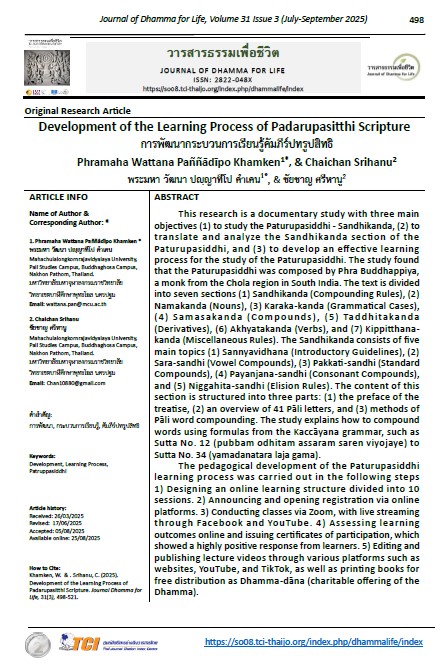
This research is a documentary study with three main objectives (1) to study the Paturupasiddhi - Sandhikanda, (2) to translate and analyze the Sandhikanda section of the Paturupasiddhi, and (3) to develop an effective learning process for the study of the Paturupasiddhi. The study found that the Paturupasiddhi was composed by Phra Buddhappiya, a monk from the Chola region in South India. The text is divided into seven sections (1) Sandhikanda (Compounding Rules), (2) Namakanda (Nouns), (3) Karaka-kanda (Grammatical Cases), (4) Samasakanda (Compounds), (5) Taddhitakanda (Derivatives), (6) Akhyatakanda (Verbs), and (7) Kippitthana-kanda (Miscellaneous Rules). The Sandhikanda consists of five main topics (1) Sannyavidhana (Introductory Guidelines), (2) Sara-sandhi (Vowel Compounds), (3) Pakkati-sandhi (Standard Compounds), (4) Payanjana-sandhi (Consonant Compounds), and (5) Niggahita-sandhi (Elision Rules). The content of this section is structured into three parts: (1) the preface of the treatise, (2) an overview of 41 Pāli letters, and (3) methods of Pāli word compounding. The study explains how to compound words using formulas from the Kaccāyana grammar, such as Sutta No. 12 (pubbam odhitam assaram saren viyojaye) to Sutta No. 34 (yamadanatara laja gama).
The pedagogical development of the Paturupasiddhi learning process was carried out in the following steps 1) Designing an online learning structure divided into 10 sessions. 2) Announcing and opening registration via online platforms. 3) Conducting classes via Zoom, with live streaming through Facebook and YouTube. 4) Assessing learning outcomes online and issuing certificates of participation, which showed a highly positive response from learners. 5) Editing and publishing lecture videos through various platforms such as websites, YouTube, and TikTok, as well as printing books for free distribution as Dhamma-dāna (charitable offering of the Dhamma).
