
Integrating the Concept of Spatial Social Innovation with the BCG Economy to Revitalize the Grassroots Economy through Bamboo
Article Sidebar
Main Article Content
Abstract
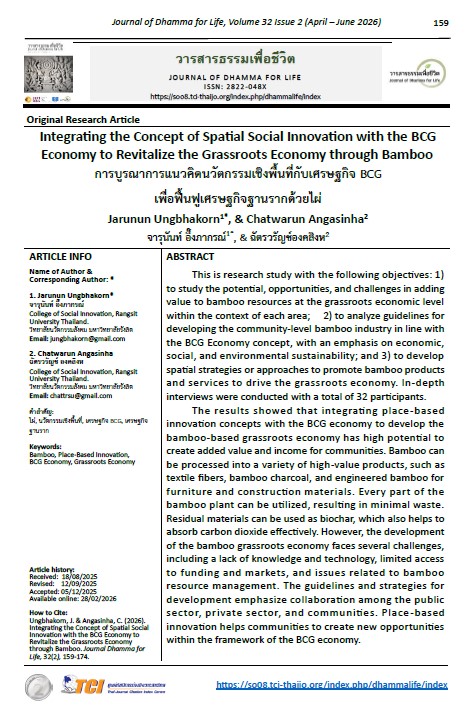
This is research study with the following objectives: 1) to study the potential, opportunities, and challenges in adding value to bamboo resources at the grassroots economic level within the context of each area; 2) to analyze guidelines for developing the community-level bamboo industry in line with the BCG Economy concept, with an emphasis on economic, social, and environmental sustainability; and 3) to develop spatial strategies or approaches to promote bamboo products and services to drive the grassroots economy. In-depth interviews were conducted with a total of 32 participants.
The results showed that integrating place-based innovation concepts with the BCG economy to develop the bamboo-based grassroots economy has high potential to create added value and income for communities. Bamboo can be processed into a variety of high-value products, such as textile fibers, bamboo charcoal, and engineered bamboo for furniture and construction materials. Every part of the bamboo plant can be utilized, resulting in minimal waste. Residual materials can be used as biochar, which also helps to absorb carbon dioxide effectively. However, the development of the bamboo grassroots economy faces several challenges, including a lack of knowledge and technology, limited access to funding and markets, and issues related to bamboo resource management. The guidelines and strategies for development emphasize collaboration among the public sector, private sector, and communities. Place-based innovation helps communities to create new opportunities within the framework of the BCG economy.
Article Details
References
กระทรวงการอุดมศึกษา วิทยาศาสตร์ วิจัยและนวัตกรรม. (2564). โมเดลเศรษฐกิจ BCG (Bio-Circular-Green Economy). กรุงเทพมหานคร: กระทรวงการอุดมศึกษา วิทยาศาสตร์ วิจัยและนวัตกรรม.
วรนุช ชื่นฤดีมล, และคณะ. (2555). การคืนภูมิปัญญาท้องถิ่นผ่านงานจักสานไม้ไผ่ในจังหวัดอ่างทอง. สำนักงานกองทุนสนับสนุนการวิจัย (สกว.).
สำนักงานสภาพัฒนาการเศรษฐกิจและสังคมแห่งชาติ. (2565). แผนพัฒนาเศรษฐกิจและสังคมแห่งชาติ ฉบับที่ 13 (พ.ศ. 2566–2570). กรุงเทพมหานคร: สำนักงานสภาพัฒนาการเศรษฐกิจและสังคมแห่งชาติ.
Cooke, P. (2001). Regional innovation systems, clusters, and the knowledge economy. Industrial and Corporate Change, 10(4), 945–974.
Ellen MacArthur Foundation. (2013). Towards the circular economy. Cowes: Ellen MacArthur Foundation.
Flyvbjerg, B. (2006). Five misunderstandings about case-study research. Qualitative Inquiry, 12(2), 219–245. https://doi.org/10.1177/1077800405284363
Food and Agriculture Organization of the United Nations. (2018). Bamboo for sustainable development. Rome: FAO.
International Bamboo and Rattan Organization. (2020). Global assessment of bamboo and rattan 2020. International Bamboo and Rattan Organization.
Kevin Morgan. (2017). Nurturing novelty: Regional innovation policy in the age of smart specialisation. Environment and Planning C: Politics and Space, 35(4), 569–583.
Liese, W., & Köhl, M. (2015). Bamboo: The plant and its uses. Springer International Publishing.
Murray, R., Caulier-Grice, J., & Mulgan, G. (2010). The open book of social innovation. The Young Foundation and Nesta.
OECD. (2010). Regional development policies in OECD countries. OECD Publishing.
OECD. (2013). Innovation-driven growth in regions: The role of smart specialisation. OECD Publishing.
Office of the National Economic and Social Development Council. (2021). Bio-Circular-Green Economy Model. NESDC.
Ostrom, E. (1990). Governing the commons: The evolution of institutions for collective action. Cambridge University Press.
Patton, M. Q. (2015). Qualitative research & evaluation methods: Integrating theory and practice (4th ed.). Sage Publications.
Porter, M. E. (1998). Clusters and the new economics of competition. Harvard Business Review, 76(6), 77–90.
Ritchie, J., Lewis, J., McNaughton Nicholls, C., & Ormston, R. (Eds.). (2013). Qualitative research practice: A guide for social science students and researchers (2nd ed.). Sage Publications.
Seravalli, G. (2015). A new development agenda for the European Union: The role of place-based development. Routledge.
United Nations Environment Programme. (2011). Towards a green economy: Pathways to sustainable development and poverty eradication. UNEP.
Van der Lugt, P. (2008). Design interventions for stimulating bamboo commercialization: Dutch design meets bamboo as a replicable model (Doctoral dissertation). Delft University of Technology.
