Guidelines for Applying the Sekhiyavatta principle to Enhance Thai Etiquette Values
Article Sidebar
Main Article Content
Abstract
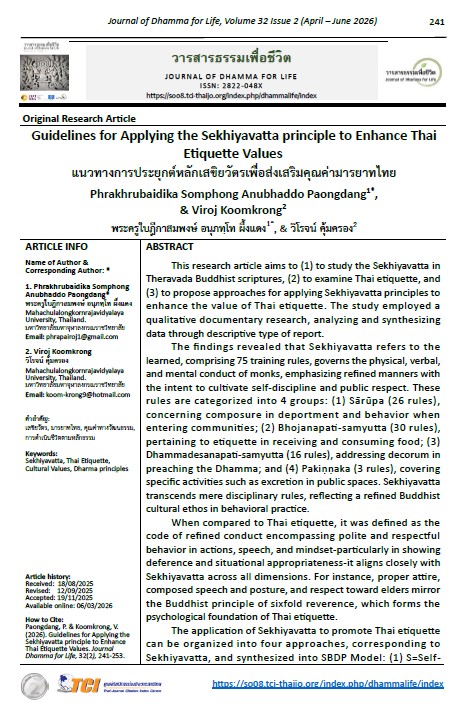
This research article aims to (1) to study the Sekhiyavatta in Theravada Buddhist scriptures, (2) to examine Thai etiquette, and (3) to propose approaches for applying Sekhiyavatta principles to enhance the value of Thai etiquette. The study employed a qualitative documentary research, analyzing and synthesizing data through descriptive type of report.
The findings revealed that Sekhiyavatta refers to the learned, comprising 75 training rules, governs the physical, verbal, and mental conduct of monks, emphasizing refined manners with the intent to cultivate self-discipline and public respect. These rules are categorized into 4 groups: (1) Sārūpa (26 rules), concerning composure in deportment and behavior when entering communities; (2) Bhojanapati-samyutta (30 rules), pertaining to etiquette in receiving and consuming food; (3) Dhammadesanapati-samyutta (16 rules), addressing decorum in preaching the Dhamma; and (4) Pakiṇṇaka (3 rules), covering specific activities such as excretion in public spaces. Sekhiyavatta transcends mere disciplinary rules, reflecting a refined Buddhist cultural ethos in behavioral practice.
When compared to Thai etiquette, it was defined as the code of refined conduct encompassing polite and respectful behavior in actions, speech, and mindset-particularly in showing deference and situational appropriateness-it aligns closely with Sekhiyavatta across all dimensions. For instance, proper attire, composed speech and posture, and respect toward elders mirror the Buddhist principle of sixfold reverence, which forms the psychological foundation of Thai etiquette.
The application of Sekhiyavatta to promote Thai etiquette can be organized into four approaches, corresponding to Sekhiyavatta, and synthesized into SBDP Model: (1) S=Self-discipline, focusing on self-control; (2) B=Behavioral decorum, emphasizing polite conduct; (3) D=Dharma-based etiquette, rooted in Buddhist principles, and (4) P=Public respect, fostering respect for society and the environment. The findings highlight that Sekhiyavatta can systematically enhance public virtue and cultivate a culture of self- and mutual respect, particularly in an era where Thai etiquette faces challenges from globalization. This research holds academic, ethical, and policy-relevant value for revitalizing Thai cultural roots grounded in Buddhist principles, fostering a profound and sustainable cultural restoration.
Article Details
References
กรมการศาสนา. (2559). มารยาทไทย. กรุงเทพมหานคร: กระทรวงวัฒนธรรม.
กรมส่งเสริมวัฒนธรรม กระทรวงวัฒนธรรม. (2550). มารยาทไทย. กรุงเทพมหานคร: กลุ่มส่งเสริมการถ่ายทอดวัฒนธรรม สำนักส่งเสริมและเผยแพร่วัฒนธรรม.
กองทัพเรือ. (2542). คู่มือมารยาทและการเข้าสังคม. กรุงเทพมหานคร: คณะทำงานพิจารณาและจัดทำ อท. ด้านข่าวสาร.
กระทรวงศึกษาธิการ. (2560). แนวทางการพัฒนาคุณธรรม จริยธรรม และค่านิยมหลักของคนไทย. กรุงเทพมหานคร: กระทรวงศึกษาธิการ.
จันจิรา เลิศศรีบัณฑิต. (2553). การเปรียบเทียบผลสัมฤทธิ์ทางการเรียนวิชาพระพุทธศาสนา เรื่องมารยาทชาวพุทธและการปฏิบัติต่อพระสงฆ์สำหรับนักเรียนชั้นมัธยมศึกษาปีที่ 2 ที่เรียนโดยใช้บทเรียนคอมพิวเตอร์ช่วยสอนกับการสอนแบบปกติ (ปริญญานิพนธ์ศึกษาศาสตรมหาบัณฑิต). มหาวิทยาลัยรามคำแหง.
พระครูประโชติพัชรพงศ์ (นัฐพงษ์ วิสุทฺโธ). (2563). คุณค่าของการอุปัฏฐากในพระพุทธศาสนาเถรวาท (วิทยานิพนธ์พุทธศาสตรมหาบัณฑิต). มหาวิทยาลัยมหาจุฬาลงกรณราชวิทยาลัย.
พระธรรมปิฎก (ป.อ. ปยุตฺโต). (2543). พุทธธรรม (ฉบับปรับปรุงและขยายความ). กรุงเทพมหานคร: มหาจุฬาลงกรณราชวิทยาลัย.
พระพิรุณ วุฑฺฒิกโร. (2554). การศึกษาวิเคราะห์เสขิยวัตรในพระพุทธศาสนาเถรวาท. กรุงเทพมหานคร: มหาวิทยาลัยมหาจุฬาลงกรณราชวิทยาลัย.
พระอุดรคณาธิการ (ชวินทร์ สระคำ) และ จำลอง สารพัดนึก. (2530). พจนานุกรมบาลี-ไทย ฉบับนักศึกษา. กรุงเทพมหานคร: โรงพิมพ์มหาจุฬาลงกรณราชวิทยาลัย.
พลอย จริยเวช. (2547). Mix & match แต่งตัวดีอย่างมีสไตล์ (พิมพ์ครั้งที่ 2). กรุงเทพมหานคร: แปลน พริ้นติ้งกรุงเทพ.
มหาจุฬาลงกรณราชวิทยาลัย. (2539). พระไตรปิฎกภาษาไทย ฉบับมหาจุฬาลงกรณราชวิทยาลัย เล่มที่ 7 (พระวินัยปิฎก มหาวรรค). กรุงเทพมหานคร: มหาจุฬาลงกรณราชวิทยาลัย.
สมชัย ใจดี และ บรรยง ศรีวิริยาภรณ์. (2533). ประเพณีและวัฒนธรรม. กรุงเทพมหานคร: โรงพิมพ์วัฒนาพาณิชย์.
สมจินตนา ภักดิ์ศรีวงศ์. (2538). มารยาทในสังคมไทย มารยาทและการเข้าสมาคม. กรุงเทพมหานคร: ต้นอ้อ แกรมมี่.
สำนักงานคณะกรรมการวัฒนธรรมแห่งชาติ. (2567). มารยาท. สืบค้นจาก http://lailouisab.blogspot.com/
สำนักงานคณะกรรมการวัฒนธรรมแห่งชาติ กรมส่งเสริมวัฒนธรรม กระทรวงวัฒนธรรม. (2567). มารยาทไทย. สืบค้นจาก http://kanchanapisek.or.th/kp8/
สำนักงานสภาพัฒนาการเศรษฐกิจและสังคมแห่งชาติ. (2561). ยุทธศาสตร์ชาติ 20 ปี (พ.ศ. 2561–2580). กรุงเทพมหานคร: สำนักนายกรัฐมนตรี.
อิงอร รอดน้อย. (2558). การพัฒนาคุณธรรมจริยธรรมของเยาวชนโดยใช้หลักพุทธธรรม. กรุงเทพมหานคร: สำนักพิมพ์มหาวิทยาลัย.
