
The Influencing Factors on the Effectiveness of Talent Training in China’s Modern Industrial Colleges
Article Sidebar
Main Article Content
บทคัดย่อ
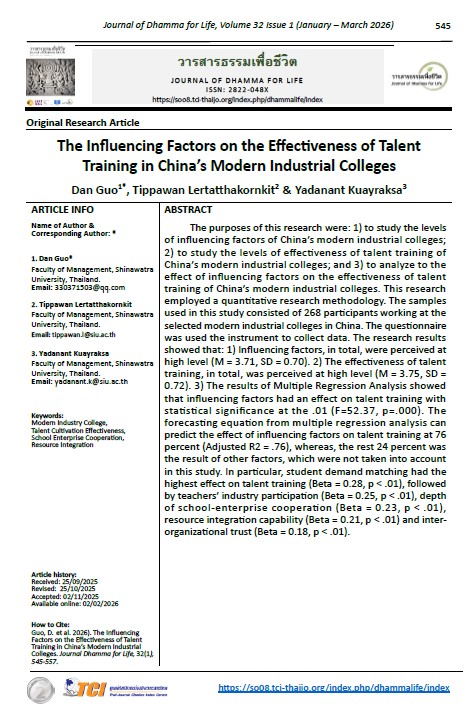
The purposes of this research were: 1) to study the levels of influencing factors of China’s modern industrial colleges; 2) to study the levels of effectiveness of talent training of China’s modern industrial colleges; and 3) to analyze to the effect of influencing factors on the effectiveness of talent training of China’s modern industrial colleges. This research employed a quantitative research methodology. The samples used in this study consisted of 268 participants working at the selected modern industrial colleges in China. The questionnaire was used the instrument to collect data. The research results showed that: 1) Influencing factors, in total, were perceived at high level (M = 3.71, SD = 0.70). 2) The effectiveness of talent training, in total, was perceived at high level (M = 3.75, SD = 0.72). 3) The results of Multiple Regression Analysis showed that influencing factors had an effect on talent training with statistical significance at the .01 (F=52.37, p=.000). The forecasting equation from multiple regression analysis can predict the effect of influencing factors on talent training at 76 percent (Adjusted R2 = .76), whereas, the rest 24 percent was the result of other factors, which were not taken into account in this study. In particular, student demand matching had the highest effect on talent training (Beta = 0.28, p < .01), followed by teachers’ industry participation (Beta = 0.25, p < .01), depth of school-enterprise cooperation (Beta = 0.23, p < .01), resource integration capability (Beta = 0.21, p < .01) and inter-organizational trust (Beta = 0.18, p < .01).
Article Details
เอกสารอ้างอิง
Bills, D. B., & Gimenez, M. (2013). Linking educational pathways and labor market outcomes: Career planning and employability. Sociology of Education, 86(3), 243–260.
Bills, D. B., & Gimenez, M. (2013). Sociology of education and work. Annual Review of Sociology, 39, 267–285. https://doi.org/10.1146/annurev-soc-071312-145613
Butler, J., & Chowdhury, R. (2011). Inter‐organizational collaboration and workforce development. Journal of Education and Work, 24(3–4), 313–335. https://doi.org/10.1080/13639080.2011.584688
Butler, J. S., & Chowdhury, J. (2011). Public policy, entrepreneurship, and economic development in China. Journal of Entrepreneurship and Public Policy, 1(1), 7–27.
Channuwong, R., Rattanamethawong, J., & Wongwanich, S. (2025). University–industry collaboration models and talent cultivation mechanisms. Higher Education Policy, 38(1), 45–62.
Channuwong, R., Siripap, K., & Charoenngam, C. (2022). Trust, collaboration, and sustainability in industry–education partnerships. International Journal of Educational Development, 92, 102613.
Chen, X., & Li, Y. (2023). Industry participation of faculty and applied talent cultivation in higher education. Journal of Higher Education Research, 44(2), 78–86.
Cui, G., & Jiang, Z. (2012). Inter‐organizational trust and cooperative performance: Evidence from university–enterprise partnerships. Management World, 28(6), 102–115.
Damrongsiri, P., Kanjanawasee, S., & Wongwanich, S. (2022). Industry–education integration and competency-based education: International perspectives. Educational Research Review, 36, 100447. https://doi.org/10.1016/j.edurev.2022.100447
Damrongsiri, S., Wattanakamolchai, S., & Kaewsaeng-on, R. (2022). Student-centered learning and employability outcomes in higher education. Journal of Education and Work, 35(5), 512–528.
Etzkowitz, H., & Leydesdorff, L. (2000). The dynamics of innovation: From national systems and “Mode 2” to a Triple Helix of university–industry–government relations. Research Policy, 29(2), 109–123. https://doi.org/10.1016/S0048-7333(99)00055-4
Grollmann, P., & Rauner, F. (2007). International perspectives on teachers and trainers in technical and vocational education. Springer.
Hillman, A. J., Withers, M. C., & Collins, B. J. (2009). Resource dependence theory: A review. Journal of Management, 35(6), 1404–1427. https://doi.org/10.1177/0149206309343469
Kuh, G. D., Kinzie, J., Buckley, J. A., Bridges, B. K., & Hayek, J. C. (2017). What matters to student success: A review of the literature. Indiana University Press.
Liu, Y., & Zhao, S. (2022). Evolution and optimization paths of industry–education integration in China. China Higher Education Research, 9, 34–41.
Lui, Y., & Zhao, K. (2022). Industry participation of faculty and innovation-oriented talent cultivation. Higher Education Research & Development, 41(6), 1850–1865.
Luo, Y., & Park, S. H. (2004). Multiparty cooperation and performance in international equity joint ventures. Journal of International Business Studies, 35(2), 142–160.
Ministry of Education of the People’s Republic of China. (2024). Graduate employment quality report. Ministry of Education.
Ministry of Education of the People’s Republic of China. (2024). Progress report on the construction of modern industrial colleges. Ministry of Education.
National Bureau of Statistics of China. (2024). China statistical yearbook 2024. China Statistics Press.
Siripap, K., Charoenngam, C., & Channuwong, R. (2021). School–enterprise cooperation and employability development in co-built colleges. Journal of Vocational Education & Training, 73(4), 563–582.
Venkatesh, V., Morris, M. G., Davis, G. B., & Davis, F. D. (2003). User acceptance of information technology: Toward a unified view. MIS Quarterly, 27(3), 425–478.
Wang, H., Li, Q., & Chen, J. (2022). Operational mechanisms and talent cultivation effects of modern industrial colleges. Higher Engineering Education Research, 4, 56–63.
Wang, Y., & Zhang, L. (2024). Governance mechanisms and performance evaluation of modern industrial colleges. Journal of Higher Education, 45(1), 89–97.
Zhou, J., & Li, M. (2021). Institutional innovation of modern industrial colleges under industry–education integration. Educational Development Research, 41(15), 52–58.
