
แรงจูงใจทางการตลาดและปัจจัยส่วนบุคคลที่มีต่อความตั้งใจซื้อรถยนต์ไฟฟ้าแบบแบตเตอรี่ (BEV) ของผู้บริโภคในจังหวัดปราจีนบุรี
Article Sidebar
Main Article Content
บทคัดย่อ
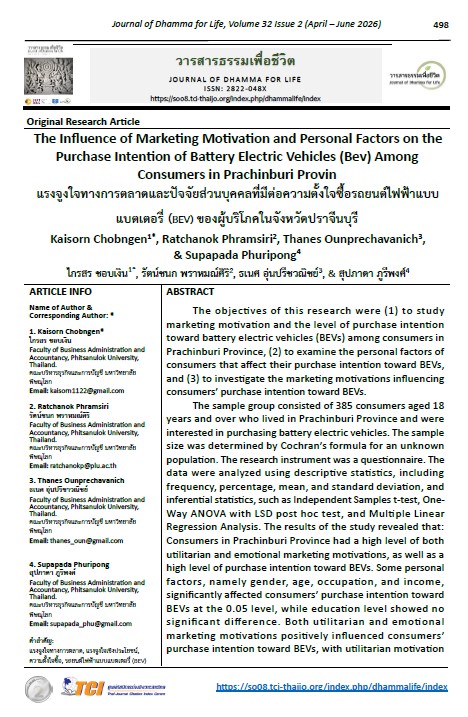
การวิจัยครั้งนี้มีวัตถุประสงค์เพื่อ (1) ศึกษาแรงจูงใจทางการตลาดและระดับความตั้งใจซื้อรถยนต์ไฟฟ้าแบบแบตเตอรี่ (BEV) ของผู้บริโภคในจังหวัดปราจีนบุรี (2) ศึกษาลักษณะปัจจัยส่วนบุคคลของผู้บริโภคที่มีผลต่อความตั้งใจซื้อรถยนต์ไฟฟ้าแบบแบตเตอรี่ (BEV) และ (3) ศึกษาแรงจูงใจทางการตลาดที่ส่งผลต่อความตั้งใจซื้อรถยนต์ไฟฟ้าแบบแบตเตอรี่ (BEV) ของผู้บริโภคในจังหวัดปราจีนบุรี กลุ่มตัวอย่างที่ใช้ในการวิจัย คือ ผู้บริโภคในจังหวัดปราจีนบุรีที่มีอายุ 18 ปีขึ้นไป จำนวน 385 คน ซึ่งได้มาจากการคำนวณขนาดกลุ่มตัวอย่างโดยใช้สูตรของ Cochran สำหรับประชากรที่ไม่ทราบจำนวนแน่ชัด เครื่องมือที่ใช้ในการวิจัยคือแบบสอบถาม สถิติที่ใช้ในการวิเคราะห์ข้อมูลประกอบด้วย สถิติเชิงพรรณนา ได้แก่ ค่าร้อยละ ค่าเฉลี่ย และส่วนเบี่ยงเบนมาตรฐาน และสถิติเชิงอนุมาน ได้แก่ Independent Samples t-test, One-Way ANOVA, การทดสอบ LSD (Least Significant Difference) และการวิเคราะห์ถดถอยพหุคูณ (Multiple Linear Regression Analysis)
ผลการวิจัยพบว่า ผู้บริโภคในจังหวัดปราจีนบุรีมีระดับแรงจูงใจทางการตลาดทั้งเชิงประโยชน์และเชิงอารมณ์อยู่ในระดับสูง และมีระดับความตั้งใจซื้อรถยนต์ไฟฟ้าแบบแบตเตอรี่ในระดับสูงเช่นกันปัจจัยส่วนบุคคลบางประการ ได้แก่ เพศ อายุ อาชีพ และรายได้ มีผลต่อความตั้งใจซื้อรถยนต์ไฟฟ้าแบบแบตเตอรี่อย่างมีนัยสำคัญทางสถิติที่ระดับ 0.05 ขณะที่วุฒิการศึกษาไม่พบความแตกต่างอย่างมีนัยสำคัญ แรงจูงใจทางการตลาดทั้งสองด้าน ได้แก่ แรงจูงใจเชิงประโยชน์ และแรงจูงใจเชิงอารมณ์ มีอิทธิพลเชิงบวกต่อความตั้งใจซื้อรถยนต์ไฟฟ้าแบบแบตเตอรี่ของผู้บริโภค โดยแรงจูงใจเชิงประโยชน์มีอิทธิพลมากที่สุด (β = 0.626, p < .001) รองลงมาคือแรงจูงใจเชิงอารมณ์ (β = 0.245, p < .001) โดยแบบจำลองสามารถอธิบายความแปรปรวนของความตั้งใจซื้อได้ร้อยละ 71.0 (R² = .710)
Article Details
เอกสารอ้างอิง
บุญชม ศรีสะอาด. (2554). การวัดและประเมินผลในงานวิจัย (พิมพ์ครั้งที่ 1). กรุงเทพฯ: สำนักพิมพ์แห่งจุฬาลงกรณ์มหาวิทยาลัย.
สำนักงานนโยบายและแผนพลังงาน. (2565). รายงานนโยบายการส่งเสริมยานยนต์ไฟฟ้าในประเทศไทย. กรุงเทพฯ: กระทรวงพลังงาน.
สถาบันการศึกษาหนึ่ง. (2020). การวิเคราะห์ปัจจัยทางการตลาดที่ส่งผลต่อความตั้งใจซื้อรถยนต์ไฟฟ้าในกรุงเทพฯและปริมณฑล. วารสารการตลาดไทย, 15(2), 55–70.
Ajzen, I. (1991). The theory of planned behavior. Organizational Behavior and Human Decision Processes, 50(2), 179–211. https://doi.org/10.1016/0749-5978(91)90020-T
Babin, B. J., Darden, W. R., & Griffin, M. (1994). Work and/or fun: Measuring hedonic and utilitarian shopping value. Journal of Consumer Research, 20(4), 644–656. https://doi.org/10.1086 /209376
Buntavong, N., & Pommi, V. (2024). Consumer perceived value and purchase intention toward electric vehicles in Thailand. Journal of Sustainable Transport Studies, 12(1), 45–63.
Cochran, W. G. (1977). Sampling techniques (3rd ed.). New York, NY: John Wiley & Sons.
Cronbach, L. J. (1970). Essentials of psychological testing (3rd ed.). New York, NY: Harper & Row.
Dodds, W. B., Monroe, K. B., & Grewal, D. (1991). Effects of price, brand, and store information on buyers’ product evaluations. Journal of Marketing Research, 28(3), 307–319. https://doi.org/10.1177/002224379102800304
Fishbein, M., & Ajzen, I. (2010). Predicting and changing behavior: The reasoned action approach. Psychology Press.
Intergovernmental Panel on Climate Change [IPCC]. (2023). Climate change 2023: Synthesis report. IPCC. https://www.ipcc.ch/report/ar6/syr/
International Energy Agency [IEA]. (2024). Global EV outlook 2024. IEA. https://www.iea. org/reports/global-ev-outlook-2024
Kotler, P., & Keller, K. L. (2016). Marketing management (15th ed.). Pearson Education.
Schiffman, L. G., & Kanuk, L. L. (2009). Consumer behavior (10th ed.). Upper Saddle River, NJ: Pearson Prentice Hall.
Songsakratree, P., & Prasertchuwong, S. (2025). Demographic factors influencing battery electric vehicle adoption in Thailand. Asian Journal of Sustainable Mobility, 3(1), 77–92.
Suphaphattharaphisan, N., & Ratsameechot, T. (2022). Marketing mix influence on electric vehicle purchase intention in Thailand. Journal of Marketing Trends, 8(4), 56–70.
Voss, K. E., Spangenberg, E. R., & Grohmann, B. (2003). Measuring the hedonic and utilitarian dimensions of consumer attitude. Journal of Marketing Research, 40(3), 310–320. https://doi.org/10.1509/jmkr.40.3.310.19238
Yang, M., Tang, Y., & Li, X. (2018). The impact of personal innovativeness on electric vehicle adoption: Evidence from China. Transportation Research Part D: Transport and Environment, 63, 1–12. https://doi.org/10.1016/j.trd.2018.05.001
Zhu, J., & Lamsali, R. (2024). Consumer behavior towards electric vehicles: A review and future research directions. International Journal of Automotive Technology and Management, 24(1), 1–25.
