พลวัตเมืองนครชัยศรีกับภาวะผู้นำเพื่อความยั่งยืน
Article Sidebar
Main Article Content
บทคัดย่อ
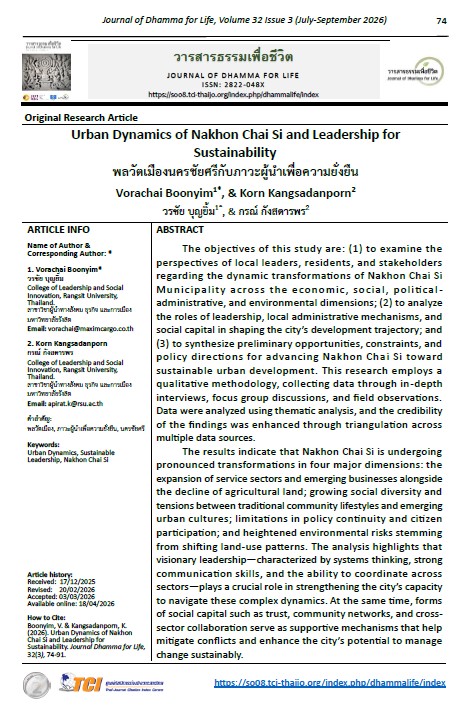
การวิจัยครั้งนี้มีวัตถุประสงค์เพื่อ (1) ศึกษามุมมองของผู้นำ ประชาชน และผู้มีส่วนได้ส่วนเสียต่อพลวัตการเปลี่ยนแปลงของเมืองนครชัยศรีในมิติด้านเศรษฐกิจ สังคม การเมืองการบริหาร และสิ่งแวดล้อม (2) วิเคราะห์บทบาทของผู้นำ กลไกการบริหารท้องถิ่น และทุนทางสังคมที่ส่งผลต่อทิศทางการพัฒนาเมือง และ (3) สังเคราะห์โอกาส อุปสรรค และแนวทางเชิงนโยบายเบื้องต้นในการพัฒนาเมืองนครชัยศรีสู่ความยั่งยืน การวิจัยใช้ระเบียบวิธีเชิงคุณภาพ เก็บข้อมูลจากการสัมภาษณ์เชิงลึก การสนทนากลุ่ม และการสังเกตพื้นที่จริง วิเคราะห์ข้อมูลด้วยการสังเคราะห์เชิงประเด็นและตรวจสอบความน่าเชื่อถือด้วยการใช้ข้อมูลหลายแหล่ง
ผลการวิจัยพบว่า เมืองนครชัยศรีกำลังเผชิญพลวัตการเปลี่ยนแปลงอย่างเด่นชัดใน 4 มิติ ได้แก่ การขยายตัวของภาคบริการและธุรกิจใหม่ควบคู่กับการลดลงของพื้นที่เกษตรกรรม ความหลากหลายทางสังคมและความตึงเครียดระหว่างวิถีชุมชนดั้งเดิมกับวัฒนธรรมเมืองใหม่ ข้อจำกัดด้านความต่อเนื่องของนโยบายและการมีส่วนร่วมของประชาชน และความเสี่ยงด้านมลภาวะจากการเปลี่ยนแปลงการใช้ประโยชน์ที่ดิน บทวิเคราะห์ชี้ว่า ภาวะผู้นำที่มีวิสัยทัศน์ คิดเชิงระบบ มีทักษะการสื่อสารและการประสานงานหลายภาคส่วน มีบทบาทสำคัญต่อความสามารถของเมืองในการรับมือความซับซ้อนของพลวัตดังกล่าว ขณะเดียวกันทุนทางสังคม เช่น ความไว้เนื้อเชื่อใจ เครือข่ายชุมชน และความร่วมมือระหว่างภาคส่วน เป็นกลไกหนุนเสริมที่ช่วยลดความขัดแย้งและเพิ่มศักยภาพเมืองในการจัดการความเปลี่ยนแปลงอย่างยั่งยืน
Article Details
เอกสารอ้างอิง
กตัญญู แก้วหานาม. (2564). การพัฒนาต้นแบบเมืองแห่งการเรียนรู้ (Learning City) ผ่านระบบ กลไกความร่วมมือเชิงพื้นที่เพื่อพัฒนาเศรษฐกิจท้องถิ่น: กรณีศึกษาเทศบาล เมืองกาฬสินธุ์. วารสารวิชาการการพัฒนาเมืองและท้องถิ่น, 10(2), 45-60.
โกวิทย์ พวงงาม. (2553). การปกครองท้องถิ่นไทย: หลักการและมิติใหม่ในอนาคต. สำนักพิมพ์เสมาธรรม.
ณิชมล ปัญญาวชิโรกุล, & สุรเชษฐ์ ศรีภูริรักษ์. (2568). [บทความ/รายงานเกี่ยวกับความเป็นเมืองในเอเชีย]. (กรุณาเพิ่มรายละเอียดแหล่งตีพิมพ์)
ปาณิสรา ตรัสศรี. (2559). [งานวิจัยด้านการพัฒนาเมือง/การมีส่วนร่วม]. (กรุณาเพิ่มรายละเอียดแหล่งตีพิมพ์)
ประเวศ วะสี. (2545). พลังสามเหลี่ยมเขยื้อนภูเขา: ยุทธศาสตร์การพัฒนาสังคมไทย. หมอชาวบ้าน.
เอนก เหล่าธรรมทัศน์. (2542). ประชาสังคมกับการพัฒนาประเทศไทย. สำนักพิมพ์วิญญูชน.
อรทัย ก๊กผล. (2554). การกระจายอำนาจกับการปกครองท้องถิ่นไทย. สถาบันพระปกเกล้า.
สมาน ศิริเจริญสุข. (2565). ภาวะผู้นำกับการจัดการความขัดแย้ง. วารสารวิจัยวิชาการ, 5(6), 301-316.
สวทช. (2560). แนวคิดเมืองอัจฉริยะ (Smart City) และการพัฒนาเมืองในประเทศไทย. สำนักงานพัฒนาวิทยาศาสตร์และเทคโนโลยีแห่งชาติ.
Angel, S. (2011). Making room for a planet of cities. Lincoln Institute of Land Policy.
Angel, S., Parent, J., Civco, D. L., Blei, A., & Potere, D. (2012). The dimensions of global urban expansion: Estimates and projections for all countries, 2000–2050. Lincoln Institute of Land Policy.
Ansell, C., & Gash, A. (2007). Collaborative governance in theory and practice. Journal of Public Administration Research and Theory, 18(4), 543–571. https://doi.org/10.1093/jopart/mum 032
Beer, A., McKenzie, F., Blažek, J., & Sotarauta, M. (2019). Place-based leadership and regional development. Routledge.
Bingham, L. B., Nabatchi, T., & O’Leary, R. (2005). The new governance: Practices and processes for stakeholder and citizen participation in the work of government. Public Administration Review, 65(5), 547–558.
Bourdieu, P. (1986). The forms of capital. In J. Richardson (Ed.), Handbook of Theory and Research for the Sociology of Education (pp. 241–258). Greenwood.
Braun, V., & Clarke, V. (2006). Using thematic analysis in psychology. Qualitative Research in Psychology, 3(2), 77–101. https://doi.org/10.1191/1478088706qp063oa
Campbell, S. (1996). Green cities, growing cities, just cities? Urban planning and the contradictions of sustainable development. Journal of the American Planning Association, 62(3), 296–312.
Coleman, J. S. (1988). Social capital in the creation of human capital. American Journal of Sociology, 94, S95–S120.
Creswell, J. W., & Poth, C. N. (2018). Qualitative inquiry and research design: Choosing among five approaches (4th ed.). Sage Publications.
Crosby, B. C., & Bryson, J. M. (2005). Leadership for the common good: Tackling public problems in a shared-power world. Jossey-Bass.
Douglas, I., et al. (2005). Urban ecology / urban environmental change in Southeast Asia. (Details need verification).
Evans, B., Joas, M., Sundback, S., & Theobald, K. (2006). Governing sustainable cities. Earthscan.
European Commission, Joint Research Centre (JRC). (2024). Urbanisation and sustainable cities in Asia: Challenges and policy responses. European Commission.
Flyvbjerg, B. (2006). Five misunderstandings about case-study research. Qualitative Inquiry, 12(2), 219–245. https://doi.org/10.1177/1077800405284363
Granovetter, M. S. (1973). The strength of weak ties. American Journal of Sociology, 78(6), 1360–1380.
Hambleton, R. (2014). Leading the inclusive city: Place-based innovation for a bounded planet. Policy Press.
Heifetz, R. A. (1994). Leadership without easy answers. Harvard University Press.
Heifetz, R. A., Grashow, A., & Linsky, M. (2009). The practice of adaptive leadership: Tools and tactics for changing your organization and the world. Harvard Business Press.
Hooghe, L., & Marks, G. (2003). Unraveling the central state, but how? Types of multi-level governance. American Political Science Review, 97(2), 233–243.
Lefebvre, H. (1991). The production of space (D. Nicholson-Smith, Trans.). Blackwell. (Original work published 1974)
Marshall, J. D., McDonald, R. L., & Levy, M. J. (2009). Urbanization and environmental health: The role of urban growth in developing countries. Environmental Research Letters, 4(4), 044005.
McGee, T. G. (1991). The emergence of desakota regions in Asia: Expanding a hypothesis. In N. Ginsburg, B. Koppel, & T. G. McGee (Eds.), The extended metropolis (pp. 3–25). University of Hawaii Press.
Mol, A. P. J., & Spaargaren, G. (2000). Ecological modernisation theory in debate. Environmental Politics, 9(1), 17–49.
Pacione, M. (2009). Urban geography: A global perspective (3rd ed.). Routledge.
Putnam, R. D. (1993). Making democracy work: Civic traditions in modern Italy. Princeton University Press.
Putnam, R. D. (2000). Bowling alone: The collapse and revival of American community. Simon & Schuster.
Rhodes, R. A. W. (1997). Understanding governance: Policy networks, governance, reflexivity and accountability. Open University Press.
Sandelowski, M. (1995). Sample size in qualitative research. Research in Nursing & Health, 18(2), 179–183. https://doi.org/10.1002/nur.4770180211
Satterthwaite, D. (2016). Successful small cities: A different vision for urbanisation. Environment and Urbanization, 28(1), 3–8. https://doi.org/10.1177/0956247815627525
Sieverts, T. (2003). Cities without cities: An interpretation of the Zwischenstadt. Routledge.
SDSN Thailand. (2024). Sustainable Development Report Thailand: SDG 11 Sustainable Cities and Communities. Sustainable Development Solutions Network Thailand.
The Rockefeller Foundation. (2025). 100 Resilient Cities: Building urban resilience in the 21st century. Rockefeller Foundation.
United Nations, Department of Economic and Social Affairs, Population Division. (2018). World Urbanization Prospects: The 2018 Revision. United Nations.
UN-Habitat. (2020). World cities report 2020: The value of sustainable urbanization. United Nations Human Settlements Programme.
Uhl-Bien, M., Marion, R., & McKelvey, B. (2007). Complexity leadership theory: Shifting leadership from the industrial age to the knowledge era. The Leadership Quarterly, 18(4), 298–318. https://doi.org/10.1016/j.leaqua.2007.04.002
World Bank. (2009). World development report 2009: Reshaping economic geography. World Bank.
Yin, R. K. (2018). Case study research and applications: Design and methods (6th ed.). Sage Publications.
