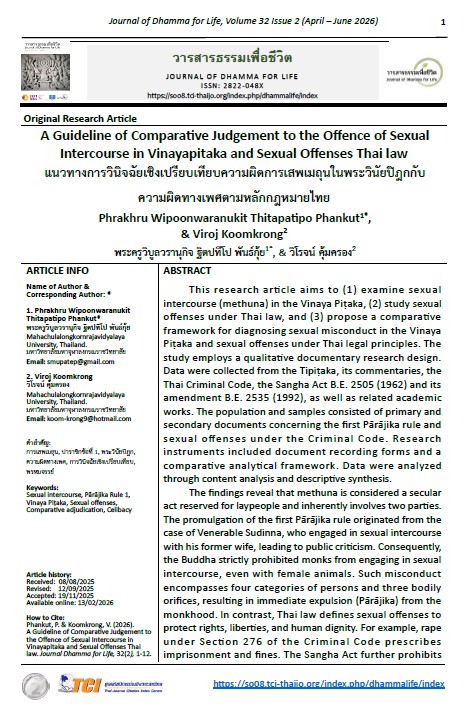
A Guideline of Comparative Judgement to the Offence of Sexual Intercourse in Vinayapitaka and Sexual Offenses Thai law
Article Sidebar
Main Article Content
Abstract
This research article aims to (1) examine sexual intercourse (methuna) in the Vinaya Piṭaka, (2) study sexual offenses under Thai law, and (3) propose a comparative framework for diagnosing sexual misconduct in the Vinaya Piṭaka and sexual offenses under Thai legal principles. The study employs a qualitative documentary research design. Data were collected from the Tipiṭaka, its commentaries, the Thai Criminal Code, the Sangha Act B.E. 2505 (1962) and its amendment B.E. 2535 (1992), as well as related academic works. The population and samples consisted of primary and secondary documents concerning the first Pārājika rule and sexual offenses under the Criminal Code. Research instruments included document recording forms and a comparative analytical framework. Data were analyzed through content analysis and descriptive synthesis.
The findings reveal that methuna is considered a secular act reserved for laypeople and inherently involves two parties. The promulgation of the first Pārājika rule originated from the case of Venerable Sudinna, who engaged in sexual intercourse with his former wife, leading to public criticism. Consequently, the Buddha strictly prohibited monks from engaging in sexual intercourse, even with female animals. Such misconduct encompasses four categories of persons and three bodily orifices, resulting in immediate expulsion (Pārājika) from the monkhood. In contrast, Thai law defines sexual offenses to protect rights, liberties, and human dignity. For example, rape under Section 276 of the Criminal Code prescribes imprisonment and fines. The Sangha Act further prohibits those expelled under Pārājika from reordination. The comparative analysis indicates that the Vinaya aims to preserve celibacy and monastic purity, whereas Thai law seeks to protect society and victims. Although differing in nature religious sanction versus criminal punishment both systems converge in regulating conduct that affects morality and social order, suggesting an integrated doctrinal and legal approach for sustainable prevention and resolution.
Article Details
References
ประมวลกฎหมายอาญา. (2562). ประมวลกฎหมายอาญา (ฉบับแก้ไขเพิ่มเติม พ.ศ. 2562). ราชกิจจานุเบกษา.
พระไตรปิฎก เล่มที่ 4. (2539). พระวินัยปิฎก มหาวัคค์. มหาจุฬาลงกรณราชวิทยาลัย.
พระไตรปิฎกภาษาไทย ฉบับมหาจุฬาลงกรณราชวิทยาลัย. (2539). กรุงเทพฯ: โรงพิมพ์มหาจุฬาลงกรณราชวิทยาลัย.
พระธรรมปิฎก (ป.อ. ปยุตฺโต). (2543). พุทธธรรม (ฉบับปรับปรุงและขยายความ). มหาจุฬาลงกรณราชวิทยาลัย.
พระพรหมคุณาภรณ์ (ป.อ. ปยุตฺโต). (2556). พจนานุกรมพุทธศาสตร์ ฉบับประมวลธรรม. มหาวิทยาลัยมหาจุฬาลงกรณราชวิทยาลัย.
พระมหาสำราญ ฐานุตฺตโม, & สมบัติ อรรถพิมล. (2567). การเปรียบเทียบหลักความรับผิดของบุคคลวิกลจริตในพระวินัยกับประมวลกฎหมายอาญา มาตรา 65. วารสารนิติศาสตร์และพระพุทธศาสนา, 12(1), 45–68.
หยุด แสงอุทัย. (2548). คำอธิบายกฎหมายอาญาภาคทั่วไป. สำนักพิมพ์มหาวิทยาลัยธรรมศาสตร์.
โทพิช ศาลพันธุ์วัฒนา. (2559). หลักปาราชิกในพระวินัยปิฎก: การวิเคราะห์เชิงนิติปรัชญา. วารสารสังคมศาสตร์และมนุษยศาสตร์, 42(3), 89–112.
Duangwises, N. (2016). Gender classifications in the Vinaya and the regulation of sexuality in the Buddhist monastic order. Journal of Buddhist Studies, 12(2), 45–68.
Namdee, P., & Promsee, S. (2025). Historical Perspectives on the Prohibition of Sexual Activities of Buddhist Monks: A Case Study from the Vinaya Pitaka. Journal of Buddhistic Sociology, 10(2), 43-58.
