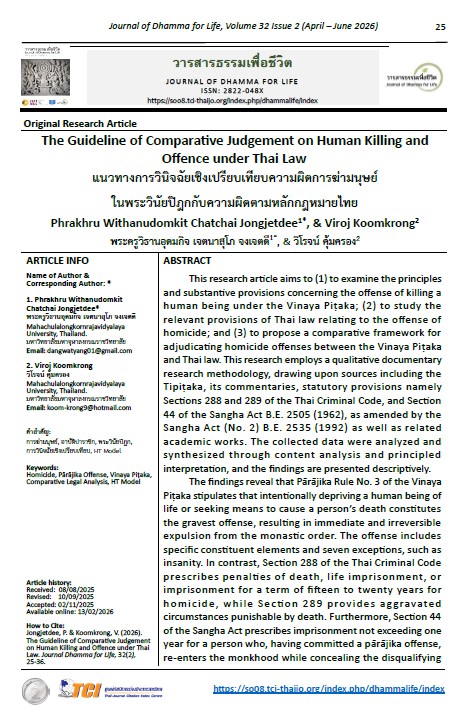
The Guideline of Comparative Judgement on Human Killing and Offence under Thai Law
Article Sidebar
Main Article Content
Abstract
This research article aims to (1) to examine the principles and substantive provisions concerning the offense of killing a human being under the Vinaya Piṭaka; (2) to study the relevant provisions of Thai law relating to the offense of homicide; and (3) to propose a comparative framework for adjudicating homicide offenses between the Vinaya Piṭaka and Thai law. This research employs a qualitative documentary research methodology, drawing upon sources including the Tipiṭaka, its commentaries, statutory provisions namely Sections 288 and 289 of the Thai Criminal Code, and Section 44 of the Sangha Act B.E. 2505 (1962), as amended by the Sangha Act (No. 2) B.E. 2535 (1992) as well as related academic works. The collected data were analyzed and synthesized through content analysis and principled interpretation, and the findings are presented descriptively.
The findings reveal that Pārājika Rule No. 3 of the Vinaya Piṭaka stipulates that intentionally depriving a human being of life or seeking means to cause a person’s death constitutes the gravest offense, resulting in immediate and irreversible expulsion from the monastic order. The offense includes specific constituent elements and seven exceptions, such as insanity. In contrast, Section 288 of the Thai Criminal Code prescribes penalties of death, life imprisonment, or imprisonment for a term of fifteen to twenty years for homicide, while Section 289 provides aggravated circumstances punishable by death. Furthermore, Section 44 of the Sangha Act prescribes imprisonment not exceeding one year for a person who, having committed a pārājika offense, re-enters the monkhood while concealing the disqualifying fact. The comparative analysis indicates that both legal systems fundamentally aim to protect the value of human life. The Vinaya emphasizes the purity and integrity of the monastic status, whereas secular law focuses on maintaining public order and social justice. Although differing in form and purpose, the severity of sanctions in both systems reflects a comparable degree of gravity. In this regard, the researcher has developed an integrated body of knowledge in the form of the “HT Model” to systematically explain the comparative adjudicative framework, contributing to further studies in Buddhist legal philosophy and jurisprudence.
Article Details
References
คณิต ณ นคร. (2561). กฎหมายอาญาภาคทั่วไป (พิมพ์ครั้งที่ 6). วิญญูชน.
ธวัชชัย สิงห์คำ. (2558). ศึกษาเปรียบเทียบเจตนาในพระพุทธศาสนากับเจตนาในประมวลกฎหมายอาญาของประเทศไทย. วารสารพุทธศาสตร์ศึกษา, 6(1).
ประมวลกฎหมายอาญา. (2566). วิญญูชน.
พระครูอุทุมพร กิตติคุณ (เลื่อน ภมโร), โกเมศ ขวัญเมือง, และพระสิทธินิติธาดา (ชลัชโชติทตฺโต). (2567). การศึกษาเปรียบเทียบความรับผิดตามพระธรรมวินัยของพระภิกษุกรณีตติยปาราชิกตามหลักพุทธศาสนาเถรวาท และความรับผิดอาญาของบุคคลในความผิดต่อชีวิตตามประมวลกฎหมายอาญา. วารสารสหวิทยาการนวัตกรรมปริทรรศน์, 7(4), 418–426.
พระไตรปิฎก เล่มที่ 4 วินัยปิฎก มหาวิภังค์. (ม.ป.ป.). มหามกุฏราชวิทยาลัย.
พระไตรปิฎกภาษาไทย ฉบับมหาจุฬาลงกรณราชวิทยาลัย. (2539). พระวินัยปิฎก เล่ม 1–2 (มหาวิภังค์ ภาค 1–2). มหาจุฬาลงกรณราชวิทยาลัย.
พระพรหมคุณาภรณ์ (ป.อ. ปยุตฺโต). (2556). พจนานุกรมพุทธศาสตร์ ฉบับประมวลธรรม. สำนักพิมพ์ผลิธัมม์.
พระมหาสำราญ ฐานุตฺตโม และสมบัติ อรรถพิมล. (2567). การศึกษาเปรียบเทียบความรับผิดของพระภิกษุวิกลจริตที่กระทำความผิดตามพระธรรมวินัย และความรับผิดของบุคคลวิกลจริตตามประมวลกฎหมายอาญา มาตรา 65. วารสารสหวิทยาการนวัตกรรมปริทรรศน์, 7(4), 237–251.
พระราชบัญญัติคณะสงฆ์ พ.ศ. 2505 และที่แก้ไขเพิ่มเติม. (2505). สำนักนายกรัฐมนตรี.
มหาจุฬาลงกรณราชวิทยาลัย. (2539). พระไตรปิฎกภาษาไทย ฉบับมหาจุฬาลงกรณราชวิทยาลัย (เล่ม 4 พระวินัยปิฎก มหาวรรค). โรงพิมพ์มหาจุฬาลงกรณราชวิทยาลัย.
สุชีพ ปุญญานุภาพ. (2540). การบริหารกิจการคณะสงฆ์ไทย. สำนักพิมพ์มหามกุฏราชวิทยาลัย.
หยุด แสงอุทัย. (2556). กฎหมายอาญา ภาค 1. สำนักพิมพ์มหาวิทยาลัยธรรมศาสตร์.
หยุด แสงอุทัย. (2560). กฎหมายอาญาภาคทั่วไป (พิมพ์ครั้งที่ 21). มหาวิทยาลัยธรรมศาสตร์.
อภิ โชค เกิดผล, สิริ พร ครองชีพ, และกฤตสุชิน พลเสน. (2564). นิติปรัชญาในระบบกฎหมายอาญาไทยกับพุทธจริยศาสตร์ว่าด้วยปาณาติบาตกรรม. ศึกษาศาสตร์ มมร, 9(1), 224–231.
