An Approach of Comparative Judgement to the Arrogance Offence in Vinaya Pitaka and the Offences under Thai Law
Article Sidebar
Main Article Content
Abstract
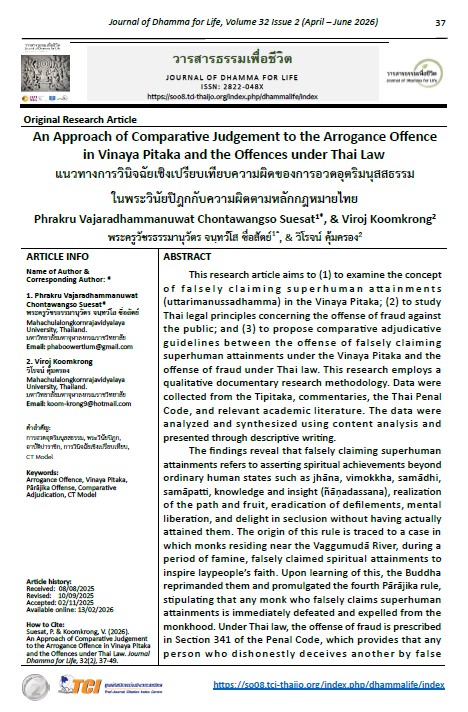
This research article aims to (1) to examine the concept of falsely claiming superhuman attainments (uttarimanussadhamma) in the Vinaya Pitaka; (2) to study Thai legal principles concerning the offense of fraud against the public; and (3) to propose comparative adjudicative guidelines between the offense of falsely claiming superhuman attainments under the Vinaya Pitaka and the offense of fraud under Thai law. This research employs a qualitative documentary research methodology. Data were collected from the Tipitaka, commentaries, the Thai Penal Code, and relevant academic literature. The data were analyzed and synthesized using content analysis and presented through descriptive writing.
The findings reveal that falsely claiming superhuman attainments refers to asserting spiritual achievements beyond ordinary human states such as jhāna, vimokkha, samādhi, samāpatti, knowledge and insight (ñāṇadassana), realization of the path and fruit, eradication of defilements, mental liberation, and delight in seclusion without having actually attained them. The origin of this rule is traced to a case in which monks residing near the Vaggumudā River, during a period of famine, falsely claimed spiritual attainments to inspire laypeople’s faith. Upon learning of this, the Buddha reprimanded them and promulgated the fourth Pārājika rule, stipulating that any monk who falsely claims superhuman attainments is immediately defeated and expelled from the monkhood. Under Thai law, the offense of fraud is prescribed in Section 341 of the Penal Code, which provides that any person who dishonestly deceives another by false representation or concealment of facts and thereby obtains property shall be liable to imprisonment for a term not exceeding 3 years, or a fine not exceeding 60,000 baht, or both. In aggravated circumstances under Section 342 (3), the penalty may extend to imprisonment not exceeding 5 years, or a fine not exceeding 100,000 baht, or both. The comparative analysis is structured into 4 dimensions: (1) legal status and doctrinal foundations; (2) criteria for determining liability; (3) sanctions and penalties; and (4) integrative remedial measures. The study proposes cooperative mechanisms between the Sangha and state authorities, including the appointment of Vinayadhara experts proficient in both ecclesiastical discipline and secular law to adjudicate such cases. The research culminates in the development of the “CT Model,” a systematic framework for comparative legal-religious analysis and adjudication.
Article Details
References
กรมการศาสนา. (2542). พระไตรปิฎกภาษาไทย ฉบับมหาจุฬาลงกรณราชวิทยาลัย เล่มที่ 1 พระวินัยปิฎก ปาราชิกกัณฑ์. โรงพิมพ์มหาจุฬาลงกรณราชวิทยาลัย.
กิตติพงษ์ กิตติยารักษ์. (2561). การตีความความผิดฐานฉ้อโกงในบริบทสังคมไทย. วารสารกฎหมายอาญา, 35(2), 1–25.
คณิต ณ นคร. (2560). กฎหมายอาญา ภาคความผิด. วิญญูชน.
ชาญชัย แสวงศักดิ์. (2563). เสรีภาพในการนับถือศาสนากับการบังคับใช้กฎหมายอาญา. วารสารนิติศาสตร์, 49(3), 45–68.
ธงทอง จันทรางศุ. (2559). หลักกฎหมายอาญากับการคุ้มครองความสงบเรียบร้อยของประชาชน. วิญญูชน.
ประมวลกฎหมายอาญา. (2499). ราชกิจจานุเบกษา, 73(95 ฉบับพิเศษ), 1–73.
พระครูอุทุมพร กิตติคุณ (เลื่อน ภมโร), โกเมศ ขวัญเมือง, และพระสิทธินิติธาดา (ชลัชโชติทตฺโต). (2567). การศึกษาเปรียบเทียบความรับผิดตามพระธรรมวินัยของพระภิกษุกรณีตติยปาราชิกตามหลักพุทธศาสนาเถรวาท และความรับผิดอาญาของบุคคลในความผิดต่อชีวิตตามประมวลกฎหมายอาญา. วารสารสหวิทยาการนวัตกรรมปริทรรศน์, 7(4), 418–426.
พระไตรปิฎก เล่มที่ 1. (ม.ป.ป.). วินัยปิฎก มหาวิภังค์. มหามกุฏราชวิทยาลัย.
พระไตรปิฎก เล่มที่ 4 วินัยปิฎก มหาวิภังค์. (2539). มหาจุฬาลงกรณราชวิทยาลัย.
พระปราบศึก อุทโย, พระมหาสุรศักดิ์ ปจฺจนฺตเสโน, และพระมหาจีรวัฒน์ กนฺตวณฺโณ. (2565). เกณฑ์การวินิจฉัยการอวดอุตตริมนุสธรรมตามหลักการในพระไตรปิฎก. วารสาร มจร พุทธศาสตร์ปริทรรศน์, 6(3), 185–200.
พระมหาสมบูรณ์ วุฑฺฒิกโร. (2560). แนวคิดเรื่องอาบัติปาราชิกในพระวินัยปิฎก. วารสารพุทธศาสตร์ศึกษา, 24(1), 12–30.
พระมหาสำราญ ฐานุตฺตโม, และสมบัติ อรรถพิมล. (2567). การศึกษาเปรียบเทียบความรับผิดของพระภิกษุวิกลจริตที่กระทำความผิดตามพระธรรมวินัย และความรับผิดของบุคคลวิกลจริตตามประมวลกฎหมายอาญา มาตรา 65. วารสารสหวิทยาการนวัตกรรมปริทรรศน์, 7(4), 237–251.
พระมหาตัณฑ์ฐวัฒน์ สนฺตจิตฺโน (ถำวาปี), และฐิติวัสส์ หมั่นกิจ. (2566). นิติศาสตร์ในพระวินัยปิฎก. วารสารมณีเชษฐาราม วัดจอมมณี, 6(1), 81–99.
มหาจุฬาลงกรณราชวิทยาลัย. (2539). อรรถกถาพระวินัยปิฎก (สมันตปาสาทิกา). โรงพิมพ์มหาจุฬาลงกรณราชวิทยาลัย.
ราชบัณฑิตยสถาน. (2564). พจนานุกรมศัพท์พระพุทธศาสน์ ฉบับราชบัณฑิตยสถาน. ราชบัณฑิตยสถาน.
สุเชาวน์ พลอยชุม. (2562). ความซื่อสัตย์ทางจิตวิญญาณกับความน่าเชื่อถือของสถาบันสงฆ์ไทย. วารสารพุทธศาสตร์ศึกษา, 26(2), 55–78.
หยุด แสงอุทัย. (2556). คำอธิบายกฎหมายอาญา ภาค 2 ตอน 2 ความผิดเกี่ยวกับทรัพย์. สำนักพิมพ์มหาวิทยาลัยธรรมศาสตร์.
Chansamorn, S. (2021). Principles of considering punishment for disciplinary offenders according to Buddhist precepts and criminal offences according to the Penal Code: A comparative study of similarities and differences. Journal of Graduate Studies, Mahamakutrajavidyalaya University, 19(2), 249–263.
Suriyo, P. S., Sinprasitkul, W., Thongnun, C., Chunu, C., & Hemrangsee, J. (2021). Legal problems concerning the renunciation of monastic vows due to criminal offences. Journal of Buddhist Anthropology, 6(2), 143–159.
