The Approach of Pancadhamma Teaching Implementation for Behavior Growth on Pancasila’s Performance
Article Sidebar
Main Article Content
Abstract
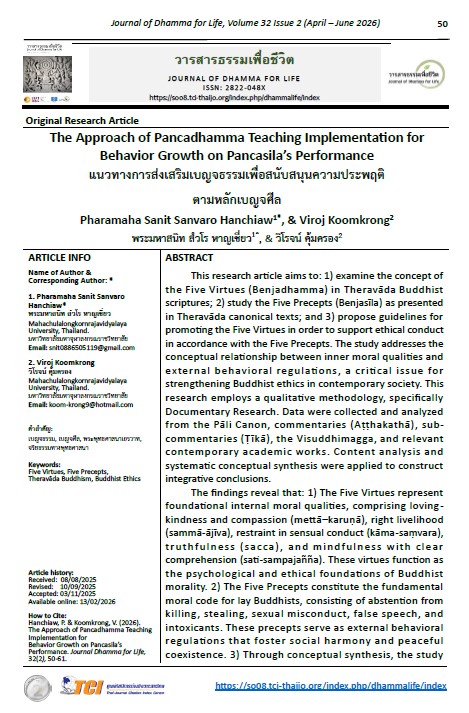
This research article aims to: 1) examine the concept of the Five Virtues (Benjadhamma) in Theravāda Buddhist scriptures; 2) study the Five Precepts (Benjasīla) as presented in Theravāda canonical texts; and 3) propose guidelines for promoting the Five Virtues in order to support ethical conduct in accordance with the Five Precepts. The study addresses the conceptual relationship between inner moral qualities and external behavioral regulations, a critical issue for strengthening Buddhist ethics in contemporary society. This research employs a qualitative methodology, specifically Documentary Research. Data were collected and analyzed from the Pāli Canon, commentaries (Aṭṭhakathā), sub-commentaries (Ṭīkā), the Visuddhimagga, and relevant contemporary academic works. Content analysis and systematic conceptual synthesis were applied to construct integrative conclusions.
The findings reveal that: 1) The Five Virtues represent foundational internal moral qualities, comprising loving-kindness and compassion (mettā–karuṇā), right livelihood (sammā-ājīva), restraint in sensual conduct (kāma-saṃvara), truthfulness (sacca), and mindfulness with clear comprehension (sati-sampajañña). These virtues function as the psychological and ethical foundations of Buddhist morality. 2) The Five Precepts constitute the fundamental moral code for lay Buddhists, consisting of abstention from killing, stealing, sexual misconduct, false speech, and intoxicants. These precepts serve as external behavioral regulations that foster social harmony and peaceful coexistence. 3) Through conceptual synthesis, the study develops an ethical framework termed the “MORAL Model” to illustrate the complementary relationship between inner virtues and outer precepts: M = Metta–Karuṇā supports the first precept; O = Occupation (Right Livelihood) supports the second; R = Restraint in Sexuality corresponds to the third; A = Accuracy in Speech aligns with the fourth; and L = Lucid Awareness reinforces the fifth. The MORAL Model represents a novel body of knowledge demonstrating how cultivated inner virtues empower individuals to observe the Five Precepts voluntarily and sustainably, with practical applications at individual, familial, community, and policy levels for sustainable social development.
Article Details
References
พระไตรปิฎก. (2549). พระไตรปิฎกภาษาไทย ฉบับมหาจุฬาลงกรณราชวิทยาลัย (เล่มที่ 10, 11, 12, 20, 24, 25). โรงพิมพ์มหาจุฬาลงกรณราชวิทยาลัย.
พระไตรปิฎกภาษาไทย ฉบับมหาจุฬาลงกรณราชวิทยาลัย. (2539). พระวินัยปิฎก เล่ม 1 มหาวิภังค์ ภาค 1 (ปาราชิก). มหาจุฬาลงกรณราชวิทยาลัย.
พระเดชา ธร จารุ ธมฺโม (พรหม เอียด), พระอภิสิทธิ์ อภิชาโต (แซ่ จ้อง), ปุณยนุช ณ รักษา, & บวร ชัยวัฒน์ (วันชัย เลือดไทย). (2024). การบูรณาการหลักเบญจศีลและเบญจธรรมเพื่อการอยู่ร่วมกันของเยาวชนในยุคโลกาภิวัตน์. วารสารมณีเชษฐาราม วัดจอมมณี, 7(3), 1103–1119.
พระพรหมคุณาภรณ์ (ป.อ. ปยุตฺโต). (2556). พุทธธรรม (ฉบับปรับขยาย). มหาจุฬาลงกรณราชวิทยาลัย.
พระพุทธโฆสเถระ. (2554). วิสุทธิมรรค (พระธรรมโกศาจารย์ (ประยูร ธมฺมจิตฺโต), ผู้แปล). ธรรมสภา.
พระมหาสนิท หาญเชี่ยว, พระมหาปราโมทย์ แก้วนาง, & วิโรจน์ คุ้มครอง. (2023). การประยุกต์ใช้ศีล 5 โดยมีหลักเบญจธรรมมาสนับสนุนในการดำเนินชีวิตยุคใหม่. วารสารนวัตกรรมการจัดการศึกษาและการวิจัย, 5(5), 1151–1162.
พระมหาทรัพย์ ญาณเตโช (ปิดตาคะโส), บุญส่ง สินธุ์นอก, พระมหาประทีป อภิวัฑฒโน, & อริย์ธัช เลิศรวมโชค. (2025). ศึกษาแนวทางการใช้หลักเบญจศีลเบญจธรรมเพื่อพัฒนาคุณภาพชีวิตของชุมชนตำบลทุ่งฝน อำเภอทุ่งฝน จังหวัดอุดรธานี. วารสารส่งเสริมและพัฒนาวิชาการสมัยใหม่, 3(1), 233–249.
พระสุรเชษฐ อิทธิเตโช (ไชยรา), พระครูพิศาลสารบัณฑิต, สมเดชนาม เกตุ, & อริย์ธัช เลิศรวมโชค. (2024). รูปแบบการพัฒนาทรัพยากรมนุษย์ตามหลักเบญจศีลและเบญจธรรมของจังหวัดหนองบัวลำภู. วารสารพุทธศาสตร์ มจร.อุบลราชธานี, 6(3), 1745–1758.
พระอธิการเกียรติศักดิ์ กตทีโป, วรกฤต เถื่อนช้าง, & ปฏิธรรม สำเนียง. (2022). แนวทางการส่งเสริมการมีส่วนร่วมของพระสอนศีลธรรมในการพัฒนาเบญจศีลเบญจธรรมของนักเรียนประถมศึกษาในสถานศึกษาอำเภอบึงนาราง จังหวัดพิจิตร. วารสารวิจัยวิชาการ, 5(5), 1–12.
พระเอก นรินทร์ อาภากโร. (2018). การประยุกต์ใช้หลักเบญจศีลเบญจธรรมในการส่งเสริมคุณธรรมจริยธรรมในโรงเรียนเทศบาลตำบลสันมหาพน อำเภอแม่แตง จังหวัดเชียงใหม่. วารสารพุทธศาสตร์ศึกษา, 9(1).
พูลศักดิ์ หอมสมบัติ, & กิตติพัฒน์ ทาวงษา. (2019). ครอบครัวรักษาศีล 5: รูปแบบและการเสริมสร้างวัฒนธรรมการดำรงชีวิตของครอบครัวไทยในจังหวัดอุบลราชธานี. วารสารพุทธศาสตร์ มจร.อุบลราชธานี, 1(1), 1–14.
สิรินาถ รักษาภักดี. (2024). เบญจศีล เบญจธรรม: จริยธรรมพื้นฐานเพื่อสังคมสันติสุข. ปัญญาปณิธาน, 9 (2), 15–28.
