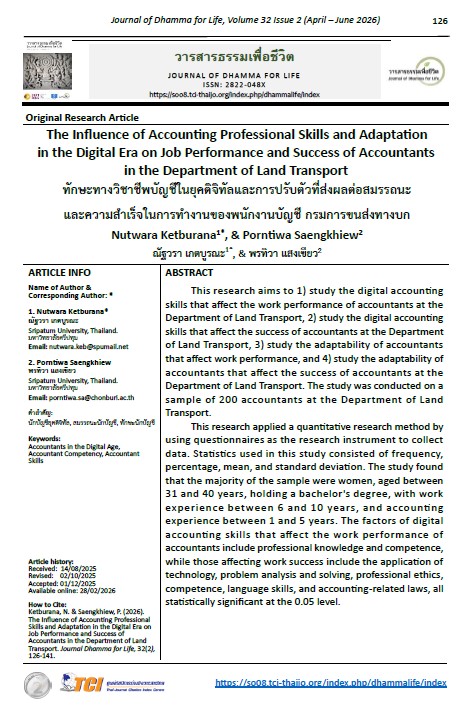
The Influence of Accounting Professional Skills and Adaptation in the Digital Era on Job Performance and Success of Accountants in the Department of Land Transport
Article Sidebar
Main Article Content
Abstract
This research aims to 1) study the digital accounting skills that affect the work performance of accountants at the Department of Land Transport, 2) study the digital accounting skills that affect the success of accountants at the Department of Land Transport, 3) study the adaptability of accountants that affect work performance, and 4) study the adaptability of accountants that affect the success of accountants at the Department of Land Transport. The study was conducted on a sample of 200 accountants at the Department of Land Transport.
This research applied a quantitative research method by using questionnaires as the research instrument to collect data. Statistics used in this study consisted of frequency, percentage, mean, and standard deviation. The study found that the majority of the sample were women, aged between 31 and 40 years, holding a bachelor's degree, with work experience between 6 and 10 years, and accounting experience between 1 and 5 years. The factors of digital accounting skills that affect the work performance of accountants include professional knowledge and competence, while those affecting work success include the application of technology, problem analysis and solving, professional ethics, competence, language skills, and accounting-related laws, all statistically significant at the 0.05 level.
Article Details
References
กองกำกับบัญชีธุรกิจ. (2567). แนวทางการดำเนินงานตามโครงการ National e-Payment และระบบภาษีอิเล็กทรอนิกส์. กรมสรรพากร.
จีระภา ยะโสและคณะ (2567). ผลกระทบของสมรรถนะนักบัญชียุคดิจิทัลที่มีต่อคุณภาพของรายงานทางบัญชี ภาครัฐ: สถานศึกษาสังกัดส านักงานคณะกรรมการการอาชีวศึกษา. วารสารวิทยาการจัดการ มหาวิทยาลัยราชภัฏอุดรธานี, 6(4), 60-71.
เจนจิรา ขันแก้ว. (2557). บทบาทนักบัญชีกับการกำกับดูแลกิจการที่ดี. วารสารวิชาการด้านการบัญชีและการเงิน, 10(2), 45–60.
ดังบัญชา มนูญกุลชัย. (2559). เศรษฐกิจดิจิทัลกับการพัฒนาระบบการชำระเงินของประเทศไทย. วารสารเศรษฐกิจและการเงิน, 12(1), 1–15.
ธีรศักดิ์ ฉั่วศรีสกุล. (2563). ความสำเร็จในการทำงานของผู้ประกอบวิชาชีพบัญชีในยุคดิจิทัล. วารสารบริหารธุรกิจและการบัญชี, 8(1), 77–92.
พัชรพร หนูประเสริฐ. (2565). ความเป็นมืออาชีพยุคดิจิทัลและการปฏิบัติงานตามจรรยาบรรณวิชาชีพบัญชี ที่ส่งผลต่อคุณภาพของงบการเงินของผู้ทำบัญชีในเขตกรุงเทพมหานคร. การค้นคว้าอิสระบัญชี มหาบัณฑิตคณะบัญชี มหาวิทยาลัยศรีปทุม.
เพ็ญนภา เกื้อเกตุ. (2563). ความรอบรู้ด้านดิจิทัลกับการพัฒนานักบัญชีไทย. วารสารการบัญชีและการจัดการ, 5(2), 101–118.
มนัสภรณ์ วังแวว และ อัศนีย์ ณ น่าน. (2567). คุณลักษณะของนักบัญชียุคดิจิทัลที่ส่งผลต่อผลสัมฤทธิ์ในการปฏิบัติงาน ของนักบัญชีสังกัดองค์กรปกครองส่วนท้องถิ่นในจังหวัดลำปาง. วารสารวิจั มหาวิทยาลัยเวสเทิร์น มนุษยศาสตร์และสังคมศาสตร์. 9(1), 183-196.
สรัชนุช บุญวุฒิ, และไพฑูรย์ อินต๊ะขัน. (2559). ทักษะวิชาชีพบัญชีในยุคดิจิทัล. วารสารวิชาชีพบัญชี, 11(3), 23–38.
สภาวิชาชีพบัญชี ในพระบรมราชูปถัมภ์. (2563). แนวโน้มและสมรรถนะนักบัญชีในอนาคต. กรุงเทพฯ: สภาวิชาชีพบัญชี.
สำนักงานส่งเสริมเศรษฐกิจดิจิทัล. (2558). นโยบายการพัฒนาเศรษฐกิจดิจิทัลของประเทศไทย. กระทรวงดิจิทัลเพื่อเศรษฐกิจและสังคม.
ACCA. (n.d.). Professional accountant – The future: Drivers of change and future skills. Retrieved from https://www.accaglobal.com
AICPA. (2018). Core competency framework. Durham, NC: American Institute of Certified Public Accountants.
Barney, J. (1991). Firm resources and sustained competitive advantage. Journal of Management, 17(1), 99–120.
Boyatzis, R. E. (1982). The competent manager: A model for effective performance. New York, NY: John Wiley & Sons.
Cewe, C., et al. (2017). Automation and digital transformation in accounting services. International Journal of Accounting Information Systems, 25, 1–15.
CGMA. (n.d.). CGMA competency framework. Retrieved from https://www.cgma.org
Drucker, P. F. (1966). The effective executive. New York, NY: Harper & Row.
European Commission. (2017). European digital competence framework for citizens (DigComp). Luxembourg: Publications Office of the European Union.
Freeman, R. E. (1984). Strategic management: A stakeholder approach. Boston, MA: Pitman.
IFAC. (2019). International education standards (IES). New York, NY: International Federation of Accountants.
Knowles, M. S. (1980). The modern practice of adult education: From pedagogy to andragogy. New York, NY: Cambridge Books.
Lewin, K. (1951). Field theory in social science: Selected theoretical papers. New York, NY: Harper & Row.
Locke, E. A., & Latham, G. P. (1990). A theory of goal setting & task performance. Englewood Cliffs, NJ: Prentice Hall.
McClelland, D. C. (1973). Testing for competence rather than for intelligence. American Psychologist, 28(1), 1–14.
Nonaka, I., & Takeuchi, H. (1995). The knowledge-creating company: How Japanese companies create the dynamics of innovation. New York, NY: Oxford University Press.
Partnership for 21st Century Skills. (2009). Framework for 21st century learning. Washington, DC: Author.
Piaget, J. (1952). The origins of intelligence in children. New York, NY: International Universities Press.
Prahalad, C. K., & Hamel, G. (1990). The core competence of the corporation. Harvard Business Review, 68(3), 79–91.
Senge, P. M. (1990). The fifth discipline: The art and practice of the learning organization. New York, NY: Doubleday.
Southern Cross University. (2016). Digital literacy framework. Australia: Southern Cross University.
Trilling, B., & Fadel, C. (2009). 21st century skills: Learning for life in our times. San Francisco, CA: Jossey-Bass.
