The Model of Private School Administration Towards Excellence In According to Buddhist Principles
Article Sidebar
Main Article Content
Abstract
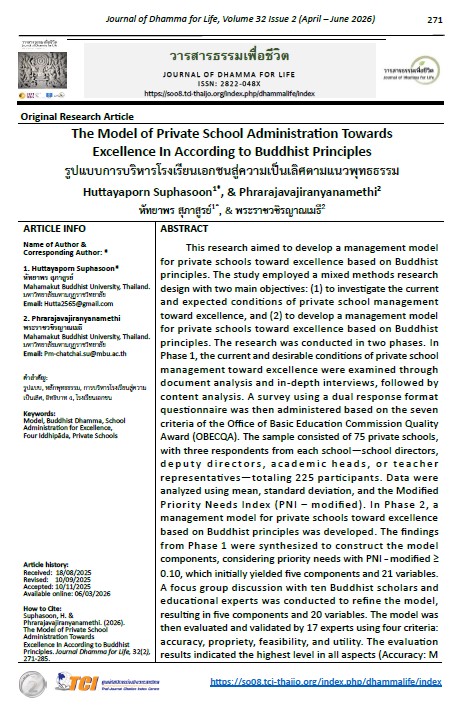
This research aimed to develop a management model for private schools toward excellence based on Buddhist principles. The study employed a mixed methods research design with two main objectives: (1) to investigate the current and expected conditions of private school management toward excellence, and (2) to develop a management model for private schools toward excellence based on Buddhist principles. The research was conducted in two phases. In Phase 1, the current and desirable conditions of private school management toward excellence were examined through document analysis and in-depth interviews, followed by content analysis. A survey using a dual response format questionnaire was then administered based on the seven criteria of the Office of Basic Education Commission Quality Award (OBECQA). The sample consisted of 75 private schools, with three respondents from each school—school directors, deputy directors, academic heads, or teacher representatives—totaling 225 participants. Data were analyzed using mean, standard deviation, and the Modified Priority Needs Index (PNI – modified). In Phase 2, a management model for private schools toward excellence based on Buddhist principles was developed. The findings from Phase 1 were synthesized to construct the model components, considering priority needs with PNI – modified ≥ 0.10, which initially yielded five components and 21 variables. A focus group discussion with ten Buddhist scholars and educational experts was conducted to refine the model, resulting in five components and 20 variables. The model was then evaluated and validated by 17 experts using four criteria: accuracy, propriety, feasibility, and utility. The evaluation results indicated the highest level in all aspects (Accuracy: M = 4.82, SD = 0.39; Propriety: M = 4.88, SD = 0.33; Feasibility: M = 4.76, SD = 0.44; Utility: M = 5.00, SD = 0.00).
The results revealed that the proposed management model consists of five components and 20 variables: (1) leadership based on the Four Bases of Success (Iddhipāda IV), (2) strategic management based on Iddhipāda IV, (3) personnel management based on Iddhipāda IV, (4) operational management based on Iddhipāda IV, and (5) results-based management according to Iddhipāda IV. The model provides a systematic framework for enhancing excellence in private school management grounded in Buddhist principles.
Article Details
References
กระทรวงศึกษาธิการ. (2542). พระราชบัญญัติการศึกษาแห่งชาติ พ.ศ. 2542 และที่แก้ไขเพิ่มเติม (ฉบับที่ 2) พ.ศ. 2545 และ (ฉบับที่ 3) พ.ศ. 2553. กรุงเทพฯ: กระทรวงศึกษาธิการ.
กฤษปกรณ์ สาคร. (2557). การพัฒนารูปแบบการบริหารจัดการความรู้ในสถานศึกษา. วารสารวิจัยทางการศึกษา, 9(2), 77–90.
จงดี เพชรสังคูณ. (2564). การบริหารโรงเรียนเอกชนตามหลักสัปปุริสธรรม 7. วารสารการบริหารการศึกษา, 17(2), 45–58.
จริญญาภรณ์ ศรีจันดาร และคณะ. (2565). การบริหารองค์กรการศึกษาที่เน้นการมีส่วนร่วมและผลลัพธ์ขององค์กร. วารสารการวิจัยทางการศึกษา, 17(1), 89–104.
จริญญาภรณ์ ศรีจันดารี และคณะ. (2564). การประยุกต์ใช้หลักพุทธธรรมในการบริหารการเปลี่ยนแปลงของสถานศึกษา. วารสารพุทธศาสตร์ศึกษา, 12(1), 89–102.
ชิรวัฒน์ นิจเนตร. (2560). การพัฒนารูปแบบทางการศึกษา. กรุงเทพฯ: สำนักพิมพ์แห่งจุฬาลงกรณ์มหาวิทยาลัย.
โชติช่วง พันธุเวส. (2551). การบริหารกระบวนการทำงานเพื่อคุณภาพในองค์กรการศึกษา. กรุงเทพฯ: โอเดียนสโตร์.
ณัฐการ บุญรักษา. (2563). แนวคิดและการพัฒนารูปแบบการวิจัยทางการศึกษา. กรุงเทพฯ: สำนักพิมพ์มหาวิทยาลัยรามคำแหง.
ณัฐการ บุญรักษา. (2563). การพัฒนารูปแบบการบริหารสถานศึกษาเพื่อยกระดับคุณภาพการศึกษา. วารสารศึกษาศาสตร์, 31(2), 112–125.
ทิพวรรณ สุพิพัฒน์โมลี. (2563). การบูรณาการหลักพุทธธรรมกับการบริหารองค์กรสมัยใหม่. วารสารพุทธศาสตร์ศึกษา, 11(2), 1–15.
นัยนา ฉายวงศ์. (2560). การพัฒนารูปแบบการจัดการเรียนรู้เพื่อพัฒนาผู้เรียน. กรุงเทพฯ: สำนักพิมพ์มหาวิทยาลัยศรีนครินทรวิโรฒ.
นัยนา ฉายวงศ์. (2560). แนวคิดและกระบวนการพัฒนารูปแบบทางการศึกษา. กรุงเทพฯ: สำนักพิมพ์โอเดียนสโตร์.
บุญยกุล หัตถกี. (2556). การบริหารเชิงกลยุทธ์ในองค์กรการศึกษา. กรุงเทพฯ: สำนักพิมพ์แห่งจุฬาลงกรณ์มหาวิทยาลัย.
พจนานุกรมฉบับราชบัณฑิตยสถาน พ.ศ. 2542. (2546). กรุงเทพฯ: ราชบัณฑิตยสถาน.
ภัทราวัลย์ ดอกบัว, และ สุนทร สายคำ. (2563). ภาวะผู้นำเชิงพุทธกับการพัฒนาองค์กรทางการศึกษา. วารสารการบริหารการศึกษา, 16(2), 45–58.
รัตนชัย เอี่ยมพิทักษ์พร. (2565). การบริหารสถานศึกษาตามแนวคิดโรงเรียนวิถีพุทธ. วารสารการบริหารการศึกษาและภาวะผู้นำ, 10(1), 66–78.
วรภัทร ภู่เจริญ. (2548). การบริหารคุณภาพในสถานศึกษา. กรุงเทพฯ: พิมพ์ดี.
วรรณา บุญมาก. (2562). การพัฒนารูปแบบการจัดการเรียนรู้ทางการศึกษา. กรุงเทพฯ: สำนักพิมพ์มหาวิทยาลัยเกษตรศาสตร์.
วาโร เพ็งสวัสดิ์. (2553). การวิจัยและพัฒนาทางการศึกษา. สกลนคร: มหาวิทยาลัยราชภัฏสกลนคร.
สำนักงานปลัดกระทรวงศึกษาธิการ. (2559). แผนพัฒนาการศึกษาของกระทรวงศึกษาธิการ ฉบับที่ 12 (พ.ศ. 2560–2564). กรุงเทพฯ: กระทรวงศึกษาธิการ.
สำนักงานรางวัลคุณภาพแห่งชาติ. (2554). เกณฑ์รางวัลคุณภาพแห่งชาติ ปี 2554–2555. กรุงเทพฯ: สำนักงานรางวัลคุณภาพแห่งชาติ.
สุรดา แก้วศรีหา และคณะ. (2566). การพัฒนาทรัพยากรมนุษย์ในองค์กรการศึกษาเพื่อยกระดับคุณภาพการศึกษา. วารสารศึกษาศาสตร์, 34(1), 112–128.
อภิญญา แก้วชื่น. (2550). การบริหารสถานศึกษาตามหลักธรรมาภิบาล. กรุงเทพฯ: สำนักพิมพ์แห่งจุฬาลงกรณ์มหาวิทยาลัย.
อุดม ชูลีวรรณ. (2559). การพัฒนาระบบการบริหารคุณภาพในสถานศึกษาเพื่อยกระดับผลสัมฤทธิ์ของผู้เรียน. วารสารการบริหารการศึกษา, 12(1), 101–115.
Ardictionary. (2008). Dictionary of architecture and design. Retrieved from http://www.ardi ctionary.com
Baldrige National Quality Program. (2019). Baldrige excellence framework: A systems approach to improving your organization’s performance. Gaithersburg, MD: National Institute of Standards and Technology.
Fulston Schools. (2003). School improvement and strategic development framework. Kent, UK: Fulston Schools.
