Can The Buddha Do a Verbal Affliction?
Article Sidebar
Main Article Content
Abstract
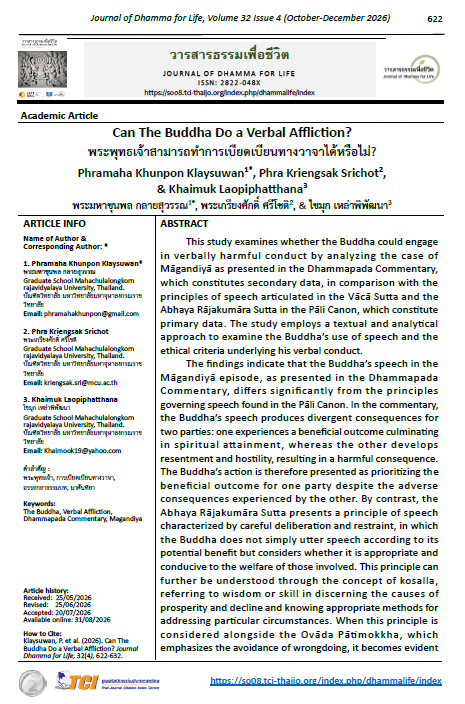
This study examines whether the Buddha could engage in verbally harmful conduct by analyzing the case of Māgandiyā as presented in the Dhammapada Commentary, which constitutes secondary data, in comparison with the principles of speech articulated in the Vācā Sutta and the Abhaya Rājakumāra Sutta in the Pāli Canon, which constitute primary data. The study employs a textual and analytical approach to examine the Buddha’s use of speech and the ethical criteria underlying his verbal conduct.
The findings indicate that the Buddha’s speech in the Māgandiyā episode, as presented in the Dhammapada Commentary, differs significantly from the principles governing speech found in the Pāli Canon. In the commentary, the Buddha’s speech produces divergent consequences for two parties: one experiences a beneficial outcome culminating in spiritual attainment, whereas the other develops resentment and hostility, resulting in a harmful consequence. The Buddha’s action is therefore presented as prioritizing the beneficial outcome for one party despite the adverse consequences experienced by the other. By contrast, the Abhaya Rājakumāra Sutta presents a principle of speech characterized by careful deliberation and restraint, in which the Buddha does not simply utter speech according to its potential benefit but considers whether it is appropriate and conducive to the welfare of those involved. This principle can further be understood through the concept of kosalla, referring to wisdom or skill in discerning the causes of prosperity and decline and knowing appropriate methods for addressing particular circumstances. When this principle is considered alongside the Ovāda Pātimokkha, which emphasizes the avoidance of wrongdoing, it becomes evident that preventing the emergence of harmful consequences is a fundamental ethical consideration in Buddhist teaching. Accordingly, even when a particular utterance may produce significant benefits for one individual, it should not be employed if it simultaneously generates a harmful consequence that could otherwise be avoided. The study therefore proposes that the Buddha’s speech, according to the principles established in the Pāli Canon, is characterized by a balanced assessment of both benefit and harm. When confronted with circumstances similar to those described in the Māgandiyā episode, the Buddha would refrain from speech that could generate a new harmful consequence, even if such speech could produce benefits for another party. Consequently, the form of verbal conduct attributed to the Buddha in the Dhammapada Commentary cannot be fully reconciled with the principles governing the Buddha’s speech as found in the Pāli Canon.
Article Details
References
พระธรรมปิฎก (ป.อ. ปยุตฺโต). (2546). พจนานุกรมพุทธศาสตร์ ฉบับประมวลธรรม (พิมพ์ครั้งที่ 10). โรงพิมพ์มหาจุฬาลงกรณราชวิทยาลัย.
พระมหามงคลกานต์ ธีรธมฺโม, พระเจริญ วฑฺฒโน, พระวรพนธ์ วรธมฺโม, พระสุขีศม สีลเตชปุตฺติโย, พระมหายงยุทธ ฐิตธมฺโม, และนฤมล จิวัฒนาสุข. (2566). สัมมาวาจา: พุทธบูรณาการเพื่อการสื่อสารเชิงพหุวัฒนธรรม. วารสาร มจร พุทธศาสตร์ปริทรรศน์, 7(3), 15–30.
พระมหาหรรษา ธมฺมหาโส. (2561). การุณยสาร: หนทางสู่สันติภาพ. มหาวิทยาลัยมหาจุฬาลงกรณราชวิทยาลัย.
พระมหาอริยะ อริยชโย (ถิรทินรัตน์), พระสมุห์นพดล อตฺถยุตฺโต (สุทนต์), & กิตติ เบญญาบวรกิตติ์. (2022). ศึกษาวิเคราะห์หลักสัมมาวาจาเพื่อประยุกต์ใช้ในสถานศึกษา. วารสาร นวพุทธศาสตร์, 1(2), 1–14.
มหาจุฬาลงกรณราชวิทยาลัย. (2539). พระไตรปิฎกภาษาไทย ฉบับมหาจุฬาลงกรณราชวิทยาลัย. กรุงเทพมหานคร: โรงพิมพ์มหาจุฬาลงกรณราชวิทยาลัย.
มหามกุฏราชวิทยาลัย. (2534). พระไตรปิฎกพร้อมอรรถกถา แปล ชุด 91 เล่ม. กรุงเทพมหานคร: โรงพิมพ์มหามกุฏราชวิทยาลัย.
วีรชาติ นิ่มอนงค์. (2560). เฮอร์เมนูติกส์: ศาสตร์แห่งความเข้าใจ (ตีความ) ของพระพุทธปรัชญา (ศาสนา) เถรวาทและมหายานเชิงเปรียบเทียบ. วารสารมหาจุฬาวิชาการ, 2(1), 79–92.
สมภาร พรมทา. (2548). พุทธศาสนากับปัญหาจริยศาสตร์: โสเภณี ทำแท้ง และการุณยฆาต (พิมพ์ครั้งที่ 2). สำนักพิมพ์แห่งจุฬาลงกรณ์มหาวิทยาลัย.
สมิทธิพล เนตรนิมิตร. (2559). อรรถกถาธรรมบทในสังคมไทย. วารสารมหาจุฬาวิชาการ, 3(1), 36–51.
