Smart Digital Technology Affects the Efficiency of Water Management of Royal Irrigation Department
Article Sidebar
Main Article Content
Abstract
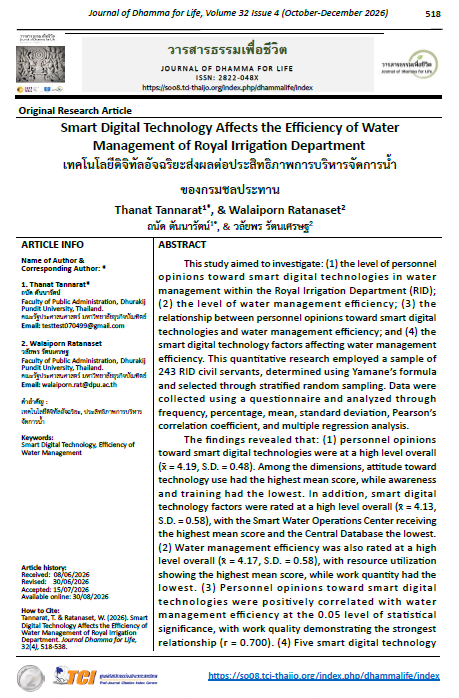
This study aimed to investigate: (1) the level of personnel opinions toward smart digital technologies in water management within the Royal Irrigation Department (RID); (2) the level of water management efficiency; (3) the relationship between personnel opinions toward smart digital technologies and water management efficiency; and (4) the smart digital technology factors affecting water management efficiency. This quantitative research employed a sample of 243 RID civil servants, determined using Yamane’s formula and selected through stratified random sampling. Data were collected using a questionnaire and analyzed through frequency, percentage, mean, standard deviation, Pearson’s correlation coefficient, and multiple regression analysis.
The findings revealed that: (1) personnel opinions toward smart digital technologies were at a high level overall (x̄ = 4.19, S.D. = 0.48). Among the dimensions, attitude toward technology use had the highest mean score, while awareness and training had the lowest. In addition, smart digital technology factors were rated at a high level overall (x̄ = 4.13, S.D. = 0.58), with the Smart Water Operations Center receiving the highest mean score and the Central Database the lowest. (2) Water management efficiency was also rated at a high level overall (x̄ = 4.17, S.D. = 0.58), with resource utilization showing the highest mean score, while work quantity had the lowest. (3) Personnel opinions toward smart digital technologies were positively correlated with water management efficiency at the 0.05 level of statistical significance, with work quality demonstrating the strongest relationship (r = 0.700). (4) Five smart digital technology factors significantly affected water management efficiency at the 0.05 level of significance and jointly explained 76.80% of the variance in water management efficiency (R² = 0.768). This indicates that smart digital technology factors have a substantial influence on water management efficiency, highlighting the importance of systematic technology development alongside personnel development and capacity building.
Article Details
References
กรมชลประทาน (2566). รายงานผลการดำเนินงานของกรมชลประทานประจำปีงบประมาณ 2566. กรุงเทพฯ: กรมชลประทาน.
กรมชลประทาน. (2568). ข้อมูลเบื้องต้นของศูนย์ปฏิบัติการน้ำอัจฉริยะ (Smart Water Operation Center : SWOC). สืบค้นเมื่อ 13 พฤศจิกายน 2568 จาก https://swocmodel.rid.go.th
ชาญชัย พิทักษ์วงศ์. (2564). การพัฒนาระบบศูนย์ปฏิบัติการน้ำอัจฉริยะเพื่อเพิ่มประสิทธิภาพการบริหารจัดการทรัพยากรน้ำ. วารสารวิศวกรรมแหล่งน้ำ, 9(2), 15–28.
ชุติมา รัตนวงศ์. (2564). ปัจจัยการยอมรับเทคโนโลยีที่ส่งผลต่อประสิทธิภาพการปฏิบัติงานของบุคลากรภาครัฐ. วารสารการบริหารเทคโนโลยีสารสนเทศ, 9(1), 50–65.
จุฑามาศ นิ่มจิตต์, และ โกวิทย์ กังสนันท์. (2564). ประสิทธิภาพการปฏิบัติงานของบุคลากรของสำนักงานอัยการจังหวัดนนทบุรีที่มีผลมาจากการปรับใช้เทคโนโลยีดิจิทัล. วารสารนวัตกรรมการบริหารและการจัดการ มหาวิทยาลัยเทคโนโลยีราชมงคลรัตนโกสินทร์, 9(3), 36–50.
ประสิทธิ์ เกิดสุข. (2564). การใช้เทคโนโลยีสารสนเทศเพื่อเพิ่มประสิทธิภาพการบริหารจัดการทรัพยากรในหน่วยงานภาครัฐ. วารสารการบริหารภาครัฐ, 9(2), 55–70.
ปิยธิดา แสงสุวรรณ. (2565). ปัจจัยด้านเทคโนโลยีดิจิทัลที่ส่งผลต่อประสิทธิภาพการบริหารจัดการของหน่วยงานภาครัฐ. วารสารนวัตกรรมการบริหาร, 11(1), 85–100.
สำนักงานการวิจัยแห่งชาติ. (2567). แนวโน้มสถานการณ์น้ำ 67 – 68 รับมือภัยแล้ง ด้วยวิจัยและนวัตกรรม. สืบค้นเมื่อ 26 มกราคม 2569 จาก https://nrct.go.th/news/detail/3351? utm_source =chatgpt.com
สำนักงานพัฒนารัฐบาลดิจิทัล. (2566). รายงานผลการดำเนินงาน ครั้งที่ 1 รอบ 6 เดือน (1 ตุลาคม 2565 – 31 มีนาคม 2566). สืบค้นเมื่อ 13 พฤศจิกายน 2568 จาก https://www.dga.or.th
สุเมธ ทองดี. (2565). การประยุกต์ใช้เทคโนโลยีดิจิทัลในการบริหารจัดการน้ำของหน่วยงานภาครัฐ. วารสารการบริหารภาครัฐและนวัตกรรม, 7(1), 66–80.
สุราวุธ สุขขุม, และ ฐิติมา ชัยกุล. (2564). ปัจจัยที่มีอิทธิพลต่อการยอมรับเทคโนโลยีระบบอัตโนมัติของพนักงานในอุตสาหกรรมอิเล็กทรอนิกส์. วารสารบัณฑิตวิทยาลัยพาณิชยศาสตร์บูรพาปริทัศน์, 16(2), 113–125.
พรธีรา เชี่ยวเชิงงาน. (2562). บทบาทของเทคโนโลยีดิจิทัลต่อการพัฒนากระบวนการบริหารจัดการภาครัฐ การค้นคว้าอิสระ, จุฬาลงกรณ์มหาวิทยาลัย. วิทยานิพนธ์และดุษฎีนิพนธ์ มหาวิทยาลัยจุฬาลงกรณ์. https://doi.org/10.58837/CHULA.IS.2019.246
อัจฉราวรรณ สุขเกิด. (2567). การยอมรับเทคโนโลยีที่ส่งผลต่อความตั้งใจใช้เทคโนโลยีปัญญาประดิษฐ์ (AI) ในการทำงานของบุคลากรมหาวิทยาลัยราชภัฏวไลยอลงกรณ์ ในพระบรมราชูปถัมภ์. วารสารวิทยาการจัดการปริทัศน์. 27(1), 132-144.
Best, J. W. (1977). Research in Education. Englewood Cliffs. New Jersy: Pretice Hall.NY: McGraw-Hill.
Davis, F., Bagozzi, R., & Warshaw, P. (1989). User Acceptance of Computer Technology: A Comparison of Two Theoretical Models. Management Science, 982-1003.
Field, A. (2018). Discovering statistics using IBM SPSS statistics (5th ed.). SAGE Publications. Kohnke, L., Moorhouse, B. L., & Zou, D. (2023). Exploring generative artificial intelligence preparedness among university language instructors: A case study. Computers and Education: Artificial Intelligence, 5, Article 100156. Retrieved from https://doi.org/10. 1016/j.caeai.2023.100156
Massie, J.L. & Douglas, J. (1981). Management: A Contemporary Introduction. 3rd ed. New
Jersey: Englewood Cliffs.
Peterson, R. S., & Plowman, D. A. (1989). Self-managed work teams: A theoretical integration and empirical examination. Journal of Applied Psychology, 74(5), 585–595.
Streiner, D. L., & Norman, G. R. (1995). Health measurement scales: A practical guide to them
development and use. (2nd ed.). Oxford University press.
Tang, Y., Yu, L., Liu, K., Zhang, F., Li, Z., & Wang, W. (2023). Flood forecasting based on machine learning pattern recognition and dynamic migration of parameters. Journal of Hydrology: Regional Studies, 47, 101406. https://doi.org/10.1016/j.ejrh.2023.101406.
Vinuesa, R., Azizpour, H., Leite, I., Balaam, M., Dignum, V., Domisch, S., & Nerini, F. F. (2020). The role of artificial intelligence in achieving the Sustainable Development Goals. Nature Communications, 11, 233. https://doi.org/10.1038/s41467-019-14108-y
Yamane, T. (1973). Statistics: an introductory analysis. New York: New York: Harper & Row.
