Factors Associated with Organizational Commitment among Subdistrict and Village Headmen
Article Sidebar
Main Article Content
Abstract
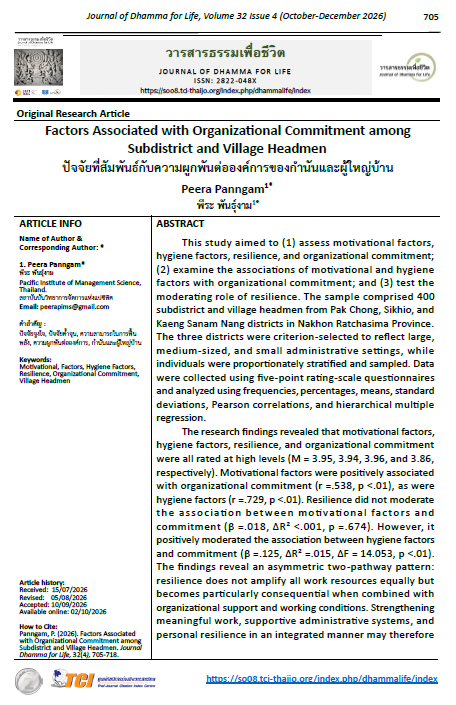
This study aimed to (1) assess motivational factors, hygiene factors, resilience, and organizational commitment; (2) examine the associations of motivational and hygiene factors with organizational commitment; and (3) test the moderating role of resilience. The sample comprised 400 subdistrict and village headmen from Pak Chong, Sikhio, and Kaeng Sanam Nang districts in Nakhon Ratchasima Province. The three districts were criterion-selected to reflect large, medium-sized, and small administrative settings, while individuals were proportionately stratified and sampled. Data were collected using five-point rating-scale questionnaires and analyzed using frequencies, percentages, means, standard deviations, Pearson correlations, and hierarchical multiple regression.
The research findings revealed that motivational factors, hygiene factors, resilience, and organizational commitment were all rated at high levels (M = 3.95, 3.94, 3.96, and 3.86, respectively). Motivational factors were positively associated with organizational commitment (r =.538, p <.01), as were hygiene factors (r =.729, p <.01). Resilience did not moderate the association between motivational factors and commitment (β =.018, ΔR² <.001, p =.674). However, it positively moderated the association between hygiene factors and commitment (β =.125, ΔR² =.015, ΔF = 14.053, p <.01). The findings reveal an asymmetric two-pathway pattern: resilience does not amplify all work resources equally but becomes particularly consequential when combined with organizational support and working conditions. Strengthening meaningful work, supportive administrative systems, and personal resilience in an integrated manner may therefore help sustain organizational commitment among local administrative leaders.
Article Details
References
กรมการปกครอง. (2565). 130 ปี วันกำนัน ผู้ใหญ่บ้าน. สำนักบริหารการปกครองท้องที่. https://multi.dopa.go.th/pab/news/cate1/view234
ปรัชญาภรณ์ แก้วรอด, และวนิชย์ ไชยแสง. (2566). ปัจจัยด้านแรงจูงใจที่มีอิทธิพลต่อความผูกพันต่อองค์การ ของบุคลากรกรมการปกครองในเขตภาคตะวันออกเฉียงเหนือ. วารสารมหาวิทยาลัยราชภัฏร้อยเอ็ด, 17(2), 188–199. https://so03.tci-thaijo.org/index.php/reru/article/view/262404
พระราชบัญญัติลักษณะปกครองท้องที่ พระพุทธศักราช 2457. (2457, 17 กรกฎาคม). ราชกิจจานุเบกษา, 31, 229–443. https://www.ratchakitcha.soc.go.th/DATA/PDF/2457/A/229.PDF
พิชญ์สินี สินสุพรรณ, และสุธรรม พงศ์สำราญ. (2568). แรงจูงใจในการปฏิบัติงานที่มีอิทธิพลต่อความผูกพัน ของพนักงาน บริษัท ไทยเซ็นเตอร์ฟู้ด โปรดักส์ จำกัด จังหวัดนครปฐม. วารสารร่มยูงทอง, 3(3), 1–17. https://so08.tci-thaijo.org/index.php/romyoongthong/article/view/5604
สำนักบริหารการปกครองท้องที่. (2568). คู่มือการปฏิบัติงานกำนัน ผู้ใหญ่บ้าน ประจำปี 2568 (ฉบับรวมหนังสือสั่งการและตอบข้อหารือ). กรมการปกครอง. https://multi. dopa.go.th/pab/news/cate1/view265
อารีรัตน์ เสสตะญาติ, และกฤษฎา มูฮัมหมัด. (2566). ปัจจัยที่มีผลต่อความผูกพันในองค์การของพนักงาน บริษัทเอกชน กลุ่มเจนเนอเรชั่นซี ในเขตกรุงเทพมหานครและปริมณฑล. วารสารวไลยอลงกรณ์ ปริทัศน์, 13(2), 161–176. https://so06.tci-thaijo.org/index.php/var/article/view/263627
Aiken, L. S., & West, S. G. (1991). Multiple regression: Testing and interpreting interactions. SAGE Publications.
Avcı Taşkıran, T., Gürbüz, B., & Doğan, M. (2024). Psychological resilience and organizational commitment: Mediating role of job satisfaction. Research in Sport Education and Sciences, 26(2), 66–74. https://doi.org/10.62425/rses.1460229
Bakker, A. B., & Demerouti, E. (2017). Job demands–resources theory: Taking stock and looking forward. Journal of Occupational Health Psychology, 22(3), 273–285. https://doi. org/10.1037/ocp0000056
Connor, K. M., & Davidson, J. R. T. (2003). Development of a new resilience scale: The Connor–Davidson Resilience Scale (CD-RISC). Depression and Anxiety, 18(2), 76–82. https://doi.org/10.1002/da.10113
Gelman, A., & Stern, H. (2006). The difference between “significant” and “not significant” is not itself statistically significant. The American Statistician, 60(4), 328–331. https://doi.org/10.1198/000313006X152649
Hayes, A. F. (2022). Introduction to mediation, moderation, and conditional process analysis: A regression-based approach (3rd ed.). The Guilford Press.
Herzberg, F., Mausner, B., & Snyderman, B. B. (1959). The motivation to work (2nd ed.). John Wiley & Sons.
Hobfoll, S. E. (1989). Conservation of resources: A new attempt at conceptualizing stress. American Psychologist, 44(3), 513–524. https://doi.org/10.1037/0003-066X.44.3.513
Hobfoll, S. E., Halbesleben, J., Neveu, J.-P., & Westman, M. (2018). Conservation of resources in the organizational context: The reality of resources and their consequences. Annual Review of Organizational Psychology and Organizational Behavior, 5, 103–128. https://doi.org/10.1146/annurev-orgpsych-032117-104640
Jung, G., & Moon, K.-K. (2024). Examining public service motivation’s impact on organizational commitment: Focusing on moderating roles of hygiene and motivation factors. Behavioral Sciences, 14(6), Article 476. https://doi.org/10.3390/bs14060476
Jung, M. K., Jung, T. G., Kang, Y. J., & Jeong, K.-H. (2025). The interactive effects of emotional leadership and resilience on job satisfaction and organizational commitment among Korean youth sports instructors. Frontiers in Psychology, 16, Article 1534812. https://doi.org/10.3389/fpsyg.2025.1534812
Likert, R. (1932). A technique for the measurement of attitudes. Archives of Psychology, 140, 1–55.
Mowday, R. T., Steers, R. M., & Porter, L. W. (1979). The measurement of organizational commitment. Journal of Vocational Behavior, 14(2), 224–247. https://doi.org/10.1016/ 0001-8791(79)90072-1
Steers, R. M. (1977). Antecedents and outcomes of organizational commitment. Administrative Science Quarterly, 22(1), 46–56. https://doi.org/10.2307/2391745
Zong, Y., & Tsaur, S.-H. (2023). Employee resilience and mentoring functions as moderators of the relationship between workplace hazing and affective organizational commitment. International Journal of Hospitality Management, 114, Article 103549. https://doi.org/ 10.1016/j.ijhm.2023.103549
