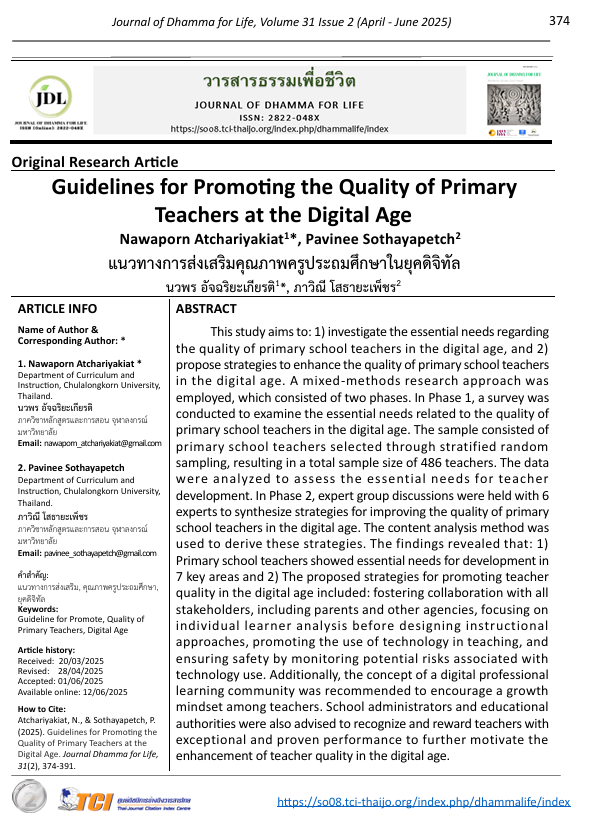
Guidelines for Promoting the Quality of Primary Teachers at the Digital Age
Article Sidebar
Main Article Content
Abstract
This study aims to: 1) investigate the essential needs regarding the quality of primary school teachers in the digital age, and 2) propose strategies to enhance the quality of primary school teachers in the digital age. A mixed-methods research approach was employed, which consisted of two phases. In Phase 1, a survey was conducted to examine the essential needs related to the quality of primary school teachers in the digital age. The sample consisted of primary school teachers selected through stratified random sampling, resulting in a total sample size of 486 teachers. The data were analyzed to assess the essential needs for teacher development. In Phase 2, expert group discussions were held with 6 experts to synthesize strategies for improving the quality of primary school teachers in the digital age. The content analysis method was used to derive these strategies. The findings revealed that: 1) Primary school teachers showed essential needs for development in 7 key areas and 2) The proposed strategies for promoting teacher quality in the digital age included: fostering collaboration with all stakeholders, including parents and other agencies, focusing on individual learner analysis before designing instructional approaches, promoting the use of technology in teaching, and ensuring safety by monitoring potential risks associated with technology use. Additionally, the concept of a digital professional learning community was recommended to encourage a growth mindset among teachers. School administrators and educational authorities were also advised to recognize and reward teachers with exceptional and proven performance to further motivate the enhancement of teacher quality in the digital age.
Article Details
References
กระทรวงศึกษาธิการ. (2566, 6 มกราคม). 6 นโยบายและจุดเน้น สำนักงานปลัดกระทรวงศึกษาธิการ ปีงบประมาณ 2566. https://moe360.blog/2023/01/06/6166/
ฐาปวี หนองหารพิทักษ์, เพ็ญศรี ฉิรินัง, อรุณ รักธรรม, & อุดมวิทย์ ไชยสกุลเกียรติ. (2565). รูปแบบการพัฒนาสมรรถนะครูระดับประถมศึกษายุคประเทศไทย 4.0. Journal of Administrative and Management Innovation, 10(3), 29–40.
ธารารัตน์ มาลัยเถาว์. (2560). กลยุทธ์การพัฒนาทักษะครูประถมศึกษา ตามแนวคิดการเรียนรู้ด้วยการนําตนเองสังกัดสำนักงานคณะกรรมการการศึกษาขั้นพื้นฐาน. วารสารวิจัยทางการศึกษา คณะศึกษาศาสตร์ มหาวิทยาลัยศรีนครินทรวิโรฒ, 11(2), 306–319.
ธิดา แซ่ชั้น, & ทัศนีย์ หมอสอน. (2559). การรู้ดิจิทัล: นิยามองค์ประกอบและสถานการณ์ในปัจจุบัน. วารสารสนเทศศาสตร์, 34(4), 116–145. https://so03.tci-thaijo.org/index.php/jiskku/article/view/ 81049/74940
นวลจันทร์ จุฑาภักดีกุล. (2558). เด็กยุคดิจิทัล. สารานุกรมศึกษาศาสตร์ คณะศึกษาศาสตร์ มหาวิทยาลัยศรีนครินทรวิโรฒ, 50(2558), 79–83. https://ejournals.swu.ac.th/index.php/ENEDU/article/view /6704/6315
พวงเพ็ญ อินทรประวัติ, ณฐกร ดวงพระเกษ, & ฐิติรัตน์ คล่องดี. (2564). สมรรถนะของครู 4 ด้านที่ส่งผลต่อการเรียนรู้ของผู้เรียนมากที่สุด. วารสารวิชาการศึกษาศาสตร์, 22(1), 180–195.
พิณสุดา สิริรังธศรี. (2557). การยกระดับคุณภาพ “ครูไทยในศตวรรษที่ 21”. https://resourcecenter-uat.thaihealth.or.th/media/31qR
มาโนช หัทยามาตย์. (2564). คุณลักษณะครูของโรงเรียนในสถานการณ์การเปลี่ยนแปลงในยุคดิจิทัล. วารสารบวรสหการศึกษาและมนุษยสังคมศาสตร์, 2(2), 18–24.
ยศวีร์ สายฟ้า. (2563). ทิศทางการผลิตครูประถมศึกษาของประเทศไทยที่ตอบสนองความต้องการของผู้ใช้ครูกับการเปลี่ยนแปลงของสังคมในยุคดิจิทัล. วารสารศึกษาศาสตร์ มหาวิทยาลัยสงขลานครินทร์ วิทยาเขตปัตตานี, 32(3), 71–85.
วรพจน์ วงศ์กิจรุ่งเรือง, & อธิป จิตตฤกษ์. (2554). ทักษะแห่งอนาคตใหม่: การศึกษาเพื่อศตวรรษที่ 21. [แปลจาก 21st Century Skills: Rethinking How Students Learn]. https://openworlds.in.th/ books/21st-century-skills/
สุวิทย์ เมษินทรีย์. (2563, 1 มิถุนายน). โลกเปลี่ยนคนปรับ เราจะอยู่ในโลกหลังวิกฤตอย่างเป็นปกติสุขได้อย่างไร. Creative Thailand. https://www.creativethailand.org/new/article/people/ 32461/th#Suvit-Maesincee-lifeaftercovid19
สำนักงานคณะกรรมการข้าราชการครูและบุคลากรทางการศึกษา. (2564). ว21/2564 ภาระงานของข้าราชการครูและบุคลากรทางการศึกษา ตำแหน่งครู ผู้บริหารสถานศึกษา ตำแหน่งศึกษานิเทศก์ และตำแหน่งผู้บริหารการศึกษา. สำนักงาน ก.ค.ศ. https://otepc.go.th/th/content_page/item/3474-2021-08-30-11-22-42.html
สำนักงานคณะกรรมการการวิจัยแห่งชาติ. (2557). รายงานประจำปี 2557 สำนักงานคณะกรรมการวิจัยแห่งชาติ (วช.). https://dl.parliament.go.th/handle/20.500.13072/581120
สำนักงานสภานโยบายการอุดมศึกษา วิทยาศาสตร์ วิจัยและนวัตกรรมแห่งชาติ. (2564, 21 พฤศจิกายน). ปรับแนวทางการศึกษาไทย เน้นสร้างทักษะให้ไทยก้าวทันการเปลี่ยนแปลงโลก. สอวช. https://www.nxpo.or.th/th/
อัญชลี สกุลอินทร์. (2561). ปัจจัยที่ส่งผลต่อผลสัมฤทธิ์ทางการเรียนของนักเรียนชั้นประถมศึกษาปีที่ 6 สังกัดสำนักงานเขตพื้นที่การศึกษาประถมศึกษาขอนแก่น เขต 2. วารสารการบริหารการศึกษา มหาวิทยาลัยบูรพา, 12(1), 49–60. https://ojs.lib.buu.ac.th/index.php/edu/article/view/6282
เจริญ ภูวิจิตร์. (2565, 8 มีนาคม). แนวทางการพัฒนาครูและบุคลากรทางการศึกษาในยุค Next Normal. https://www.nidtep.go.th/2017/publish/doc/20220308-4.pdf
Alberta Government. (2018). Teaching quality standards. Alberta.
Graham, J., & Flamini, M. (2023). Teacher quality and students’ post-secondary outcomes. Educational Policy, 37(3), 800–839. https://doi.org/10.1177/08959048211049429
Herman, K. C., Hickmon-Rosa, J., & Reinke, W. M. (2018). Empirically derived profiles of teacher stress, burnout, self-efficacy, and coping and associated student outcomes. Journal of Positive Behavior Interventions, 20(2), 90–100. https://doi.org/10.1177/ 1098300717732066
Ibda, H., Syamsi, I., & Rukiyati, R. (2023). Professional elementary teachers in the digital era: A systematic. International Journal of Evaluation and Research in Education, 12(1), 459–467.
Jukes, I., McCain, T., & Crockett, L. (2010). Understanding the digital generation: Teaching and learning in the new digital landscape. SAGE Publications.
OECD. (2022). Education at a glance 2022. https://www.oecd.org/en/publications/education-at-a-glance-2022_3197152ben.html
Perez, B. (2013). Teacher quality and teaching quality of 7th-grade Algebra I honors teachers (Order No. 3571434). Available from Publicly Available Content Database. (1426424569).
Safetyculture. (2023, December 13). Teacher evaluation methods for effective quality teaching. https://safetyculture.com/topics/teacher-evaluation/
Skaalvik, E. M., & Skaalvik, S. (2007). Dimensions of teacher self-efficacy and relations with strain factors, perceived collective teacher efficacy, and teacher burnout. Journal of Educational Psychology, 99(3), 611–625. https://doi.org/10.1037/0022-0663.99.3.611
SousaI, M. D. C., & ZanonI, D. A. V. (2023). The elementary school and teachers work qualification: Challenges and perspectives of the professional. Revista Brasileira de Educação, 28(e280046), 1–16. https://doi.org/10.1590/S1413-24782023280047
UNESCO. (2019). Global framework for professional teaching standards. Education International.