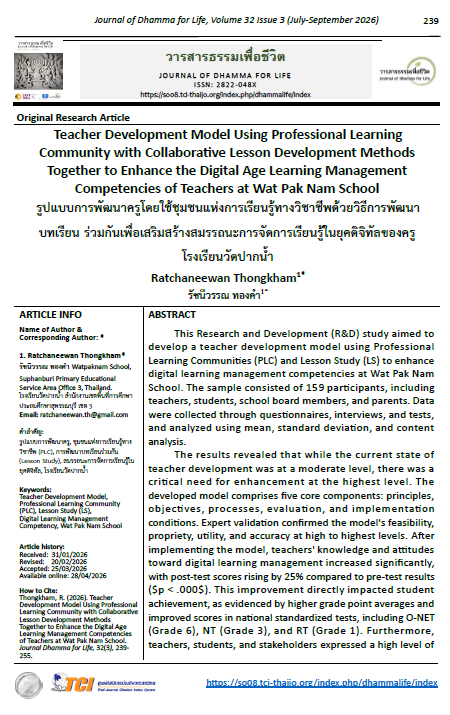
Teacher Development Model Using Professional Learning Community with Collaborative Lesson Development Methods Together to Enhance the Digital Age Learning Management Competencies of Teachers at Wat Pak Nam School
Article Sidebar
Main Article Content
Abstract
This Research and Development (R&D) study aimed to develop a teacher development model using Professional Learning Communities (PLC) and Lesson Study (LS) to enhance digital learning management competencies at Wat Pak Nam School. The sample consisted of 159 participants, including teachers, students, school board members, and parents. Data were collected through questionnaires, interviews, and tests, and analyzed using mean, standard deviation, and content analysis.
The results revealed that while the current state of teacher development was at a moderate level, there was a critical need for enhancement at the highest level. The developed model comprises five core components: principles, objectives, processes, evaluation, and implementation conditions. Expert validation confirmed the model's feasibility, propriety, utility, and accuracy at high to highest levels. After implementing the model, teachers' knowledge and attitudes toward digital learning management increased significantly, with post-test scores rising by 25% compared to pre-test results ($p < .000$). This improvement directly impacted student achievement, as evidenced by higher grade point averages and improved scores in national standardized tests, including O-NET (Grade 6), NT (Grade 3), and RT (Grade 1). Furthermore, teachers, students, and stakeholders expressed a high level of satisfaction with the model. In conclusion, integrating PLC and LS processes effectively empowers teachers to navigate digital education and significantly enhances student learning outcomes.
Article Details
References
กระทรวงศึกษาธิการ. (2562). แนวทางการดำเนินงานชุมชนแห่งการเรียนรู้ทางวิชาชีพ (Professional Learning Community: PLC). กรุงเทพฯ: กระทรวงศึกษาธิการ.
ขัตติยา ทองเทพ. (2565). สมรรถนะครูด้านดิจิทัลกับการจัดการเรียนรู้เชิงรุก. วารสารวิจัยและพัฒนาการศึกษา, 18(3), 77–92.
จารุชา สมศรี. (2566). การพัฒนารูปแบบการเรียนรู้เชิงปฏิบัติในสถานศึกษา. กรุงเทพฯ: สำนักพิมพ์การศึกษา.
ชรินรัตน์ จิตตสุโภ. (2564ข). การพัฒนาคู่มือการจัดการเรียนรู้สำหรับครูในศตวรรษที่ 21. วารสารศึกษาศาสตร์, 32(2), 45–60.
นิชวรรณ นิลสุข. (2563ข). การพัฒนาครูโดยใช้กระบวนการชุมชนแห่งการเรียนรู้ทางวิชาชีพ. วารสารการศึกษาไทย, 14(2), 55–70.
นวพัฒน์ เก็มกาแมน. (2563ข). การใช้เทคโนโลยีดิจิทัลในการจัดการเรียนการสอนของครู. วารสารครุศาสตร์, 48(1), 101–115.
พิมพ์รำไพ ลายระยะพงษ์. (2563). การอบรมเชิงปฏิบัติการเพื่อพัฒนาสมรรถนะดิจิทัลของครู. วารสารเทคโนโลยีและสื่อสารการศึกษา, 9(1), 23–38.
ภาณุมาศ เกสรสุริวงค์. (2566ข). การพัฒนาวิชาชีพครูด้วยกระบวนการเรียนรู้ร่วมกัน. วารสารวิจัยทางการศึกษา, 21(2), 88–103.
วิจารณ์ พานิช. (2555). ครูเพื่อศิษย์สร้างห้องเรียนกลับทาง. กรุงเทพฯ: มูลนิธิสยามกัมมาจล.
ศศิธร ศรีวงษ์ญาติด. (2566). การตรวจสอบความตรงของรูปแบบทางการศึกษาโดยผู้เชี่ยวชาญ. วารสารวิชาการศึกษาศาสตร์, 25(1), 1–15.
ศุภกฤต ดิษฐสุวรรณ. (2564ข). การใช้เทคโนโลยีดิจิทัลเพื่อพัฒนาการจัดการเรียนรู้. วารสารครุศาสตร์อุตสาหกรรม, 20(2), 30–44.
สไบทิพย์ แสงอรุณ. (2566). สมรรถนะดิจิทัลของครูกับการเรียนรู้ในศตวรรษที่ 21. วารสารนวัตกรรมการศึกษา, 11(2), 40–58.
สมเกียรติ ดาสา. (2565ข). การพัฒนารูปแบบการเรียนการสอนในสถานศึกษา. วารสารบริหารการศึกษา, 19(3), 66–80.
สำนักงานราชบัณฑิตยสภา. (2558). พจนานุกรมศัพท์ศึกษาศาสตร์ร่วมสมัย. กรุงเทพฯ: สำนักงานราชบัณฑิตยสภา.
สำนักงานเลขาธิการสภาการศึกษา. (2561). พระราชบัญญัติการศึกษาแห่งชาติ พ.ศ. 2542 และที่แก้ไขเพิ่มเติม. กรุงเทพฯ: สำนักงานเลขาธิการสภาการศึกษา.
อรไท แสงลุน. (2564ข). การพัฒนารูปแบบการจัดการเรียนรู้โดยผู้เชี่ยวชาญ. วารสารศึกษาศาสตร์มหาวิทยาลัย, 12(1), 12–27.
ไพฑูรย์ สินลารัตน์. (2561). การศึกษาไทยในศตวรรษที่ 21. กรุงเทพฯ: โรงพิมพ์แห่งจุฬาลงกรณ์มหาวิทยาลัย.
DuFour, R. (2007). Professional learning communities: A bandwagon, an idea worth considering, or our best hope for high levels of learning? Middle School Journal, 39(1), 4–8.
Fullan, M. (2016). The new meaning of educational change (5th ed.). Teachers College Press.
Joyce, B., & Weil, M. (2009). Models of teaching (8th ed.). Pearson.
Lewis, C. (2002). Lesson study: A handbook of teacher-led instructional improvement. Research for Better Schools.
Mishra, P., & Koehler, M. J. (2006). Technological pedagogical content knowledge: A framework for teacher knowledge. Teachers College Record, 108(6), 1017–1054.
Ministry of Education, Thailand. (2019). Policy on professional learning community development in schools. Bangkok: Ministry of Education.
Murata, A. (2011). Introduction: Conceptual overview of lesson study. ZDM Mathematics Education, 43(6–7), 375–379.
Stoll, L., Bolam, R., McMahon, A., Wallace, M., & Thomas, S. (2006). Professional learning communities: A review of the literature. Journal of Educational Change, 7(4), 221–258.
UNESCO. (2018). UNESCO ICT competency framework for teachers. UNESCO.
Voogt, J., Fisser, P., Pareja Roblin, N., Tondeur, J., & van Braak, J. (2013). Technological pedagogical content knowledge – a review of the literature. Journal of Computer Assisted Learning, 29(2), 109–121.
Vygotsky, L. S. (1978). Mind in society: The development of higher psychological processes. Harvard University Press.
