Development Of a Phenomenon-Based Learning Manual for Master's Degree Students in Social Studies, Mahachulalongkornrajavidyalaya University, Nakhon Sawan Campus
Article Sidebar
Main Article Content
Abstract
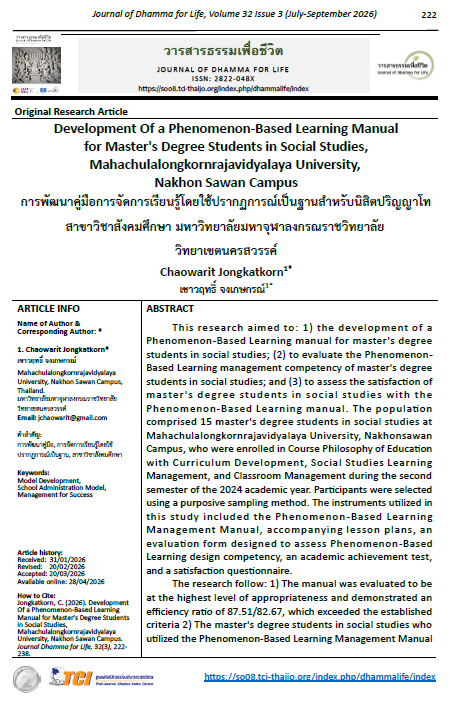
This research aimed to: 1) the development of a Phenomenon-Based Learning manual for master's degree students in social studies; (2) to evaluate the Phenomenon-Based Learning management competency of master's degree students in social studies; and (3) to assess the satisfaction of master's degree students in social studies with the Phenomenon-Based Learning manual. The population comprised 15 master's degree students in social studies at Mahachulalongkornrajavidyalaya University, Nakhonsawan Campus, who were enrolled in Course Philosophy of Education with Curriculum Development, Social Studies Learning Management, and Classroom Management during the second semester of the 2024 academic year. Participants were selected using a purposive sampling method. The instruments utilized in this study included the Phenomenon-Based Learning Management Manual, accompanying lesson plans, an evaluation form designed to assess Phenomenon-Based Learning design competency, an academic achievement test, and a satisfaction questionnaire.
The research follow: 1) The manual was evaluated to be at the highest level of appropriateness and demonstrated an efficiency ratio of 87.51/82.67, which exceeded the established criteria 2) The master's degree students in social studies who utilized the Phenomenon-Based Learning Management Manual demonstrated an increase in their knowledge and understanding of PBL management, reflecting an improvement of 70.37%. 3) Master's degree students in social studies at Mahachulalongkornrajavidyalaya University, Nakhonsawan Campus, expressed satisfaction at the highest level.
Article Details
References
เจริญวิชญ์ สมพงษ์ธรรม และคณะ. (2553). การพัฒนาสมรรถนะการปฏิบัติงาน: สมรรถนะหลัก (Core Competency). ชลบุรี: มหาวิทยาลัยบูรพา.
เชาวฤทธิ์ จงเกษกรณ์. (2564). การจัดการเรียนรู้วิชาสังคมศึกษาโดยใช้ปรากฏการณ์เป็นฐานสำหรับห้องเรียนแบบไฮบริด ใน การประชุมวิชาการระดับชาติ “วิทยาลัยสงฆ์แพร่”. ครั้งที่ 2 ของวิทยาลัยสงฆ์แพร่.
ทัณฑธร จุ้ยสวัสดิ์. (2564). การพัฒนาผลสัมฤทธิ์ทางการเรียนและทักษะการคิดอย่างมีวิจารณญาณของนักเรียนชั้นมัธยมศึกษาปีที่ 5 ด้วยการจัดการเรียนรู้โดยใช้ปรากฏการณ์เป็นฐาน.ปริญญาการศึกษามหาบัณฑิต. สาขาวิชาหลักสูตรและการสอน, บัณฑิตวิทยาลัย,มหาวิทยาลัยบูรพา.
ทิศนา แขมมณี. (2554). ศาสตร์การสอน องค์ความรู้เพื่อการจัดกระบวนการที่มีประสิทธิภาพ. กรุงเทพฯ: สำนักพิมพ์แห่งจุฬาลงกรณ์มหาวิทยาลัย.
หัสวนัส เพ็งสันเทียะ. (2563). ผลการจัดการเรียนรู้โดยใช้ปรากฏการณ์เป็นฐานที่มีต่อการคิดอย่างมีวิจารณญาณและการคิดสร้างสรรค์ของนักเรียนชั้นมัธยมศึกษาปีที่ 6. ปริญญาการศึกษามหาบัณฑิต. สาขาวิชาการวัด ประเมิน และวิจัยการศึกษา, บัณฑิตวิทยาลัย, มหาวิทยาลัย ศรีนครินทรวิโรฒ.
พัชทิชา กุลสุวรรณ์. (2558). การพัฒนาคู่มือการจัดการเรียนการสอนเศรษฐศาสตร์สิ่งแวดล้อมแบบบูรณาการ สำหรับนิสิตปริญญาตรี มหาวิทยาลัยมหาสารคาม ใน วารสารศึกษาศาสตร์ มหาวิทยาลัยนเรศวร, 19(1): 265-276.
วุฒิศักดิ์ บุญแน่น. (2558). การพัฒนากิจกรรมการเรียนรู้เพื่อกระตุ้นความเพียรของนักเรียนที่มีผลการเรียนต่ำโรงเรียนสาธิตมหาวิทยาลัยมหาสารคาม (ฝ่ายมัธยม). มหาสารคาม: โรงเรียนสาธิตมหาวิทยาลัยมหาสารคาม (ฝ่ายมัธยม).
เลขาธิการสภาการศึกษา. (2562). รายงานความก้าวหน้าการจัดการเรียนรู้ ระดับการศึกษาขั้นพื้นฐาน ปี 2561-2562. กรุงเทพฯ: สํานักงานเลขาธิการสภาการศึกษา.
ไพบูลย์ ลิ้มมณี. (2558). การพัฒนาคู่มือการจัดการเรียนรู้รายวิชา การถ่ายภาพสิ่งแวดล้อมศึกษาสำหรับนิสิตระดับปริญญาตรี มหาวิทยาลัยมหาสารคาม. มหาสารคาม: มหาวิทยาลัยมหาสารคาม.
Bubpamas, S., & Songserm, U. (2024). Teacher competency development through phenomenological learning. Journal of Educational Studies, 18(2), 45–60.
Chaiwon, P., & Nugultham, S. (2021). Phenomenologically-based integrated learning to promote higher-order thinking skills. Journal of Educational Studies, 15(1), 23–37.
Chantem, S. (2022). Hybrid Learning with the innovation of teaching accounting subjects in the 21st century. 21: Case studies of the University of the Thai Chamber of Commerce. Retrieved December 8, 2022 from https://bit.ly/3nyjaw3/. (In Thai)
Chotchuang, R., Somchai, T., & Kittipong, N. (2025). Development of active learning management using 21st-century creative thinking concepts. Journal of Educational Research, 20(1), 75–92.
Insan, M. (2025). Application of artificial intelligence combined with phenomenological learning. Journal of Educational Technology and Innovation, 12(1), 101–118.
Jongyung, K. (2025). Phenomenon-based learning: Integrating interdisciplinary knowledge in modern classrooms. International Journal of Educational Innovation, 9(1), 33–48.
Kongrat, S. (2024). The effect of phenomenon-based learning management on student achievement and satisfaction. University Journal of Educational Studies, 17(3), 89–105.
Manowaluilou, P., Srisawat, K., & Thamma, R. (2022). Teacher competency development based on constructivist learning concept. Journal of Educational Research, 14(2), 55–70.
Niyomphon, T., Wattanakul, P., & Rattanachai, S. (2023). Phenomena-based learning management to develop analytical thinking skills. Journal of Educational Research and Development, 19(2), 112–128.
Pibool, S., & Suthasinobol, T. (2021). Educational reform in Finland and its application in Thailand. Journal of Educational Policy, 10(1), 1–15.
Randall, V. A., & Thornton, N. A. (2001). Do androgens influence hair growth by altering the paracrine factors secreted by dermal papilla cells? in Eur J Dermatol, 11(4): 315-20.
Richard M. (1990). Management: Theory, Process and Practice. 5thed. New York: Harcourt Brace Jovanorich.
