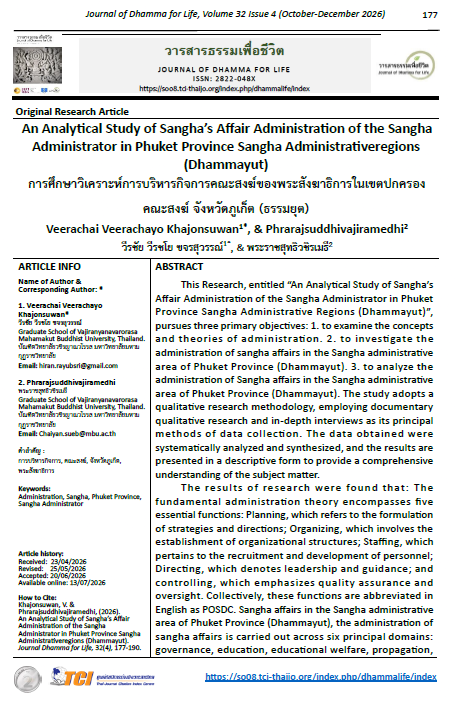
An Analytical Study of Sangha’s Affair Administration of the Sangha Administrator in Phuket Province Sangha Administrativeregions (Dhammayut)
Article Sidebar
Main Article Content
Abstract
This Research, entitled “An Analytical Study of Sangha’s Affair Administration of the Sangha Administrator in Phuket Province Sangha Administrative Regions (Dhammayut)”, pursues three primary objectives: 1. to examine the concepts and theories of administration. 2. to investigate the administration of sangha affairs in the Sangha administrative area of Phuket Province (Dhammayut). 3. to analyze the administration of Sangha affairs in the Sangha administrative area of Phuket Province (Dhammayut). The study adopts a qualitative research methodology, employing documentary qualitative research and in-depth interviews as its principal methods of data collection. The data obtained were systematically analyzed and synthesized, and the results are presented in a descriptive form to provide a comprehensive understanding of the subject matter.
The results of research were found that: The fundamental administration theory encompasses five essential functions: Planning, which refers to the formulation of strategies and directions; Organizing, which involves the establishment of organizational structures; Staffing, which pertains to the recruitment and development of personnel; Directing, which denotes leadership and guidance; and controlling, which emphasizes quality assurance and oversight. Collectively, these functions are abbreviated in English as POSDC. Sangha affairs in the Sangha administrative area of Phuket Province (Dhammayut), the administration of sangha affairs is carried out across six principal domains: governance, education, educational welfare, propagation, public utilities, and social welfare. The driving force behind these activities is the faith of Buddhist devotees, which sustains the collective effort to preserve and promote Buddhism, while ensuring the continuity of religious successors to uphold the teachings of the Buddha.
An analysis of the administration in these six domains reveals that all activities are conducted within the framework of Buddhist faith and monastic discipline. When linked to the POSDC management theory, it becomes evident that planning defines the direction of religious development, organizing establishes clear systems of operation, staffing focuses on recruiting and cultivating future monastic leaders, directing embodies leadership in the propagation of the Dhamma, and controlling ensures the quality of public utilities and social welfare initiatives. This synthesis demonstrates that Sangha administration is not merely structural management, but rather a dynamic integration of modern management principles with religious values, thereby ensuring the effective and sustainable preservation of Buddhism.
Article Details
References
พระธรรมโกศาจารย์ (ประยูร ธมฺมจิตฺโต). (2549). พุทธวิธีบริหาร. กรุงเทพฯ: มหาจุฬาลงกรณราชวิทยาลัย.
พระธรรมโกศาจารย์ (ประยูร ธมฺมจิตฺโต). (2559). พุทธวิธีการบริหาร. กรุงเทพฯ: โรงพิมพ์มหาจุฬาลงกรณราชวิทยาลัย.
พระธรรมโกศาจารย์ (พุทธทาสภิกขุ). (2553). ธรรมะเพื่อการบริหาร.
สมเด็จพระมหารัชมังคลาจารย์. (2551). การเผยแผ่พระพุทธศาสนา. กรุงเทพฯ: โรงพิมพ์การศาสนา.
สมพงษ์ เกษมสิน. (2538). การบริหาร. กรุงเทพฯ: ไทยพัฒนาการพิมพ์.
สมยศ นาวีการ. (2544). การบริหารเชิงกลยุทธ์. กรุงเทพฯ: จุฬาลงกรณราชวิทยาลัย.
สมศักดิ์ คงเที่ยง. (2542). หลักและทฤษฎีการบริหารการศึกษา. กรุงเทพฯ: มิตรภาพการพิมพ์และสตูดิโอ.
สัมพันธ์ ภู่ไพบูลย์. (2542). องค์การและการจัดการ (พิมพ์ครั้งที่ 2). กรุงเทพฯ: พิทักษ์อักษร.
สำนักงานเลขาธิการมหาเถรสมาคม. (2560). คู่มือพระสังฆาธิการ. กรุงเทพฯ: โรงพิมพ์สำนักงานพระพุทธศาสนาแห่งชาติ.
สำเริง บุญเรืองรัตน์. (2549). การบริหารตามหลักอริยสัจสี่. กรุงเทพฯ: SUNPRINTING.
สุรพล สุยะพรหม. (2555). พื้นฐานทางการจัดการ. พิมพ์ครั้งที่ 1. กรุงเทพฯ: มหาวิทยาลัยมหาจุฬาลงกรณราชวิทยาลัย.
