A Study of Guidelines for Developing City Museums to Promote UNESCO Learning Cities
Article Sidebar
Main Article Content
Abstract
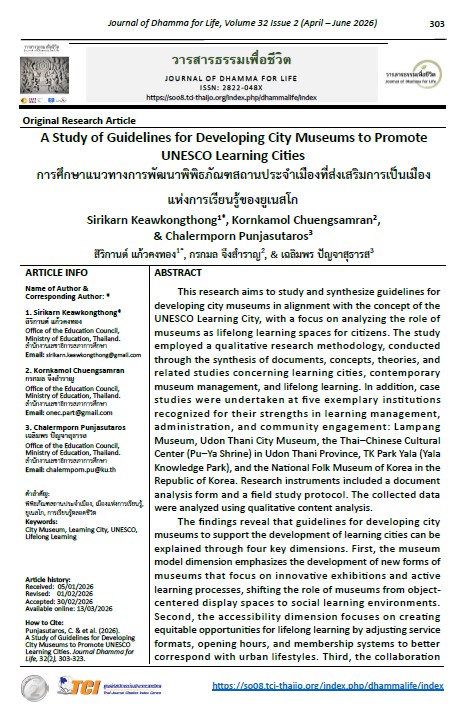
This research aims to study and synthesize guidelines for developing city museums in alignment with the concept of the UNESCO Learning City, with a focus on analyzing the role of museums as lifelong learning spaces for citizens. The study employed a qualitative research methodology, conducted through the synthesis of documents, concepts, theories, and related studies concerning learning cities, contemporary museum management, and lifelong learning. In addition, case studies were undertaken at five exemplary institutions recognized for their strengths in learning management, administration, and community engagement: Lampang Museum, Udon Thani City Museum, the Thai–Chinese Cultural Center (Pu–Ya Shrine) in Udon Thani Province, TK Park Yala (Yala Knowledge Park), and the National Folk Museum of Korea in the Republic of Korea. Research instruments included a document analysis form and a field study protocol. The collected data were analyzed using qualitative content analysis.
The findings reveal that guidelines for developing city museums to support the development of learning cities can be explained through four key dimensions. First, the museum model dimension emphasizes the development of new forms of museums that focus on innovative exhibitions and active learning processes, shifting the role of museums from object-centered display spaces to social learning environments. Second, the accessibility dimension focuses on creating equitable opportunities for lifelong learning by adjusting service formats, opening hours, and membership systems to better correspond with urban lifestyles. Third, the collaboration dimension highlights the importance of building cooperative networks among government agencies, educational institutions, private sectors, and communities through multi-stakeholder participation, thereby fostering a shared sense of ownership of learning resources. Finally, the social role dimension seeks to position museums as safe public spaces that support knowledge exchange, social healing, and the improvement of quality of life for people of all ages. In conclusion, city museums need to transform their roles from being primarily institutions for collecting and displaying cultural heritage to becoming important social learning resources that contribute to the development of learning cities and promote a sustainable culture of lifelong learning in Thai society.
Article Details
References
กรมศิลปากร. (2536). พิพิธภัณฑสถาน: บทบาทหน้าที่และการดำเนินงาน. กรุงเทพมหานคร: กรมศิลปากร.
คณะกรรมการบูรณาการด้านพิพิธภัณฑ์และแหล่งเรียนรู้. (2559). แผนยุทธศาสตร์การบูรณาการด้านพิพิธภัณฑ์และแหล่งเรียนรู้ ระยะ 20 ปี (พ.ศ. 2560–2579). กรุงเทพมหานคร: สำนักนายกรัฐมนตรี.
จุฑามาศ แก้วพิจิตร. (2559). พิพิธภัณฑ์การเรียนรู้กับการพัฒนากระบวนการเรียนรู้ของผู้เรียน. กรุงเทพมหานคร: สถาบันพิพิธภัณฑ์การเรียนรู้แห่งชาติ.
ปรีดี ปลื้มสำราญกิจ, และ ฟ้า วิไลข้า. (2561). แนวคิดพิพิธภัณฑ์การเรียนรู้กับการพัฒนาสังคมแห่งการเรียนรู้. กรุงเทพมหานคร: สถาบันพิพิธภัณฑ์การเรียนรู้แห่งชาติ.
ศิรินทร์ พิณโกศล. (2560). ปัจจัยที่ส่งผลต่อการบริหารจัดการพิพิธภัณฑ์ท้องถิ่นในประเทศไทย. วารสารพิพิธภัณฑ์ศึกษา, 12(2), 45–63.
ศูนย์มานุษยวิทยาสิรินธร (องค์การมหาชน). (2563). ฐานข้อมูลพิพิธภัณฑ์ในประเทศไทย. กรุงเทพมหานคร: ศูนย์มานุษยวิทยาสิรินธร.
สำนักงานราชบัณฑิตยสภา. (2554). พจนานุกรมฉบับราชบัณฑิตยสถาน พ.ศ. 2542. กรุงเทพมหานคร: ราชบัณฑิตยสภา.
American Alliance of Museums (AAM). (2021). TrendsWatch: The future of museums. Washington, DC: American Alliance of Museums.
International Council of Museums (ICOM). (2022). Museum definition. Paris: International Council of Museums.
UNESCO Institute for Lifelong Learning. (2015). UNESCO Global Network of Learning Cities: Guiding documents. Hamburg: UNESCO Institute for Lifelong Learning.
