
The Effects of Using Start Strategy to Enhance English Reading Comprehension Abilities of Eighth Grade Students
Article Sidebar
Main Article Content
Abstract
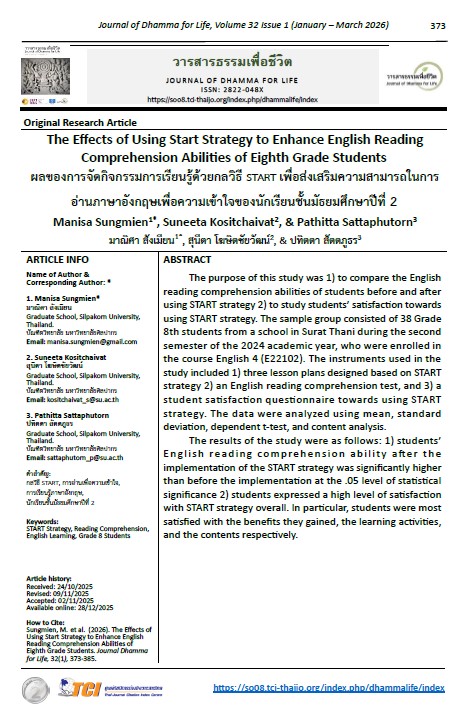
The purpose of this study was 1) to compare the English reading comprehension abilities of students before and after using START strategy 2) to study students’ satisfaction towards using START strategy. The sample group consisted of 38 Grade 8th students from a school in Surat Thani during the second semester of the 2024 academic year, who were enrolled in the course English 4 (E22102). The instruments used in the study included 1) three lesson plans designed based on START strategy 2) an English reading comprehension test, and 3) a student satisfaction questionnaire towards using START strategy. The data were analyzed using mean, standard deviation, dependent t-test, and content analysis.
The results of the study were as follows: 1) students’ English reading comprehension ability after the implementation of the START strategy was significantly higher than before the implementation at the .05 level of statistical significance 2) students expressed a high level of satisfaction with START strategy overall. In particular, students were most satisfied with the benefits they gained, the learning activities, and the contents respectively.
Article Details
References
กระทรวงศึกษาธิการ. (2552). หลักสูตรแกนกลางการศึกษาขั้นพื้นฐาน พุทธศักราช 2551. สำนักพิมพ์สำนักงานคณะกรรมการการศึกษาขั้นพื้นฐาน.
กระทรวงศึกษาธิการ. (2557). นโยบายปฏิรูปการเรียนการสอนภาษาอังกฤษ. สำนักนโยบายและแผนการศึกษา.
จุฑารัตน์ พิมพ์ไทยสง. (2563). การพัฒนาการจัดการเรียนรู้การอ่านภาษาอังกฤษเพื่อความเข้าใจตามแนวทฤษฎีคอนสตรัคติวิสต์สำหรับนักเรียนชั้นมัธยมศึกษาปีที่ 3. ปริญญาการศึกษามหาบัณฑิต. มหาวิทยาลัยมหาสารคาม.
สำนักเลขานุการของคณะกรรมการยุทธศาสตร์ชาติ. (2561). ยุทธศาสตร์ชาติ พ.ศ. 2561–2580.
วสันต์. (2563). การส่งเสริมการเรียนรู้ด้วยสื่อเทคโนโลยีและโครงสร้างการเรียนรู้ที่ชัดเจน: กรณีศึกษาการใช้ Mind Map. วิทยานิพนธ์ปริญญามหาบัณฑิต, มหาวิทยาลัย.
วิภารัตน์. (2564). การพัฒนาทักษะการอ่านเพื่อความเข้าใจของนักเรียนด้วยกลวิธี START. วิทยานิพนธ์ปริญญามหาบัณฑิต, มหาวิทยาลัย.
Brown, H. D. (2001). Teaching by principles: An interactive approach to language pedagogy (2nd ed.). Longman.
Duke, N. K., & Pearson, P. D. (2002). Effective practices for developing reading comprehension. In A. E. Farstrup & S. J. Samuels (Eds.), What research has to say about reading instruction (205–242). International Reading Association.
EF English Proficiency Index. (2023–2024). EF EPI rankings. https://www.ef.com/epi
Grabe, W. (2009). Reading in a second language: Moving from theory to practice. Cambridge University Press.
NCSALL. (2005). Focus on comprehension: Reading strategies for adult learners. National Center for the Study of Adult Learning and Literacy.
Oakhill, J. (1994). Reading comprehension and its development. Psychology Press.
Oxford, R. L. (1990). Language learning strategies: What every teacher should know. Heinle & Heinle.
Vygotsky, L. S. (1978). Mind in society: The development of higher psychological processes. Harvard University Press.
