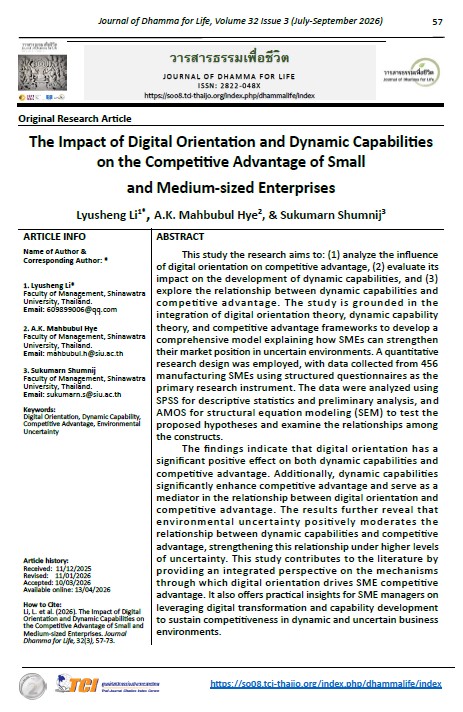
The Impact of Digital Orientation and Dynamic Capabilities on the Competitive Advantage of Small and Medium-sized Enterprises
Article Sidebar
Main Article Content
Abstract
This study the research aims to: (1) analyze the influence of digital orientation on competitive advantage, (2) evaluate its impact on the development of dynamic capabilities, and (3) explore the relationship between dynamic capabilities and competitive advantage. The study is grounded in the integration of digital orientation theory, dynamic capability theory, and competitive advantage frameworks to develop a comprehensive model explaining how SMEs can strengthen their market position in uncertain environments. A quantitative research design was employed, with data collected from 456 manufacturing SMEs using structured questionnaires as the primary research instrument. The data were analyzed using SPSS for descriptive statistics and preliminary analysis, and AMOS for structural equation modeling (SEM) to test the proposed hypotheses and examine the relationships among the constructs.
The findings indicate that digital orientation has a significant positive effect on both dynamic capabilities and competitive advantage. Additionally, dynamic capabilities significantly enhance competitive advantage and serve as a mediator in the relationship between digital orientation and competitive advantage. The results further reveal that environmental uncertainty positively moderates the relationship between dynamic capabilities and competitive advantage, strengthening this relationship under higher levels of uncertainty. This study contributes to the literature by providing an integrated perspective on the mechanisms through which digital orientation drives SME competitive advantage. It also offers practical insights for SME managers on leveraging digital transformation and capability development to sustain competitiveness in dynamic and uncertain business environments.
Article Details
References
Al Dhaheri, M. H., Ahmad, S. Z., & Papastathopoulos, A. (2024). Do environmental turbulence, dynamic capabilities, and artificial intelligence force SMEs to be innovative? Journal of Innovation & Knowledge, 9(3).
Alshourah, S., Altawalbeh, M., Mansour, M., Al Haraisa, Y., & Al-Kharabsheh, A. (2023). Digital strategic orientation and firm’s performance: the moderating effect of environmental uncertainty. Polish Journal of Management Studies, 28.
Asikin, M. Z., Fadilah, M. O., Saputro, W. E., Aditia, O., & Ridzki, M. M. (2024). The Influence of Digital Marketing on Competitive Advantage and Performance of Micro, Small and Medium Enterprises. International Journal of Social Service and Research, 4(03), 963-970.
Banerjee, C. S., Farooq, A., & Upadhyaya, S. (2018). The relationship between dynamic capabilities, competitive advantage & organizational performance. International Journal of Interdisciplinary Research and Innovations, 6(3), 603-610.
Bari, N., Chimhundu, R., & Chan, K.-C. (2022). Dynamic capabilities to achieve corporate sustainability: a roadmap to sustained competitive advantage. Sustainability, 14(3), 1531.
Boikanyo, D. H. (2024). Utilization of 4IR Technologies to enhance strategic intelligence and dynamic capabilities for a sustainable competitive advantage.
Csiki, O., Demeter, K., & Losonci, D. (2023). How to improve firm performance?The role of production capabilities and routines. International Journal of Operations & Production Management, 43(13), 1-26.
Channuwong, S. (2014). The strategic management of Coco-Cola and Starbucks company. Journal of Business Administration and Languages, 2(2), 55-58.
Damrongsiri, T., Harnphanich, B., Snongtaweeporn, T., Channuwong, S., Benjawatanapon, W., Raktakanishtha, P., Vongsurakrai, S,Siribensanont, C. (2022). Leadership of administrators for improving mission implementation of Thai private higher education institutions. Journal of Positive School Psychology, 6(9), 2558-2568.
Fainshmidt, S., Wenger, L., Pezeshkan, A., & Mallon, M. R. (2019). When do dynamic capabilities lead to competitive advantage? The importance of strategic fit. Journal of Management Studies, 56(4), 758-787.
Faruque, M. O., Chowdhury, S., Rabbani, G., & Nure, A. (2024). Technology adoption and digital transformation in small businesses: Trends, challenges, and opportunities. International Journal for Multidisciplinary Research, 6(10.36948).
Frank Doylea, D. J. C. (2019). Steps towards digitization of manufacturing in an SME environment.pdf. Procedia Manufacturing, 38, 540–547.
Ina M. Sebastian, J. W. R., Cynthia Beath, Martin Mocker, Kate G. Moloney, Nils O. Fonstad. (2017). How Big Old Companies Navigate Digital. MIS Quarterly Executive, 16(3), 197–213.
Jukkola, M. (2021). Digital transformation and strategic crisis responses in B2B marketing: a dynamic capabilities approach.
Kessler, A., Frank, H., & Fuetsch, E. (2025). Conceptualizing digitalization orientation as a strategic posture–How to boost the impact of digital technologies in businesses: A qualitative good practices approach. Technological Forecasting and Social Change, 213, 123997.
Kim, C.-G., & Yang, O.-S. (2024). Global Companies’ Dynamic Response to Business Environment Uncertainty through Digital Transformation: Sustainable Digital Quality–Customer Value–Market Performance Relationships. Sustainability, 16(15), 6541.
Kwiotkowska, A. (2022). The interplay of resources, dynamic capabilities and technological uncertainty on digital maturity. Zeszyty Naukowe. Organizacja i Zarządzanie/Politechnika Śląska.
Li, X., Wu, T., Zhang, H., & Yang, D. (2022). Digital Technology Adoption and Sustainable Development Performance of Strategic Emerging Industries. Journal of Organizational and End User Computing, 34(8), 1-18.
Mushangai, D. (2023). Dynamic capabilities: Axiomatic formation of firms’ competitive competencies. Social Sciences & Humanities Open, 8(1), 100654.
Nguyet, N. T. M., & Quynh, L. T. (2024). Food Processing Enterprises Performance: Roles of Dynamic Capabilities and Competitive Advantage. 유통과학연구, 22(6), 57-68.
Praditya, R. A., & Purwanto, A. (2024). Linking the influence of dynamic capabilities and innovation capabilities on competitive advantage: PLS-SEM analysis. PROFESOR: Professional Education Studies and Operations Research, 1(02), 6-10.
Raihan, A. (2024). A review of the digitalization of the small and medium enterprises (SMEs) toward sustainability. Global Sustainability Research, 3(2), 1-16.
Rhee, M. S., A. R. A. E. (2020). Innovation-orientated technology assimilation strategy and Korean SMEs’ enhancing innovation capability, competitive advantage and firm performance. International Journal of Innovation Management, 24.
Saputra, M. H., Utomo, M. N., Ariansyah, K., Wismayanti, Y. F., & Ansyah, R. H. A. (2024). Small and medium-sized enterprises dynamic capabilities and competitive advantage: The mediating effect of digitalization. Entrepreneurial Business and Economics Review, 12(3), 41-67.
Sarkar, B., Dey, B. K., Sarkar, M., & Kim, S. J. (2022). A smart production system with an autonomation technology and dual channel retailing. Computers & Industrial Engineering, 173, 108607.
Soluk, J., & Kammerlander, N. (2021). Digital transformation in family-owned Mittelstand firms: A dynamic capabilities perspective. European Journal of Information Systems, 30(6), 676-711.
Tang, H., Yao, Q., Boadu, F., & Xie, Y. (2023). Distributed innovation, digital entrepreneurial opportunity, IT-enabled capabilities, and enterprises' digital innovation performance: a moderated mediating model. European Journal of Innovation Management, 26(4), 1106-1128.
Torough, S., Ayatse, F., Hanmaikyur, T., Umogbai, M., & Adudu, C. (2023). Dynamic Capabilities and Competitive Advantage of Quoted Telecommunication Companies in Nigeria. International Journal of Business, in Africa, 13(10), 14-36.
Wamba, S. F., Dubey, R., Gunasekaran, A., & Akter, S. (2020). The performance effects of big data analytics and supply chain ambidexterity: The moderating effect of environmental dynamism. International Journal of Production Economics, 222, 107498.
Ward, M., & Osiyevskyy, O. (2025). Design-led innovation as a generative source of competitive advantage. Business Horizons, 68(5), 687-698.
Xue, F., Tan, Y., & Anwar, S. (2024). Innovation strategy, digital transformation and competitive advantage of manufacturing enterprises: evidence from China. European Journal of Innovation Management.
Yohanes, Y., Margaretha, F., & Sudibyo, Y. A. (2021). Analysis Of the Influence of Dynamic Capabilities on Company Performance Mediated by Competitive Advantage. Eduvest-Journal of Universal Studies, 1(10), 1.007-001.020.
