The Influence of Buddhist-Based Learning Management On Academic Achievement and Desirable Characteristics of Primary School Students
Article Sidebar
Main Article Content
Abstract
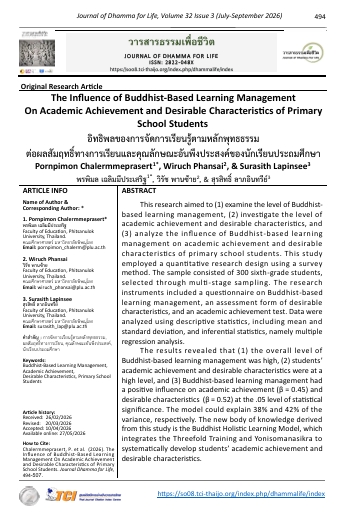
This research aimed to (1) examine the level of Buddhist-based learning management, (2) investigate the level of academic achievement and desirable characteristics, and (3) analyze the influence of Buddhist-based learning management on academic achievement and desirable characteristics of primary school students. This study employed a quantitative research design using a survey method. The sample consisted of 300 sixth-grade students, selected through multi-stage sampling. The research instruments included a questionnaire on Buddhist-based learning management, an assessment form of desirable characteristics, and an academic achievement test. Data were analyzed using descriptive statistics, including mean and standard deviation, and inferential statistics, namely multiple regression analysis.
The results revealed that (1) the overall level of Buddhist-based learning management was high, (2) students’ academic achievement and desirable characteristics were at a high level, and (3) Buddhist-based learning management had a positive influence on academic achievement (β = 0.45) and desirable characteristics (β = 0.52) at the .05 level of statistical significance. The model could explain 38% and 42% of the variance, respectively. The new body of knowledge derived from this study is the Buddhist Holistic Learning Model, which integrates the Threefold Training and Yonisomanasikra to systematically develop students’ academic achievement and desirable characteristics.
Article Details
References
กัลยา วานิชย์บัญชา. (2561). สถิติสำหรับงานวิจัย. กรุงเทพฯ: สำนักพิมพ์แห่งจุฬาลงกรณ์มหาวิทยาลัย.
กระทรวงศึกษาธิการ. (2564). แนวทางการจัดการเรียนรู้เชิงกระบวนการเพื่อพัฒนาผู้เรียนในศตวรรษที่ 21. กรุงเทพมหานคร: กระทรวงศึกษาธิการ.
กระทรวงศึกษาธิการ. (2564). รายงานผลการดำเนินงานด้านการศึกษาของประเทศไทย. https://www.moe.go.th
กัลยา วานิชย์บัญชา. (2561). การวิเคราะห์สถิติ: สถิติสำหรับการบริหารและวิจัย (พิมพ์ครั้งที่ 15). สำนักพิมพ์จุฬาลงกรณ์มหาวิทยาลัย
ชยาภา คำเมรี และคณะ. (2566). การพัฒนาการเรียนรู้ตามหลักพุทธธรรม. https://journal.ubonmcu.org
นิภาพร ครุฑจันทร์ และคณะ. (2566). การจัดการเรียนรู้โดยใช้หลักธรรมทางพระพุทธศาสนา. จากเว็บไซด์: https://so06.tci-thaijo.org/index.php/jra/article/view/258510
บุญชม ศรีสะอาด. (2560). การวิจัยเบื้องต้น (พิมพ์ครั้งที่ 10). สุวีริยาสาส์น
พระพรหมคุณาภรณ์ (ป.อ. ปยุตฺโต). (2563). พุทธธรรม (ฉบับปรับปรุงและขยายความ). มหาวิทยาลัยมหาจุฬาลงกรณราชวิทยาลัย
ศิริพล เจียมประกอบ. (2564). ผลของการใช้กิจกรรมแนะแนวตามหลักอริยสัจ 4. จากเว็บไซด์: https://ir.stou.ac.th
สมชาย วงศ์สุวรรณ. (2562). การจัดการเรียนรู้ตามแนวพุทธธรรมในโรงเรียนประถมศึกษา. วารสารศึกษาศาสตร์, 30(2), 45–60
สำนักงานการวิจัยแห่งชาติ. (2562). แนวทางการดำเนินการพัฒนาจริยธรรมการวิจัยในมนุษย์. จากเว็บไซด์: https://www.fercit.org/file/Thai_Ethical_Guidelines_Full.pdf
สำนักงานคณะกรรมการการศึกษาขั้นพื้นฐาน. (2562). หลักสูตรแกนกลางการศึกษาขั้นพื้นฐาน พ.ศ. 2551 (ฉบับปรับปรุง 2560). จากเว็บไซด์: https://academic.obec.go.th/images/document/ 1559878925_d_1.pdf
สำนักงานคณะกรรมการการศึกษาขั้นพื้นฐาน. (2565). แนวทางการพัฒนาคุณธรรมและจริยธรรมในสถานศึกษา. จากเว็บไซด์: https://contentcenter.obec.go.th/detail/book/67876
สำนักงานเลขาธิการสภาการศึกษา. (2563). รายงานสภาวะการศึกษาไทย พ.ศ. 2561–2562. สำนักงานเลขาธิการสภาการศึกษา
สุภางค์ จันทวานิช และคณะ. (2564). การวิจัยทางสังคมศาสตร์ (พิมพ์ครั้งที่ 14). สำนักพิมพ์แห่งจุฬาลงกรณ์มหาวิทยาลัย
