Localization Strategy, Digital Marketing, and Consumer Perceptions Affecting Brand Performance of Hot Pot Businesses in Thailand
Article Sidebar
Main Article Content
Abstract
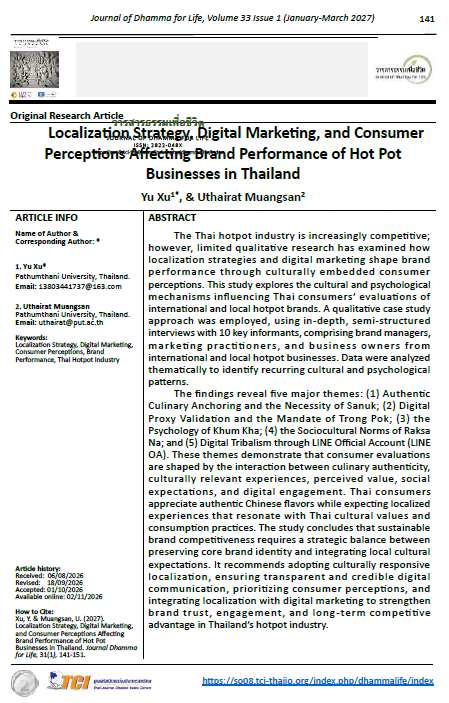
The Thai hotpot industry is increasingly competitive; however, limited qualitative research has examined how localization strategies and digital marketing shape brand performance through culturally embedded consumer perceptions. This study explores the cultural and psychological mechanisms influencing Thai consumers’ evaluations of international and local hotpot brands. A qualitative case study approach was employed, using in-depth, semi-structured interviews with 10 key informants, comprising brand managers, marketing practitioners, and business owners from international and local hotpot businesses. Data were analyzed thematically to identify recurring cultural and psychological patterns.
The findings reveal five major themes: (1) Authentic Culinary Anchoring and the Necessity of Sanuk; (2) Digital Proxy Validation and the Mandate of Trong Pok; (3) the Psychology of Khum Kha; (4) the Sociocultural Norms of Raksa Na; and (5) Digital Tribalism through LINE Official Account (LINE OA). These themes demonstrate that consumer evaluations are shaped by the interaction between culinary authenticity, culturally relevant experiences, perceived value, social expectations, and digital engagement. Thai consumers appreciate authentic Chinese flavors while expecting localized experiences that resonate with Thai cultural values and consumption practices. The study concludes that sustainable brand competitiveness requires a strategic balance between preserving core brand identity and integrating local cultural expectations. It recommends adopting culturally responsive localization, ensuring transparent and credible digital communication, prioritizing consumer perceptions, and integrating localization with digital marketing to strengthen brand trust, engagement, and long-term competitive advantage in Thailand’s hotpot industry.
Article Details
References
Braun, V., & Clarke, V. (2022). Thematic analysis: A practical guide. SAGE Publications.
Cleveland, M., & Laroche, M. (2007). Acculturation to the global consumer culture: Scale development and research paradigm. Journal of Business Research, 60(3), 249–259. https://doi.org/10.1016/j.jbusres.2006.11.006
Findley, M. G., Kikuta, K., & Denly, M. (2021). External Validity. Annual Review of Political Science, 24(1), 365–393.
Jacobs, F. A., Johnston, W., & Kotchetova, N. (2021). Customer Profitability. Industrial Marketing Management, 30(4), 353–363.
Jahari, S. A., Hass, A., Idris, I. B., & Joseph, M. (2022). An integrated framework examining sustainable green behavior among young consumers. Journal of Consumer Marketing, 39(4), 333–344.
Kandampully, J., Bilgihan, A., Van Riel, A. C. R., & Sharma, A. (2023). Toward Holistic Experience-Oriented Service Innovation: Co-Creating Sustainable Value with Customers and Society. Cornell Hospitality Quarterly, 64(2), 161–183.
Koponen, S., & Mustonen, P. (2022). Eating alone, or commensality redefined? Solo dining and the aestheticization of eating (out). Journal of Consumer Culture, 22(2), 359–377.
Lincoln, Y. S., & Guba, E. G. (1985). Naturalistic inquiry. SAGE Publications.
Maafs-Rodríguez, A., Otis, B., & Mattei, J. (2022). Cultural Adaptation and Social Media Promotion of Healthy Eating Guides for Spanish Speakers. Journal of Nutrition Education and Behavior, 54(9), 863–871.
Mosmans, A. (2022). Brand strategy: Creating concepts that drive the business. Journal of Brand Management, 3(3), 156–165.
Schmitt, B. (2012). The consumer psychology of brands. Journal of Consumer Psychology, 22(1),
7–17.
Stefani, G., Romano, D., & Cavicchi, A. (2006). Consumer expectations, liking and willingness to pay for specialty foods: Do sensory characteristics tell the whole story? Food Quality and Preference, 17(1–2), 53–62.