
Business Fundamentals Affecting Opinions on Key Factors In Location Selection of Distribution Centers for Community Enterprises in Chiang Mai Province
Article Sidebar
Main Article Content
Abstract
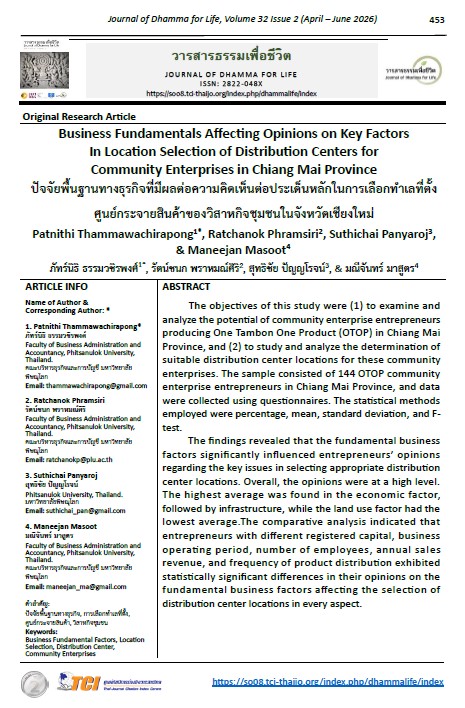
The objectives of this study were (1) to examine and analyze the potential of community enterprise entrepreneurs producing One Tambon One Product (OTOP) in Chiang Mai Province, and (2) to study and analyze the determination of suitable distribution center locations for these community enterprises. The sample consisted of 144 OTOP community enterprise entrepreneurs in Chiang Mai Province, and data were collected using questionnaires. The statistical methods employed were percentage, mean, standard deviation, and F-test.
The findings revealed that the fundamental business factors significantly influenced entrepreneurs’ opinions regarding the key issues in selecting appropriate distribution center locations. Overall, the opinions were at a high level. The highest average was found in the economic factor, followed by infrastructure, while the land use factor had the lowest average.The comparative analysis indicated that entrepreneurs with different registered capital, business operating period, number of employees, annual sales revenue, and frequency of product distribution exhibited statistically significant differences in their opinions on the fundamental business factors affecting the selection of distribution center locations in every aspect.
Article Details
References
กระทรวงพาณิชย์. (2568). โครงการหนึ่งตำบลหนึ่งผลิตภัณฑ์ (OTOP): การส่งเสริมธุรกิจชุมชนและเศรษฐกิจท้องถิ่น. กรุงเทพฯ: สำนักพัฒนาการค้าชุมชน.
จุฑามาศ อินทร์แก้ว. (2556). การวิเคราะห์ปัจจัยการเลือกทำเลที่ตั้งสาขา: กรณีศึกษา หจก. เอสเอส ค้าไม้ จังหวัดสุราษฎร์ธานี (วิทยานิพนธ์ปริญญาโท). มหาวิทยาลัยมหิดล, ประเทศไทย.
บุญเรียง. (2543). เทคนิคการวิจัยและสถิติสำหรับงานบริหารธุรกิจ. กรุงเทพฯ: สำนักพิมพ์มหาวิทยาลัย.
ล้วน, ส., สายยศ, และ อังคณา, ส. (2549). การวิเคราะห์ข้อมูลเชิงสถิติสำหรับงานวิจัย. กรุงเทพฯ: สำนักพิมพ์มหาวิทยาลัย.
สำนักงานจังหวัดเชียงใหม่. (2568). ข้อมูลและผลิตภัณฑ์ชุมชนจังหวัดเชียงใหม่. เชียงใหม่: สำนักงานจังหวัดเชียงใหม่.
สำนักงานเลขานุการกรรมการส่งเสริมวิสาหกิจชุมชน. (2560). รายงานวิสาหกิจชุมชนจังหวัดเชียงใหม่. เชียงใหม่: สำนักงานเลขานุการ.
Chamnarnpan, S., Sangsawang, A., & La-ongsri, W. (2020). Factors affecting the entrepreneurial potential of OTOP community enterprises in Chiang Mai Province, Thailand. Chiang Mai University Press.
Chopra, S., & Meindl, P. (2019). Supply chain management: Strategy, planning, and operation (7th ed.). Pearson.
Hisrich, R. D., Peters, M. P., & Shepherd, D. A. (2017). Entrepreneurship (10th ed.). McGraw-Hill Education.
Somboon, S. (2018). Entrepreneurial knowledge and skills for sustainable OTOP products: A study in local community enterprises. Journal of Business and Economics Research, 16(4), 45–59.
Suphanchaimat, R., Wibulpolprasert, S., & Tangcharoensathien, V. (2017). Logistics and supply chain management in Thailand’s local product distribution. Thai Journal of Management, 32(2), 12–28.
Yamane, T. (1967). Statistics: An introductory analysis (2nd ed.). New York: Harper and Row.
