Structural Equation Modeling of Factors Affecting Employment Decisions for People with Visual Impairments in Bangkok and Its Vicinity
Article Sidebar
Main Article Content
Abstract
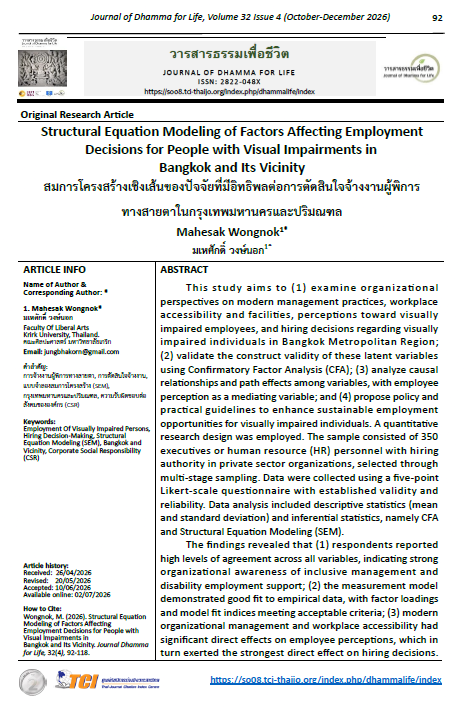
This study aims to (1) examine organizational perspectives on modern management practices, workplace accessibility and facilities, perceptions toward visually impaired employees, and hiring decisions regarding visually impaired individuals in Bangkok Metropolitan Region; (2) validate the construct validity of these latent variables using Confirmatory Factor Analysis (CFA); (3) analyze causal relationships and path effects among variables, with employee perception as a mediating variable; and (4) propose policy and practical guidelines to enhance sustainable employment opportunities for visually impaired individuals. A quantitative research design was employed. The sample consisted of 350 executives or human resource (HR) personnel with hiring authority in private sector organizations, selected through multi-stage sampling. Data were collected using a five-point Likert-scale questionnaire with established validity and reliability. Data analysis included descriptive statistics (mean and standard deviation) and inferential statistics, namely CFA and Structural Equation Modeling (SEM).
The findings revealed that (1) respondents reported high levels of agreement across all variables, indicating strong organizational awareness of inclusive management and disability employment support; (2) the measurement model demonstrated good fit to empirical data, with factor loadings and model fit indices meeting acceptable criteria; (3) modern organizational management and workplace accessibility had significant direct effects on employee perceptions, which in turn exerted the strongest direct effect on hiring decisions. Additionally, both factors had significant indirect effects on hiring decisions through the mediating variable; and (4) policy implications should be integrated across three levels: macro (government policy), organizational (management systems and accessible technologies), and individual (enhancing self-efficacy and career advancement), to promote sustainable employment of visually impaired individuals in urban contexts.
Article Details
References
กรมส่งเสริมและพัฒนาคุณภาพชีวิตผู้พิการ. (2565). แนวทางการจัดสภาพแวดล้อมสำหรับผู้พิการในองค์กร. กรุงเทพฯ: กรมส่งเสริมและพัฒนาคุณภาพชีวิตผู้พิการ.
ชณิษฐา กำเหนิด. (2566). แนวทางการจัดการเพื่อการทำงานแบบผสมผสานที่มีประสิทธิภาพ. วิทยานิพนธ์มหาบัณฑิต, มหาวิทยาลัยสุโขทัยธรรมาธิราช.
ชนินทร์, พ., พุ่มบัณฑิต, ก., & กรธวัฒน์, ส. (2563). ผลของสวัสดิการและการสนับสนุนต่อความมั่นคงในการทำงานของผู้พิการ. กรุงเทพฯ: สำนักพิมพ์มหาวิทยาลัย.
ชนินทร์ พุ่มบัณฑิต และ กรธวัฒน์ สกลคฤหเดช. (2563). รูปแบบการจ้างงานและสวัสดิการของผู้พิการในประเทศไทย. วารสารบัณฑิตวิทยาลัย มหาวิทยาลัยราชภัฏจันทรเกษม, 15(1).
ธีรพงศ์ สุขเจริญ. (2567) แนวทางการจัดการองค์การยุคใหม่: ความยืดหยุ่นและการปรับตัวขององค์กร. วารสารการบริหารจัดการสมัยใหม่, 10(1), 15–33.
ปิยะรัตน์ เทียงปา. (2563). การติดตามการจ้างงานผู้พิการในสถานประกอบการ: กรณีศึกษาผู้พิการในสถานคุ้มครองและพัฒนา ผู้พิการบ้านนนทภูมิจังหวัดนนทบุรี. สารนิพนธ์ มหาวิทยาลัยธรรมศาสตร์.
ปาณิสรา บารมีสกุลชัย. (2556). โอกาสในการจ้างงานและงานที่มีคุณค่าของผู้พิการทางการเห็น. (สารนิพนธ์มหาบัณฑิต สาขาพัฒนาแรงงานและสวัสดิการ). มหาวิทยาลัยสยาม.
พัณณิดา พันธุนะ. (2565). การจ้างงานผู้พิการทางสายตา โอกาสและความท้าทาย (การค้นคว้าอิสระปริญญาบริหารธุรกิจมหาบัณฑิต). มหาวิทยาลัยธรรมศาสตร์.
สุพจน์ โพธิ์เฉลิม. (2563). การศึกษาการเข้าถึงการให้บริการสาธารณะของผู้พิการในองค์การบริหารส่วนตำบลชายนา. มหาวิทยาลัยราชภัฏพระนครศรีอยุธยา.
สุวิมล วงษา. (2566). ปัจจัยที่ส่งผลต่อคุณภาพชีวิตในการทำงานของผู้พิการทางการเคลื่อนไหว ที่ปฏิบัติงานในหน่วยงานภาคเอกชน. มหาวิทยาลัยมหิดล.
สันติพงศ์ เมืองคลี่. (2565). แนวคิดการจัดการองค์การสมัยใหม่และการปรับตัวต่อยุคดิจิทัล. วารสารการบริหารธุรกิจสมัยใหม่, 12(2), 77-91.
วิชิต อู่อ้น. (2550). การวิเคราะห์ข้อมูลในการวิจัยเชิงคุณภาพ (พิมพ์ครั้งที่ 9). กรุงเทพฯ: จุฬาลงกรณ์มหาวิทยาลัย.
วิพัฒน์, ก. (2562). การจ้างงานผู้พิการ: ปัจจัยและอุปสรรคในบริบทองค์กรไทย. วารสารวิจัยสังคมศาสตร์, 8(1), 77–95.
วิพัฒน์ กิจวิไล. (2562). การศึกษาสถานการณ์การจ้างงานผู้พิการในประเทศไทยและเปรียบเทียบกับมาตรฐานสากล. วารสารสังคมศาสตร์บูรณาการ, 7(1), 89–105.
วายุ จิตอารีย์. (2567). ทฤษฎีการรับรู้การสนับสนุนจากองค์การ ในการพัฒนาบุคลากรพิการ. วารสารจิตวิทยาไทย, 39(2), 66–82.
พรพรรณ มีสุข. (2568). เทคโนโลยีช่วยการเข้าถึงสำหรับผู้พิการทางสายตาในงานบริการ. วารสารนวัตกรรมและความหลากหลาย, 10(1), 94–110.
เอื้องฟ้า ขนอม. (2564). การพัฒนาคุณภาพชีวิตของผู้พิการภายใต้นโยบายการจ้างงานผู้พิการในองค์กร. วิทยานิพนธ์. มหาวิทยาลัยสุโขทัยธรรมาธิราช
อังสนา ธนัญชัย. (2563). การพัฒนารูปแบบการสร้างเสริมสุขภาพสำหรับผู้พิการทางการมองเห็น. วิทยานิพนธ์มหาวิทยาลัยศิลปากร.
Ajzen, I. (1991). The theory of planned behavior. Organizational Behavior and Human Decision Processes, 50(2), 179–211.
Armstrong, M. (2023). Armstrong's handbook of strategic human resource management. Kogan Page.
Bandura, A. (1986). Social foundations of thought and action: A social cognitive theory. Englewood Cliffs, NJ: Prentice-Hall.
Bandura, A. (1997). Self-efficacy: The exercise of control. New York, NY: W.H. Freeman.
Barnes, C., & Mercer, G. (2024). Employment ecosystem and inclusive-oriented management: Strategies for sustainable disability employment. London, UK: Routledge.
Bhaskar, A., Baruch, Y., & Gupta, R. (2023). Organizational support mechanisms for employees with disabilities. Journal of Business and Psychology, 38(4), 875–893.
Bhaskar, A.U., Baruch, Y., & Gupta, S. (2023). Drivers of career success among the visually impaired: Improving career inclusivity and sustainability in a career ecosystem. Work, Employment and Society, 37(7), 1237-1256.
Boeckmann, M., Ingram, T., & Doren, B. (2023). Employer perceptions and structural readiness for hiring people with disabilities. Disability & Employment Journal, 12(1), 45–62.
Boxall, P., & Purcell, J. (2022). Strategy and human resource management (5th ed.). Oxford University Press.
Castle, C. L. (2024). Attitudes of employers towards people with visual impairment: a scoping review. Frontiers in Rehabilitation Sciences, 5, 1383984.
Crudden, A., et al. (2024). Individual and organizational factors affecting sustainable employment of persons with disabilities. International Journal of Disability Management, 11(2), 101–120.
Hair, J. F., Black, W. C., Babin, B. J., & Anderson, R. E. (2019). Multivariate Data Analysis (8th ed.). Cengage Learning.
ILO. (2021). Decent work and the sustainable development goals: A global perspective. International Labour Organization.
Kline, R. B. (2016). Principles and practice of structural equation modeling (4th ed.). New York, NY: Guilford Press.
Moh’d, S., Gregory, A., Barroca, L., & Sharp, D. (2024). Agile human resource management in inclusive workplaces. Human Resource Management Review, 34(1), 100874.
Nilsson, K., Boman, U., & Lindberg, E. (2021). General self-efficacy in individuals with visual impairment compared with the general population. Disability and Rehabilitation, 43(14), 1929-1936.
Oliver, M. (1996). Understanding disability: From theory to practice. Basingstoke, UK: Macmillan.
Ogedengbe, T.O., Sukhai, M., & Wittich, W. (2024). Towards identifying gaps in employment integration of people living with vision impairment: A scoping review. British Journal of Visual Impairment, 42(1), 1–18.
Story, M. F. (2011). Universal design principles in practice. Assistive Technology, 23(4), 205–213.
Taherdoost, H. (2022). Validity and Reliability of Questionnaires: How to Test the Validation of a Questionnaire/Survey in Research. International Journal of Academic Research in Management, 11(1), 1–16.
UNDP Thailand. (2023). Promoting decent work and inclusion for persons with disabilities. United Nations Development Programme.
Wickham, M. D. (2023). Addressing the Diversity Paradox: A Resource‐Based View of Diversity, Equity, and Inclusion (DEI). Journal of Organizational Behavior, 44(3), 233-245.
Yusoff, M. S. B. (2019). ABC of Content Validation and Index of Item-Objective Congruence (IOC). Education in Medicine Journal, 11(2), 49–54.
