The Impact of Leadership Style and Organizational Culture on Project Success in the Construction Industry in Nepal: The Mediating Role of Team Collaboration
Article Sidebar
Main Article Content
Abstract
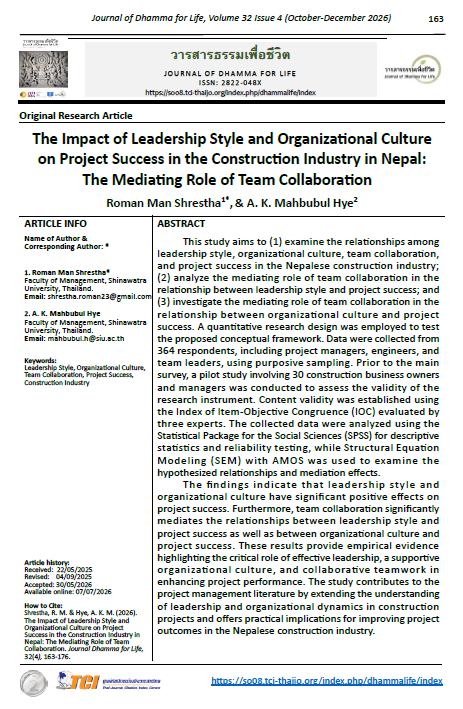
This study aims to (1) examine the relationships among leadership style, organizational culture, team collaboration, and project success in the Nepalese construction industry; (2) analyze the mediating role of team collaboration in the relationship between leadership style and project success; and (3) investigate the mediating role of team collaboration in the relationship between organizational culture and project success. A quantitative research design was employed to test the proposed conceptual framework. Data were collected from 364 respondents, including project managers, engineers, and team leaders, using purposive sampling. Prior to the main survey, a pilot study involving 30 construction business owners and managers was conducted to assess the validity of the research instrument. Content validity was established using the Index of Item-Objective Congruence (IOC) evaluated by three experts. The collected data were analyzed using the Statistical Package for the Social Sciences (SPSS) for descriptive statistics and reliability testing, while Structural Equation Modeling (SEM) with AMOS was used to examine the hypothesized relationships and mediation effects.
The findings indicate that leadership style and organizational culture have significant positive effects on project success. Furthermore, team collaboration significantly mediates the relationships between leadership style and project success as well as between organizational culture and project success. These results provide empirical evidence highlighting the critical role of effective leadership, a supportive organizational culture, and collaborative teamwork in enhancing project performance. The study contributes to the project management literature by extending the understanding of leadership and organizational dynamics in construction projects and offers practical implications for improving project outcomes in the Nepalese construction industry.
Article Details
References
Abuezhayeh, S. W., Ruddock, L., & Shehabat, I. (2022). Integration between knowledge management and business process management and its impact on the decision-making process in the construction sector: A case study of Jordan. Construction Innovation, 22(4), 987–1010.
Adham, T. K. I. (2023). Conflict resolution in team: Analyzing the causes of conflicts and best skills for resolution. Scholars Journal of Engineering and Technology, 8, 152–162.
Bagga, S. K., Gera, S., & Haque, S. N. (2023). The mediating role of organizational culture: Transformational leadership and change management in virtual teams. Asia Pacific Management Review, 28(2), 120–131.
Cai, J. (2023). Effects of leadership styles and organizational strategy to enhance performance efficiency. Journal of Enterprise and Business Intelligence, 3(1), 012–022.
Central Bureau of Statistics. (2018). National Economic Census 2018: National Report. Government of Nepal. https://cbs.gov.np/wp-content/upLoads/2020/12/National-Economic-Census-2018-National-Profile-3-.pdf
Channuwong, S., Siripap, P., Ladnongkun, V., & Makingrilas, J. (2022). The model of marketing strategies influencing customer satisfaction of supermarkets in Bangkok areas. Journal of MCU Peace Studies, 10(2), 472–487.
Dartey-Baah, S. K. (2022). The relationship between project complexity and project success and the moderating effect of project leadership styles and roles in the construction industry of an emerging economy (Doctoral dissertation, Stellenbosch University).
Do, S. T., Nguyen, V. T., & Dang, C. N. (2022). Exploring the relationship between failure factors and stakeholder coordination performance in high-rise building projects: Empirical study in the finishing phase. Engineering, Construction and Architectural Management, 29(2), 870–895.
Hatema, Z. M., Kassemc, M. A., Alic, K. N., & Khoiryd, M. A. (2022). A new perspective on the relationship between the construction industry performance and the economy outcome: A literature review. Journal of Kejuruteraan, 34, 191–200.
Iqbal, J., & Parray, Z. A. (2024). Striking the balance: Unraveling the influence of organizational culture on organizational citizenship behavior with corporate social responsibility as the bridge. International Journal of Productivity and Performance Management.
Jerab, D., & Mabrouk, T. (2023). The role of leadership in changing organizational culture. SSRN. https://doi.org/10.2139/ssrn.4574324
Jiang, H., Guo, H., Sun, Z., Xing, Q., Zhang, H., Ma, Y., & Li, S. (2022). Projections of urban built-up area expansion and urbanization sustainability in China's cities through 2030. Journal of Cleaner Production, 367, 133086.
Lertsukkheerat, T., Kongyoungyune, R., Channuwong, S., & Benjawatanapon, W. (2025). Ethical leadership, ethical organizational culture and their impact on organizational effectiveness in modern online platform businesses. Journal of Information Systems Engineering and Management, 10(3), 1070–1081.
Oh, J., Lee, H., & Zo, H. (2021). The effect of leadership and teamwork on ISD project success. Journal of Computer Information Systems.
Piwowar-Sulej, K. (2021). Organizational culture and project management methodology: Research in the financial industry. International Journal of Managing Projects in Business, 14(6), 1270–1289.
Purwadi, A. (2024). The effect of transformational leadership on team performance on construction projects. International Journal of Management Science and Information Technology, 4(1), 129–136.
Rekogama, K. M. R. S. B. (2022). How organisational transformation factors influence on market orientation and the effect of organisation culture? A study on Sri Lankan telecommunication sector. University of Wales Trinity Saint David.
Shrestha, D. K., & Praveen, B. M. (2025). Attitudinal aspects of consultants, builders, local people and other stakeholders towards sustainable infrastructure development. NPRC Journal of Multidisciplinary Research, 2(1), 53–72.
Umuteme, O. M., & Adegbite, W. M. (2023). Mitigating the impact of cross-culture on project team effectiveness in the Nigerian oil and gas industry: The mediating role of organizational culture and project leadership. Social Sciences & Humanities Open, 8(1), 100653.
Wongmajarapinya, K., Channuwong, S., & Pratoomsawat, T. (2024). The model of modern management influencing sustainable organization development of Thai Smile Bus Company Limited. Migration Letters, 21(S2), 385–399.
Yahya, M. Y., Abba, W. A., Yassin, A. M., Omar, R., Sarpin, N., & Orbintang, R. (2024). Innovative strategies for enhancing construction project performance. Journal of Technology Management and Business, 11(1), 17–31.
