Saṅgahavatthu Principles of School Administrators Affecting Organizational Culture of Schools Under Bangkok Metropolitan Administration, Southern Krungthon Group
Article Sidebar
Main Article Content
Abstract
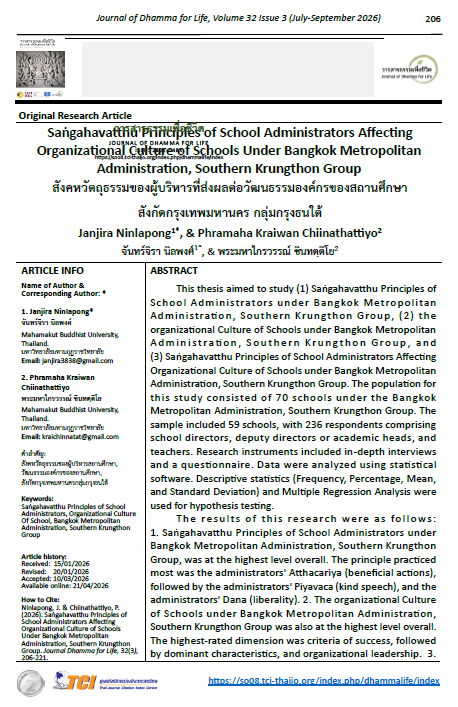
This thesis aimed to study (1) Saṅgahavatthu Principles of School Administrators under Bangkok Metropolitan Administration, Southern Krungthon Group, (2) the organizational Culture of Schools under Bangkok Metropolitan Administration, Southern Krungthon Group, and (3) Saṅgahavatthu Principles of School Administrators Affecting Organizational Culture of Schools under Bangkok Metropolitan Administration, Southern Krungthon Group. The population for this study consisted of 70 schools under the Bangkok Metropolitan Administration, Southern Krungthon Group. The sample included 59 schools, with 236 respondents comprising school directors, deputy directors or academic heads, and teachers. Research instruments included in-depth interviews and a questionnaire. Data were analyzed using statistical software. Descriptive statistics (Frequency, Percentage, Mean, and Standard Deviation) and Multiple Regression Analysis were used for hypothesis testing.
The results of this research were as follows: 1. Saṅgahavatthu Principles of School Administrators under Bangkok Metropolitan Administration, Southern Krungthon Group, was at the highest level overall. The principle practiced most was the administrators' Atthacariya (beneficial actions), followed by the administrators' Piyavaca (kind speech), and the administrators' Dana (liberality). 2. The organizational Culture of Schools under Bangkok Metropolitan Administration, Southern Krungthon Group was also at the highest level overall. The highest-rated dimension was criteria of success, followed by dominant characteristics, and organizational leadership. 3. Saṅgahavatthu Principles of School Administrators affected the organizational Culture of Schools under Bangkok Metropolitan Administration, Southern Krungthon Group, with statistical significance at the .01 level, and the predictive equation can be written as follows:
Forecast equations in raw score form
Y ̂ = 1.017+ .198(X2) + .177(X3) + .344(X4)
Forecast equations in standard score form
Z ̂ = .236(X2) + .218(X3) + .412(X4)
Article Details
References
กรมการศาสนา. (2544). สารานุกรมไทย ฉบับเยาวชน เล่ม 4. กรุงเทพฯ: พระบรมมหาราชวัง, 38.
กัญญาณัฐ สิมสวัสดิ์. (2566). การบริหารงานสังคหวัตถุธรรมของผู้บริหารสถานศึกษา: ผลกระทบต่อ วัฒนธรรมองค์กร. วารสารการบริหารการศึกษา, 12(1), 23–37.
จินตนา ทายะ. (2565). วัฒนธรรมองค์กรกับองค์กรแห่งการเรียนรู้ของสถานศึกษาสังกัดสำนักงาน เขตพื้นที่การศึกษาประถมศึกษากาญจนบุรี เขต 1. วิทยานิพนธ์การศึกษาครุศาสตรมหาบัณฑิต, สาขาวิชาการ บริหารการศึกษา, บัณฑิตวิทยาลัย, มหาวิทยาลัยราชภัฏหมู่บ้านจอมบึง.
จิราภรณ์ พงษ์พัง. (2565). วัฒนธรรมองค์กรกับประสิทธิผลของสถานศึกษาสังกัด สำนักงานเขตพื้นที่ การศึกษาประถมศึกษานครปฐมเขต 2. วิทยานิพนธ์ศาสตรมหาบัณฑิต, สาขาวิชาการบริหารการศึกษา แผน ก แบบ ก2 , บัณฑิตวิทยาลัย, มหาวิทยาลัยศิลปากร.
นิติพล ภูตะโชติ. (2560). พฤติกรรมองค์การและการพัฒนาองค์การ. กรุงเทพฯ: สำนักพิมพ์แห่งจุฬาลงกรณ์มหาวิทยาลัย.
บรรณวัชร พลคํา. (2567). การบริหารวิทยาลัยอาชีวศึกษาตามหลักสังคหวัตถุ 4 นักวิชาการอิสระ. วารสาร มจร เพชรบุรี ปริทรรศน์, 7(3), 218.
พระครูไพโรจน์กิจจาทร (สกุล สุภทฺโท). (2563). การพัฒนาผู้บริหารสถานศึกษาตามหลักสังคหวัตถุ 4 สำหรับโรงเรียนประถมศึกษาสังกัดกรุงเทพมหานคร. วารสารครุศาสตร์ปริทรรศน์คณะครุศาสตร์มหาวิทยาลัยมหาจุฬาลงกรณราชวิทยาลัย, 7(2).
พุทธทาสภิกขุ. (2525). สังคหวัตถุ 4 และหลักธรรมเพื่อการอยู่ร่วมกัน. สุราษฎร์ธานี: ธรรมทานมูลนิธิ.
สมเด็จพระมหาวีรวงศ์ (พิมพ์ ธมฺมธโร). (2541). หลักธรรมทางพระพุทธศาสนาเพื่อการพัฒนาสังคม. กรุงเทพฯ: โรงพิมพ์มหามกุฏราชวิทยาลัย.
สำนักงานเลขาธิการสภาการศึกษา. (2560). แผนการศึกษาแห่งชาติ พ.ศ. 2560–2579. กรุงเทพฯ: กระทรวงศึกษาธิการ.
Brown, M. E., & Treviño, L. K. (2006). Ethical leadership: A review and future directions. The Leadership Quarterly, 17(6), 595–616. https://doi.org/10.1016/j.leaqua.2006.10.004
Senge, P. M. (1990). The fifth discipline: The art and practice of the learning organization. New York: Doubleday.
